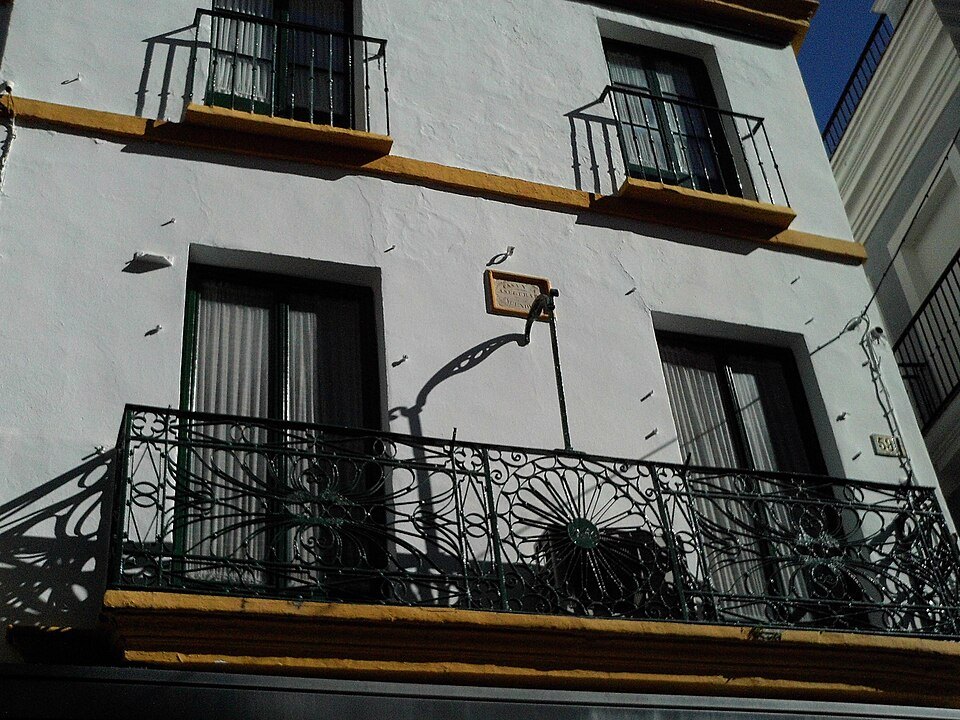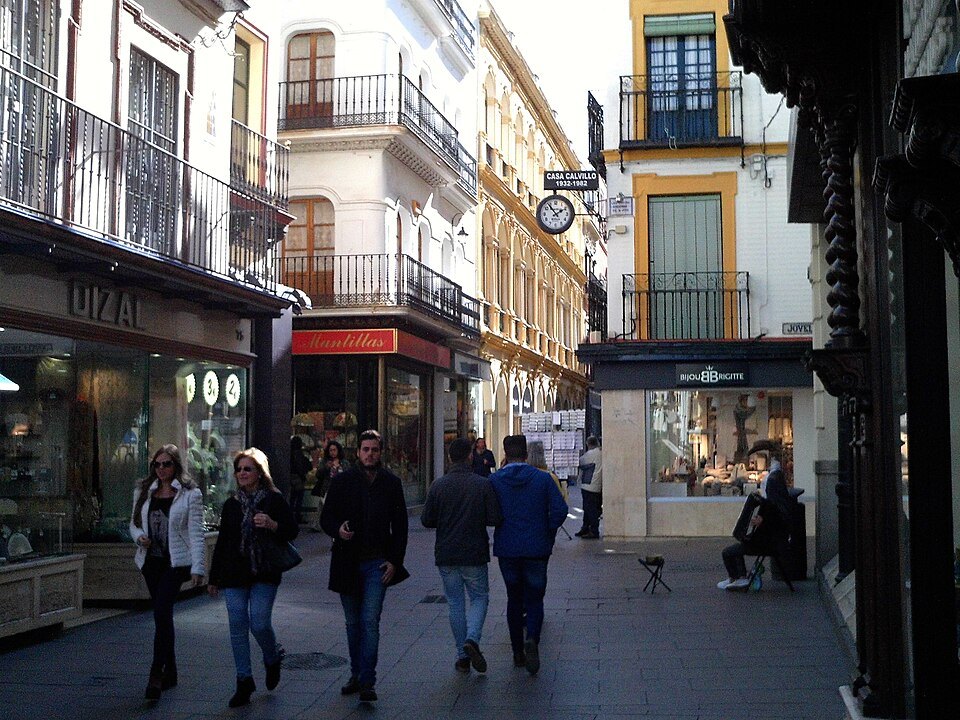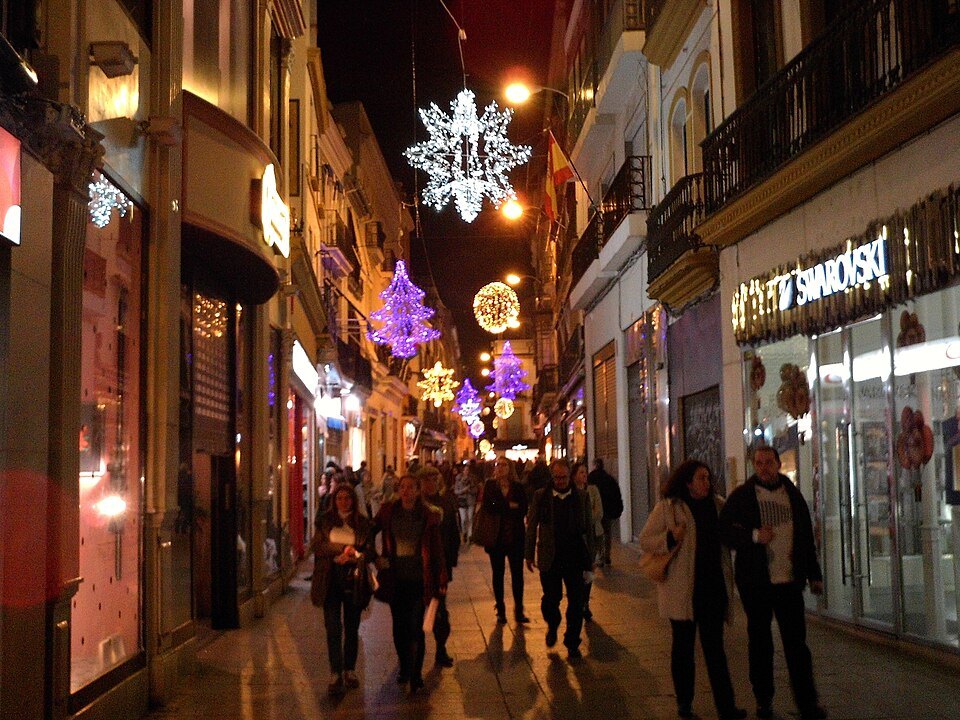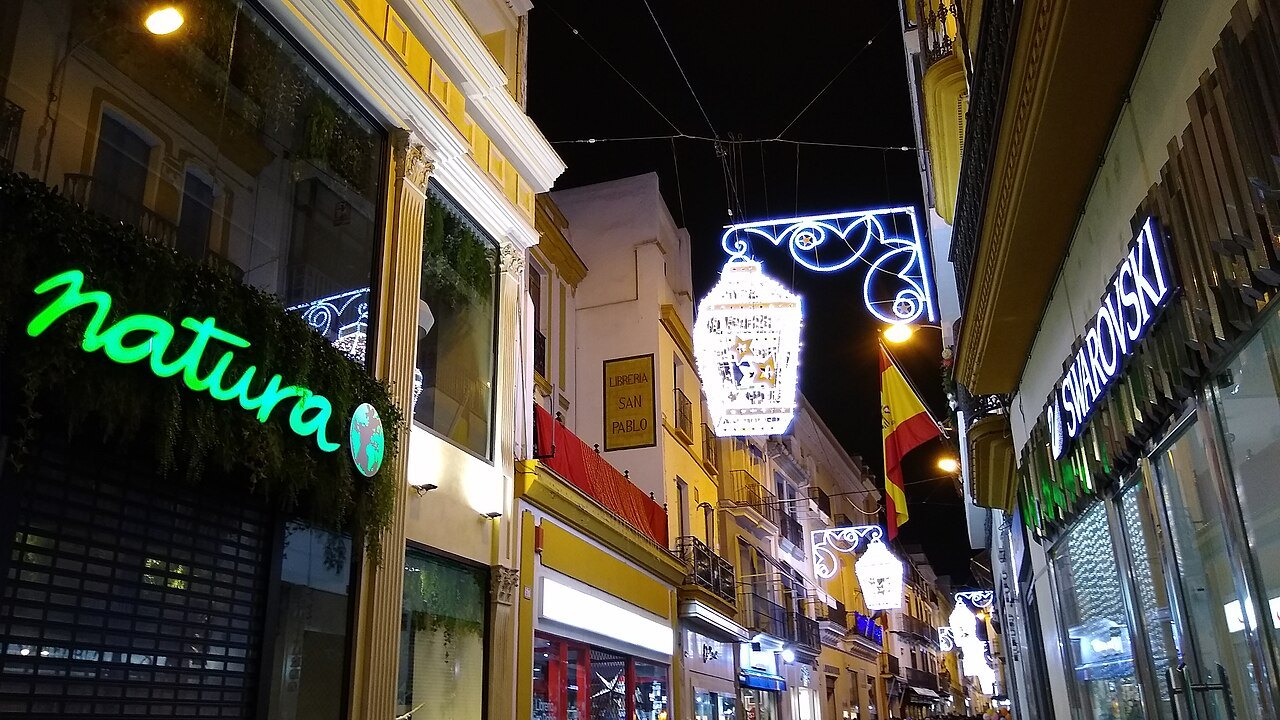
Sierpes runs north from the center and has been the commercial spine of Seville for centuries. It is narrow, pedestrian, and lined with long-established shops — hat makers, fan makers, and the confectionery the city is fond of.
⭐ In summer awnings are strung between the buildings along its whole length, turning the street into a shaded corridor. It is the most visible piece of climate-driven design in the city and it works.
Use it as a route north in the afternoon. It is several degrees cooler than the parallel streets and that is not an exaggeration.
From riverbed to high street
Calle Sierpes runs from the Plaza de la Campana to the Plaza de San Francisco, where the city hall stands. It is long, straight and of uneven width, and it has been closed to traffic since the nineteenth century. Before it was a street at all, it was the bed of the Guadalquivir, which once flowed this way from what is now the Alameda de Hércules. In the second half of the eleventh century the river drifted west, but in floods the water found its old course again; around 1725 people were still complaining that a stepping bridge had been removed and the street could not be crossed in the rain. It was first paved with brick in 1522.
From the end of spring until the end of summer, awnings are stretched across at roof height, so that Sierpes and the streets around it walk in shade. In Holy Week it is part of the official route of the processions, the carrera oficial, which starts at La Campana and ends at the cathedral.
Why "serpents"?
Since Ferdinand III's conquest in the thirteenth century it was the Calle de la Sierpe, the serpent; it became Calle de las Sierpes in the second half of the eighteenth century and plain Sierpes in the nineteenth. Nobody knows why. The writer Luis Montoto said a knight called Gil de las Sierpes lived here, but no such surname appears in any record, and the French writer Prosper Mérimée suggested the street once wound like a snake, which it never did. In 1692 a wrought-iron cross, the Cruz de la Sierpes, was set up where Calle Rioja meets the street; removed in 1840 because it blocked traffic, it went to the Museum of Fine Arts and since 1921 has stood in the Plaza de Santa Cruz.
The favorite explanation is a legend retold by the writer José María de Mena. In the fifteenth century children began to disappear from Seville. A prisoner in the Royal Prison, digging an escape tunnel, broke into the old Roman sewers and found the cause: a serpent some 6 meters long, which he killed. He traded his secret for a pardon, the beast was put on show in the street, then called Espaderos, and the street took its name from it — and the prisoner married the daughter of the city's governor. Historians point out that the street was never called Espaderos; the story even inspired a boss in the video game Blasphemous, by the studio The Game Kitchen.
Cervantes in jail
The Royal Prison of Seville stood at the end of the street from the Middle Ages until 1840, and among its inmates were Miguel de Cervantes, around 1594, and the novelist Mateo Alemán. Cervantes put the street in his comedy El rufián dichoso, where a hunchbacked Frenchman keeps a card shop on Sierpes. Philip II passed along it on his visit in 1570. Convents once lined it: the Augustinian college of San Acacio, with a fine library, has housed the Círculo de Labradores since 1951, and on the site of another convent at the corner of Calle Rioja stood the Llorens cinema. Nearby the sixteenth-century doctor Nicolás Monardes kept the garden where he studied plants brought from the Americas.
Shops and buildings
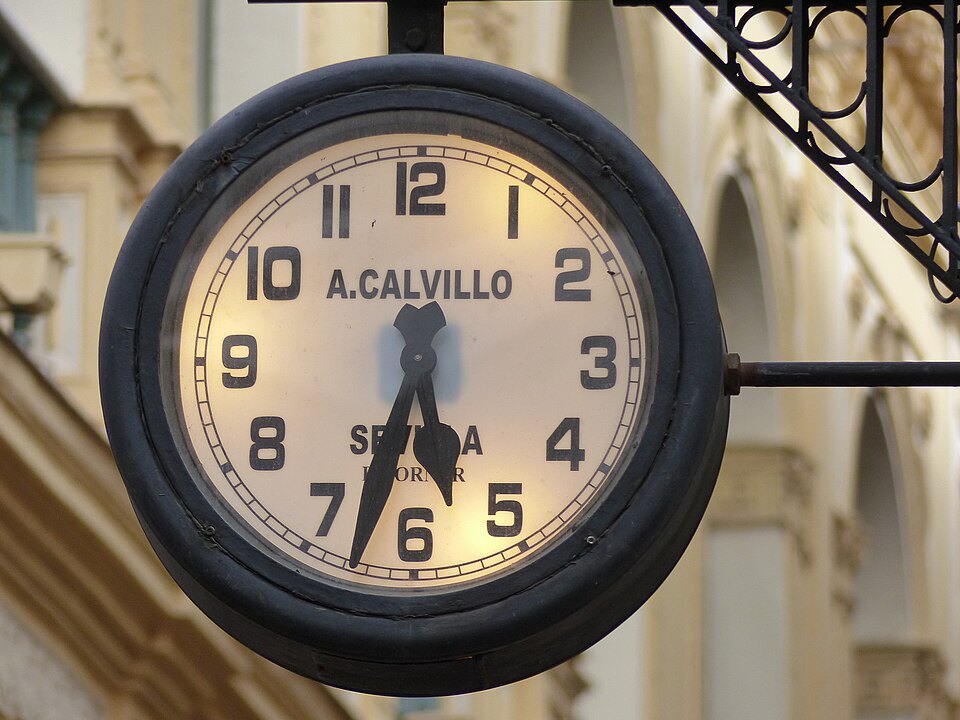
The street became Seville's great shopping street at the start of the nineteenth century, got gas lighting in 1854, and took its present form when three houses at the San Francisco end were pulled down in 1927. Some of its old shops are still trading: the Papelería Ferrer, a stationer of 1856; the Confitería La Campana, a pastry shop of 1885 in an eighteenth-century building at number 1; the watchmaker El Cronómetro of 1901; and the hat shop Sombrerería Maquedano of 1910. The Círculo Mercantil e Industrial has had its home at number 65 since 1900. At the San Francisco corner, the building of the bar Laredo, designed by Ramón Balbuena y Huertas in 1918, is a fine example of Seville's regionalist architecture. Famous cafés where writers and talkers once gathered have gone, and since the second half of the twentieth century the street has been given over almost entirely to shops. Since August 31, 1991, it has been twinned with Schadowstraße in Düsseldorf.
Sources
Calle Sierpes, photographed