Itálica was founded in 206 BC and became substantial: the emperors Trajan and Hadrian were both born here, and the city was rebuilt on a grand scale under Hadrian.
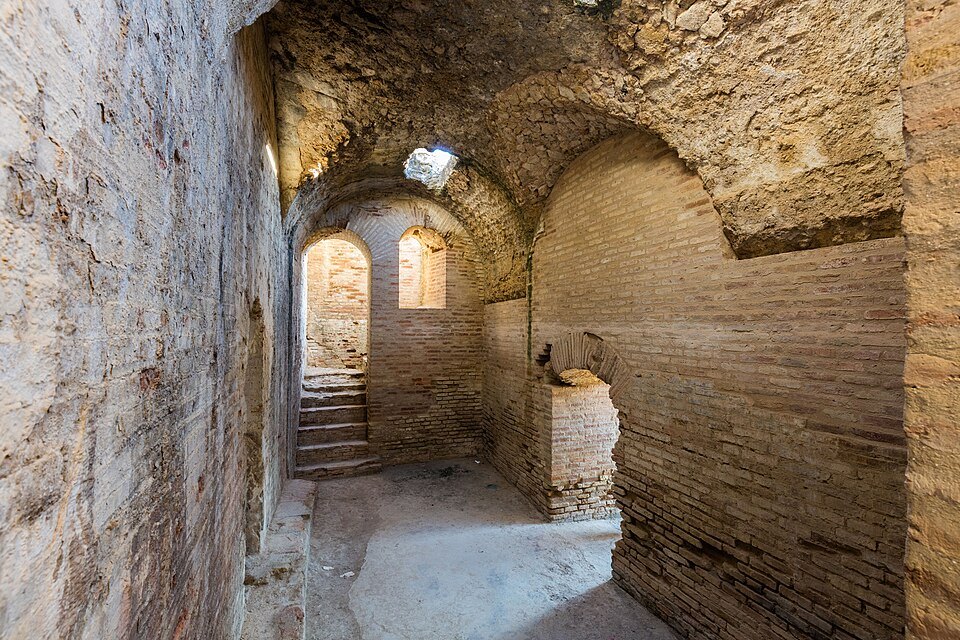
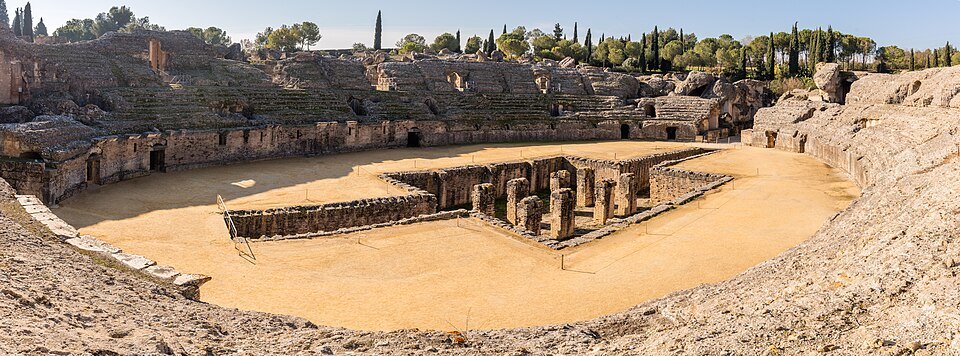
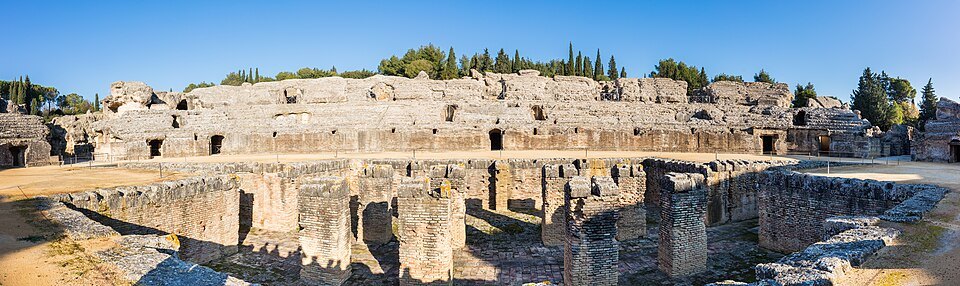
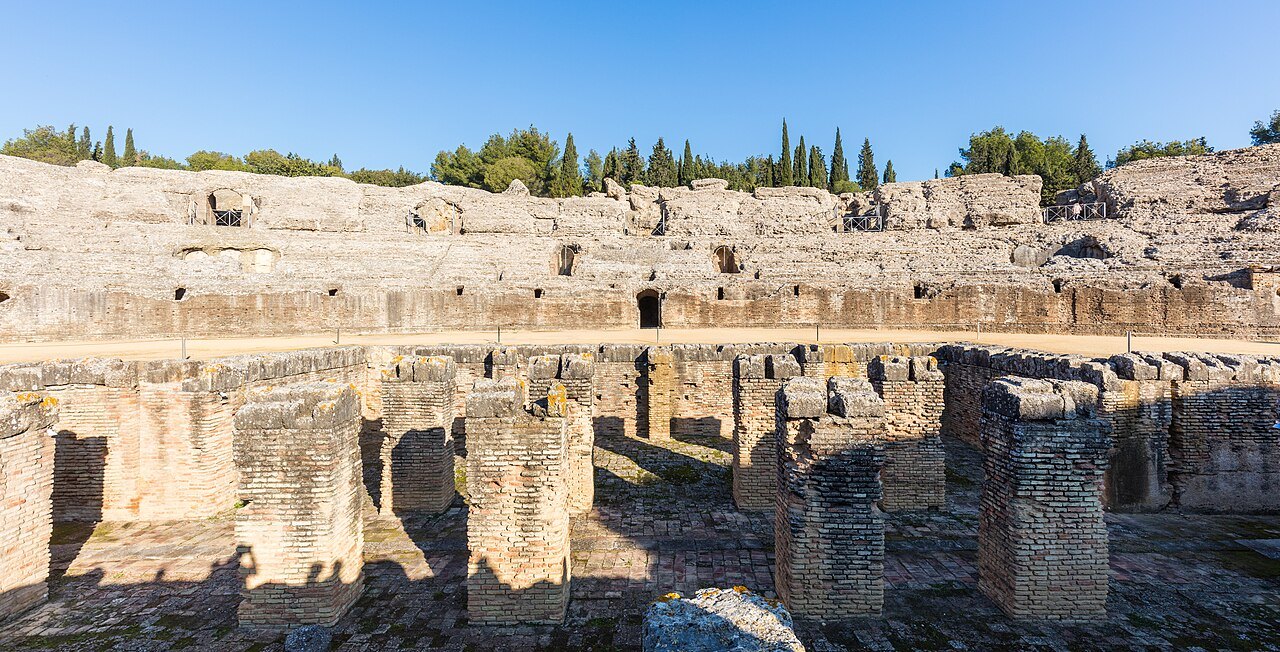
⭐ The amphitheater is the reason to come — among the largest in the Roman world, and you walk in through the same entrances the crowds used. The arena floor and the pits beneath it are open.
The residential quarter beyond it keeps its street grid and a number of large houses with mosaic floors in place.
⚠️ There is very little shade on the site. In summer this is a morning trip.
Go early, do the amphitheater first while it is empty, and keep the mosaics for when the sun is high enough to light them.
The first Roman town in Spain
Itálica was founded in 206 BC by the Roman general Scipio, during the Second Punic War, as a settlement for his sick and wounded Italic veterans beside a native Turdetani town, and it was named after them. It was the first Roman settlement in Spain. Among its settlers were branches of the families of the Ulpii and the Aelii, the ancestors of the emperors Trajan and Hadrian, both born here; some authors add Theodosius I too. The old town, the vetus urbs, grew into a prosperous place with a grid of streets, a forum and a busy river port, and it lies today under the village of Santiponce.
Hadrian favored his birthplace. He extended it north as the nova urbs, the new city, made it a colonia under the name Colonia Aelia Augusta Italica, rebuilt public buildings, and raised the Traianeum, an enormous building on the highest point of the new city, usually identified as his temple to his adoptive father Trajan, though no inscription has proved it, 108 by 80 meters, surrounded by porticoes with more than a hundred columns of Greek Cipollino marble. Decline began as early as the third century, when the Guadalquivir shifted its bed and left the river port high and dry, while Hispalis, Seville, kept on growing. The town still had its own bishop in late antiquity, and the Visigothic king Leovigild repaired its walls in 583.
The amphitheater
Itálica's amphitheater was one of the largest in the Roman Empire, counted third or fourth by capacity, slightly bigger than the one at Tours. It held 25,000 spectators, about half as many as the Colosseum, in a town of perhaps 8,000 people, a sign that the local elite were spending on games to win status far beyond Itálica. It had three tiers of seating, and under the old wooden arena floor runs the service pit used for gladiator fights and wild-beast shows.
Mosaics in place
Because no later town was built over the new city, it survives unusually well, with cobbled Roman streets and floor mosaics still where they were laid. The houses of the wealthy quarter are named for their mosaics or their plans: the House of the Exedra, the House of the Neptune Mosaic, the House of the Birds, the House of the Planetarium, the House of Hylas and the House of the Rhodian Patio. Many of the best finds, including the famous marble statue of Trajan, are in the Archaeological Museum in Seville's María Luisa Park.
Quarry, ruin and monument
For centuries Itálica was admired by travelers and plundered as a quarry. In 1740 Seville ordered the walls of the amphitheater pulled down to build a dam on the Guadalquivir, and in 1796 the old town was used for the new royal road to Extremadura. The first law to protect the site came in 1810, under the French occupation. Regular excavation began only in 1839–1840; late in the century some mosaic floors were acquired by the Countess of Lebrija, who built her palace in Seville to show them, despite the protests of the archaeologist in charge. Itálica was declared a National Monument by a royal order of 1912, and its protected area was finally defined in 2001.
The theater and the baths
The theater, the oldest known public building in Itálica, lies apart from the main site, on the San Antonio hill in Santiponce, built into the slope above the river between the first century BC and the first century AD. It was used, more and more rarely, until at least the fifth century, then filled with storerooms, rubbish and the silt of floods; its seating was partly visible in a backyard in the 1940s, it was excavated in 1970–1973, and it now hosts the Itálica theater festival.
There were at least two public baths. The Lesser Baths, or Baths of Trajan, are in Santiponce on Calle Trajano, built before Hadrian. The Great Baths of the new city, known as the Baños de la Reina Mora, date from Hadrian's reign and covered a whole block of some 32,000 square meters, with a T-shaped pool lined in white marble, hot, warm and cold rooms, a library and an exercise ground; they seem never to have been finished, and part is still unexcavated. Hadrian also built a new aqueduct to bring in the extra water the new city needed.
Sources
Itálica, photographed