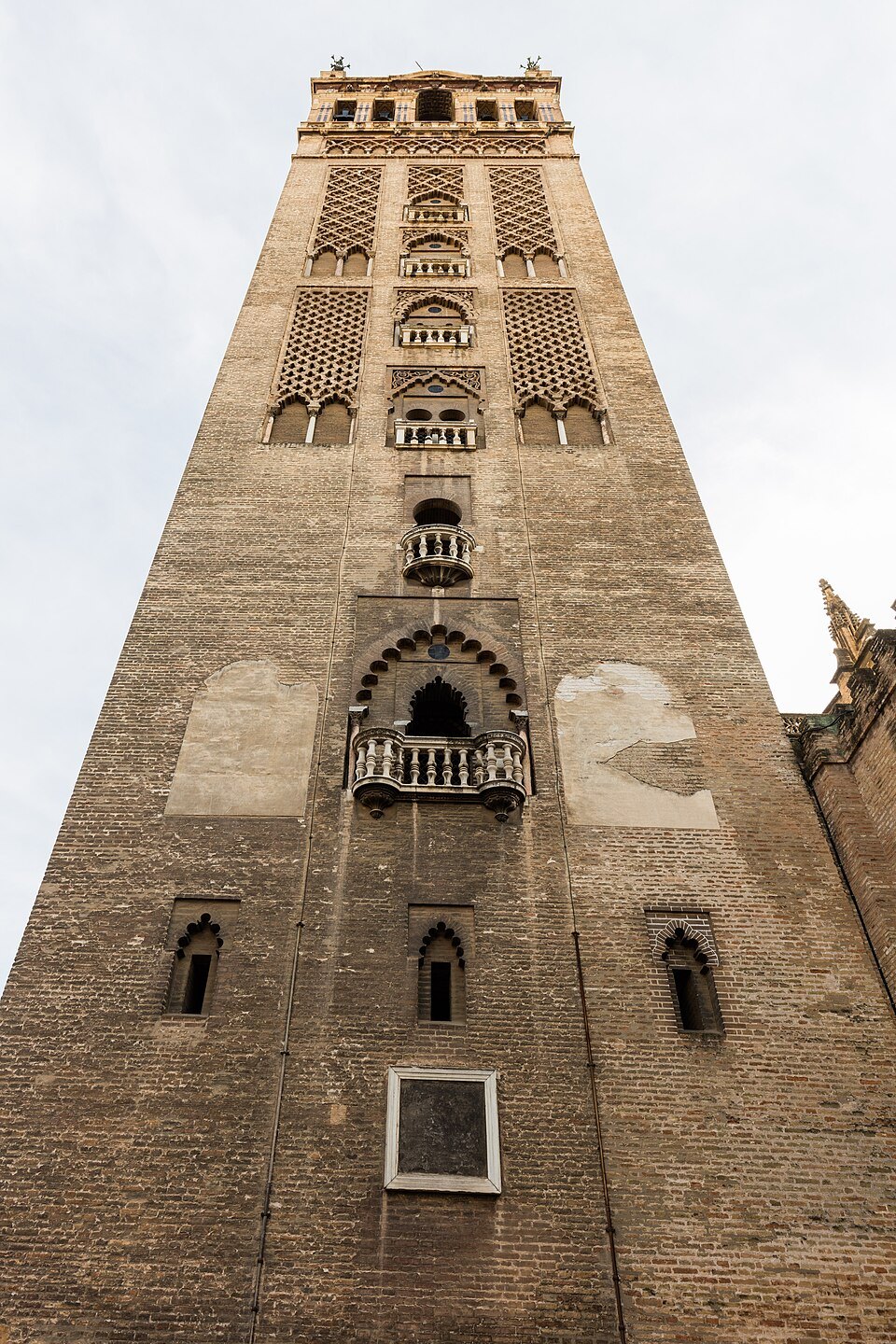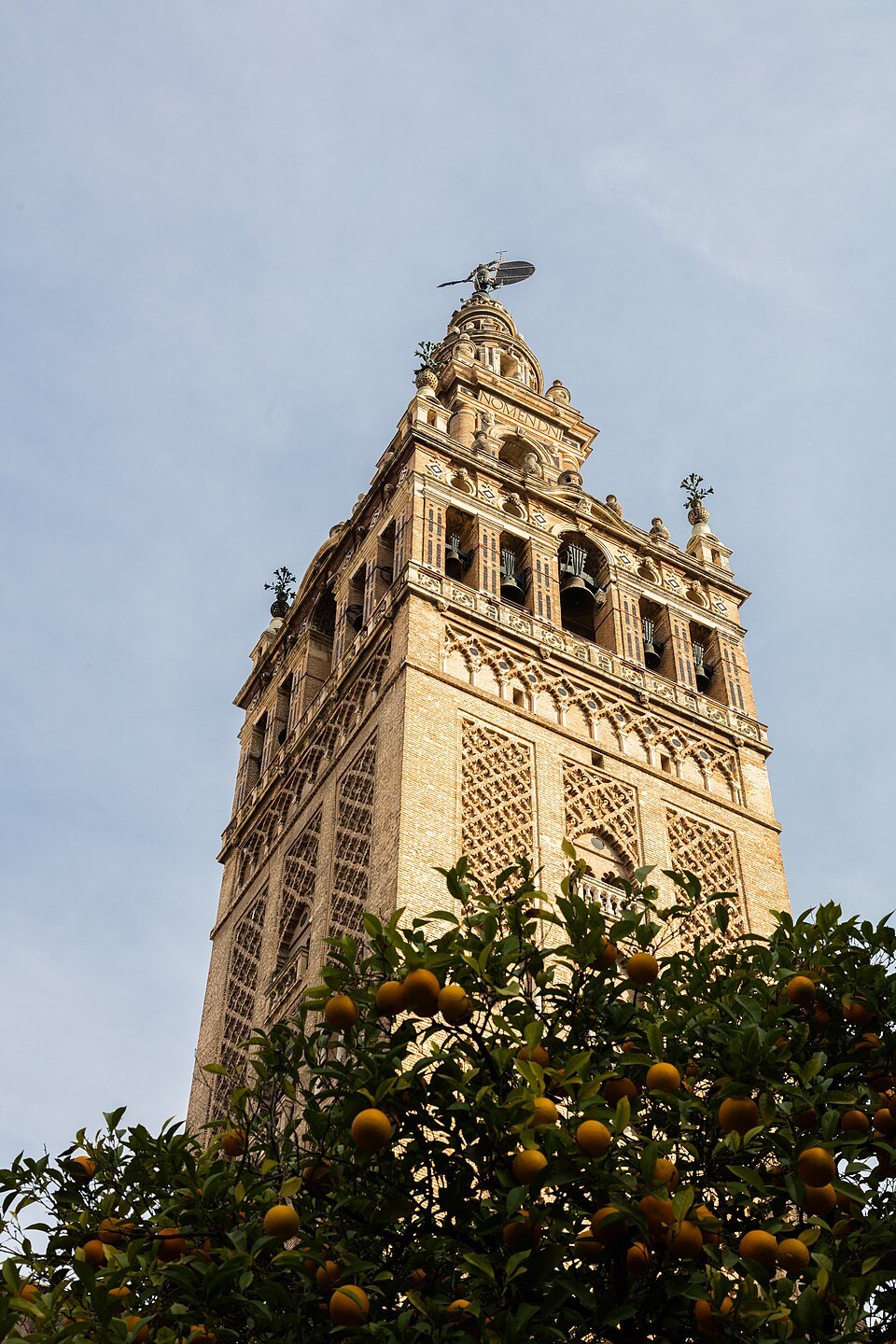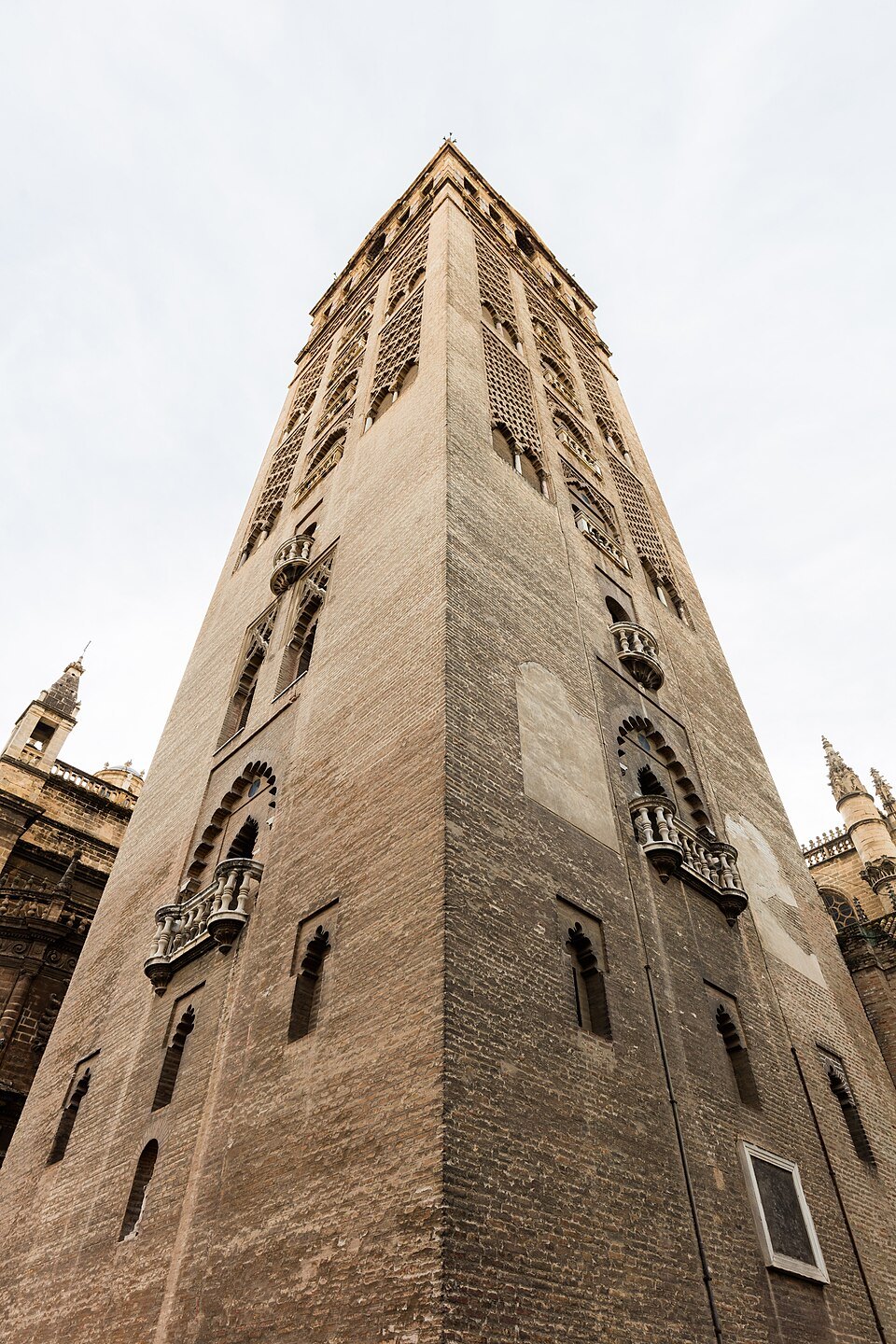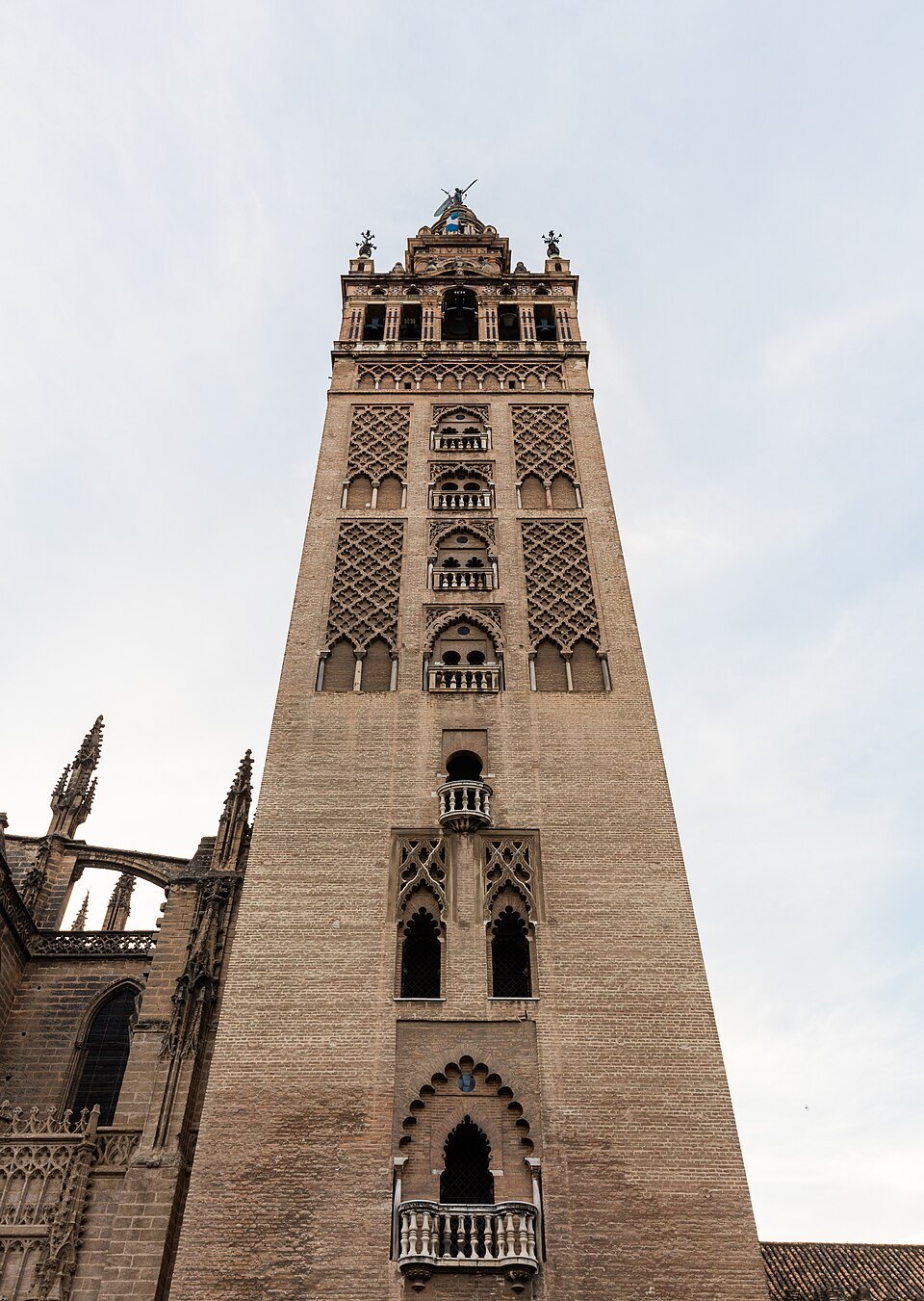
The lower two thirds are Almohad, built as the minaret of the mosque that stood here. The belfry above it was added in the 16th century, and the weathervane figure that gives the tower its name — giraldillo, the thing that turns — stands on top.
⭐ There are almost no stairs. You go up 35 ramps, wide enough, tradition says, for a rider on horseback, and only the last 17 steps to the bells. It is much easier than a bell tower usually is, and it is why people who avoid towers should still do this one.
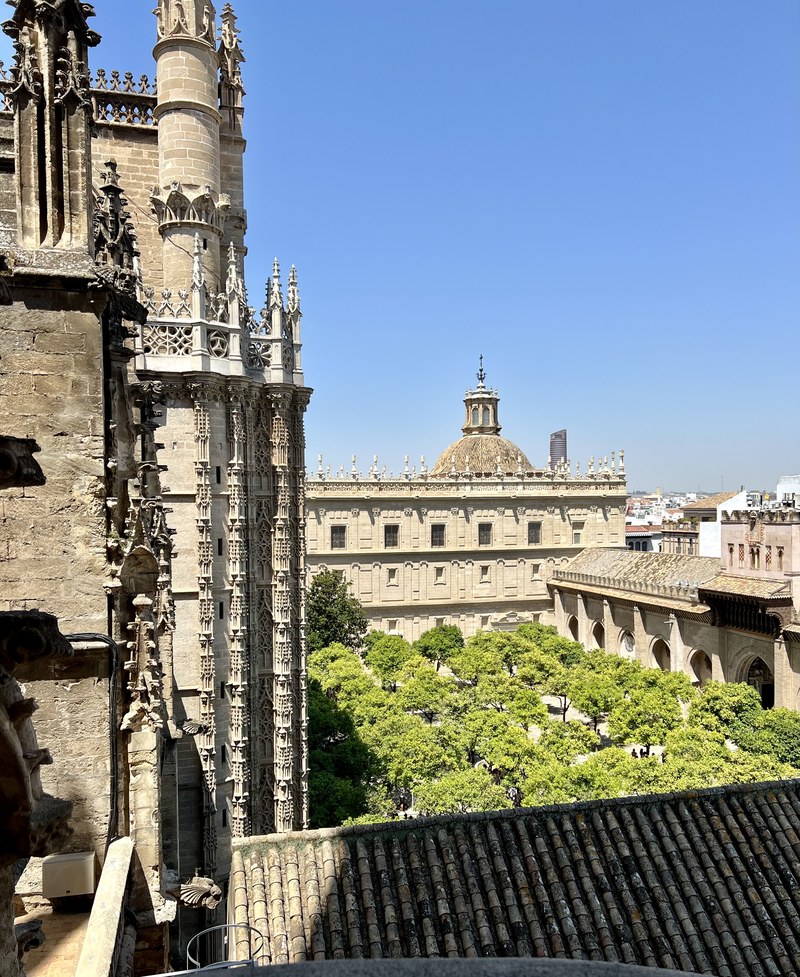
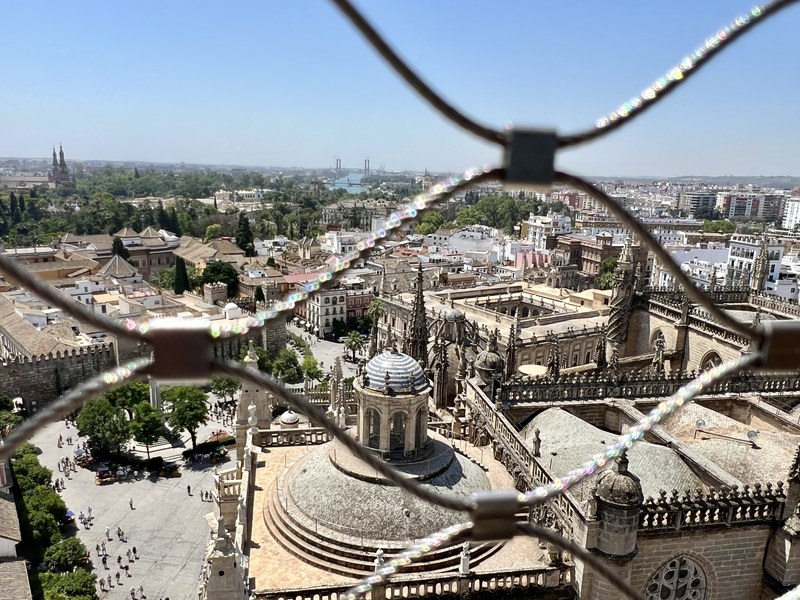
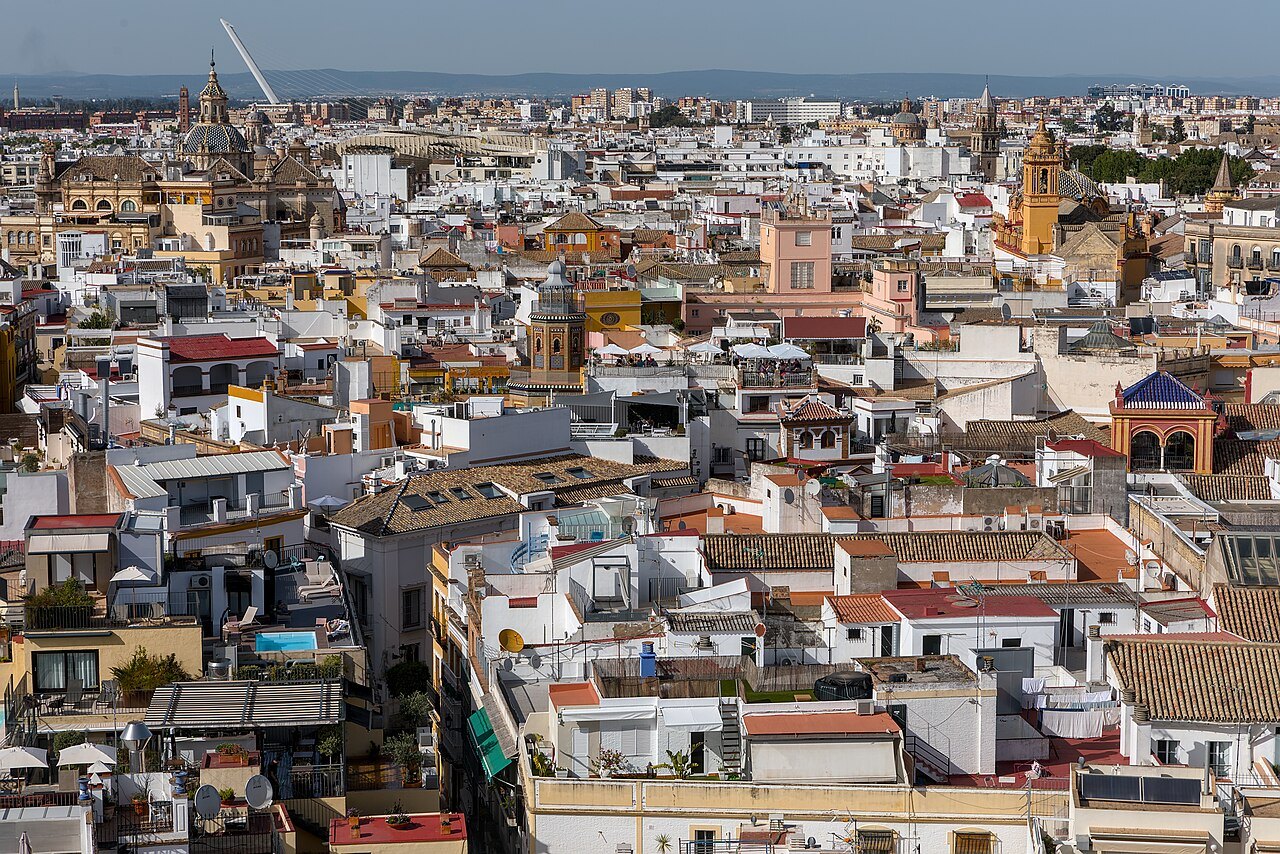
The view is the whole city: the cathedral's roof and buttresses immediately below, the Patio de los Naranjos, the Alcázar's gardens, and the river beyond.
⚠️ The bells are live and they are loud. If you are near the top on the hour you will know.
Look down into the orange courtyard on the way up — it is the clearest view anyone gets of the mosque's original plan.
A minaret for a caliph
The Giralda was built as the minaret of the great mosque that the Almohad caliph Abu Yaqub Yusuf commissioned for Seville in 1171. He ordered the tower itself in 1184, but that same year both its architect and the caliph died, and work stalled until 1188. Ahmad Ibn Baso laid the base in cut stone, reusing blocks from the Roman city walls and an older palace; a Maghrebi architect, Ali al-Ghumari, raised the main body in brick; and a Sicilian, Abu Layth al-Siqilli, built the small upper shaft. On March 10, 1198, it was finished with a finial of four gilded metal spheres at the top, celebrating al-Mansur's victory at Alarcos.
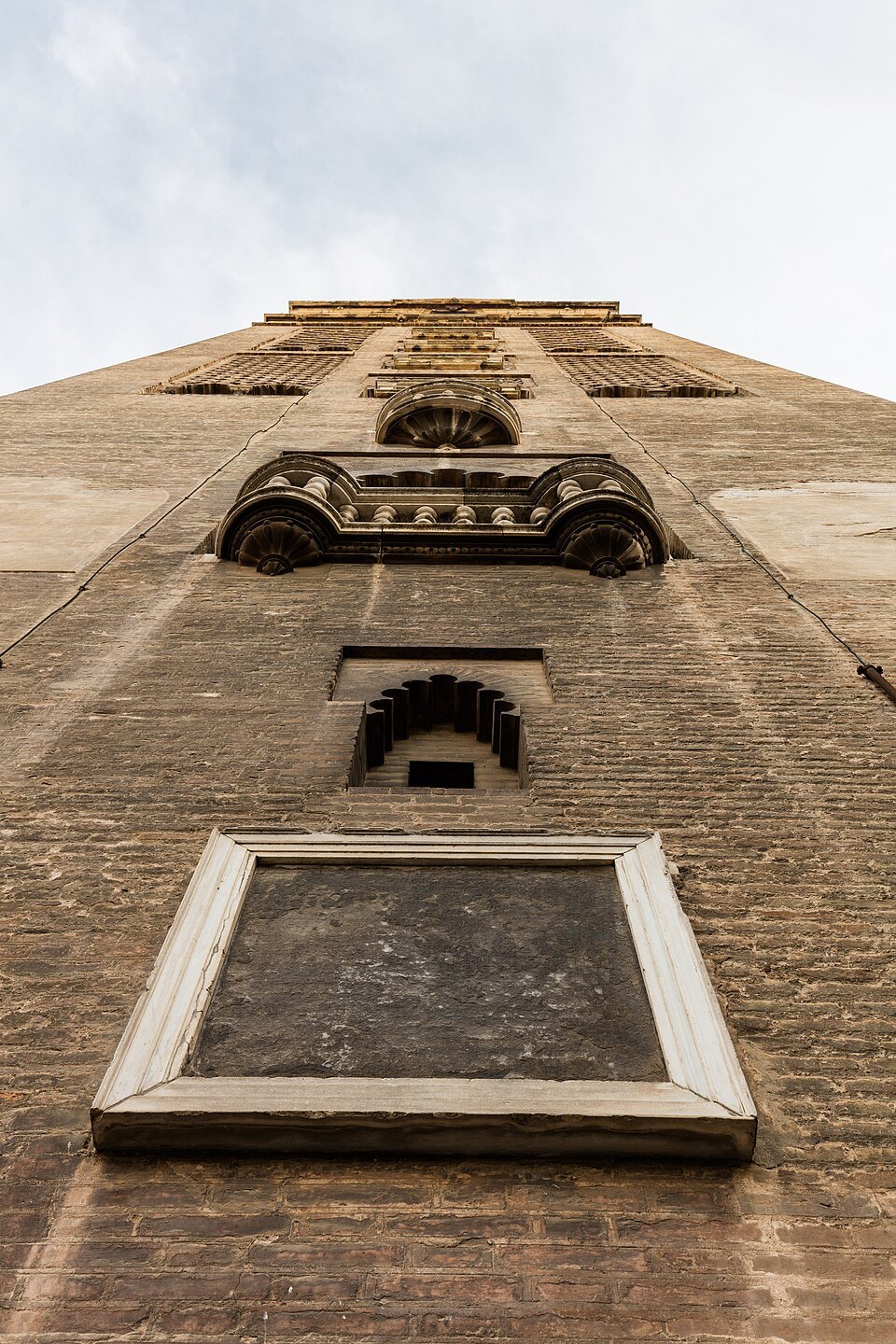
The tower stands on a square base 13.6 meters a side, over a foundation about 5 meters deep. The main shaft is just over fifty meters tall, and inside it 35 ramps wind around seven vaulted rooms stacked at the core — built, said a chronicler of the time, for "beasts of burden, people and the custodians". The windows on the outside are stepped to follow the ramps, so that the light falls on the way up.
Reading the facades
The brick decoration is one of the most refined pieces of Almohad architecture anywhere. Each face is divided into three vertical bands: windows in the middle, from simple horseshoe arches to paired, many-lobed openings with a marble column between them, and on either side big panels of sebka, a net-like lattice of interlaced arches springing from rows of blind arcades. Many of the marble columns carry capitals taken from Umayyad buildings of the ninth and tenth centuries.
From minaret to bell tower
After the Christian conquest of 1248 the minaret became the cathedral's bell tower. The spheres fell in the earthquake of 1356 and were replaced by a cross and a bell, and around the same time the tower received the first public striking clock in Spain. Between 1558 and 1568 Hernán Ruiz the Younger built the Renaissance belfry on top, with the bells hung in arched openings, stone urns along its edge and the Latin inscription TURRIS FORTISSIMA NOMEN DNI, "the name of the Lord is a strong tower", from the Book of Proverbs. The Giralda has 24 bells, 18 of them hung to swing right over, plus the clock bell above. The belfry brought the tower to about 95 or 96 meters before the weathervane was set on top, and from the bell level, the highest point visitors reach, the whole of Seville is laid out around you.
The Giraldillo
The bronze figure on the summit, added in 1568, gave the tower its name. Designed by Luis de Vargas, modeled by Juan Bautista Vázquez the Elder and cast by Bartolomé Morel, it is a woman holding a banner, probably inspired by Pallas Athena and turned into a symbol of the Christian faith. It is 4 meters tall and weighs 1,500 kilograms, yet it turns in the wind on a vertical axle like a weathervane. Damaged in the Lisbon earthquake of 1755, it was taken apart and repaired in 1770; in 1999 it was taken down for restoration by the Andalusian Historical Heritage Institute, with a replica in its place, and put back in 2005 with instruments to monitor its condition. A replica also stands in front of the cathedral's Door of Saint Christopher, so you can see it at eye level.
Copied around the world
Church towers across the province, notably at Lebrija and Carmona, are known as Giraldillas, and the tower was copied again and again in the United States between 1890 and 1937: the San Francisco Ferry Building's clock tower, the Freedom Tower in Miami, the Wrigley Building in Chicago and the Terminal Tower in Cleveland all borrow from it, as did the second Madison Square Garden in New York.
Sources
La Giralda, photographed