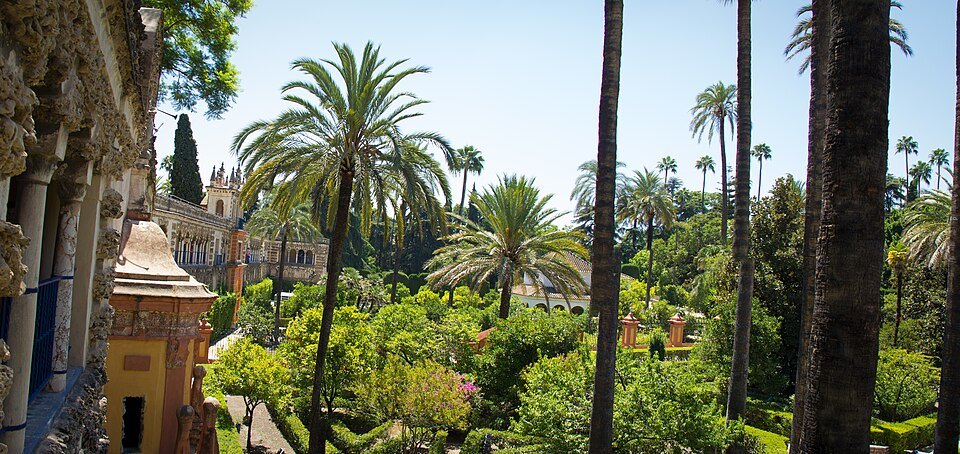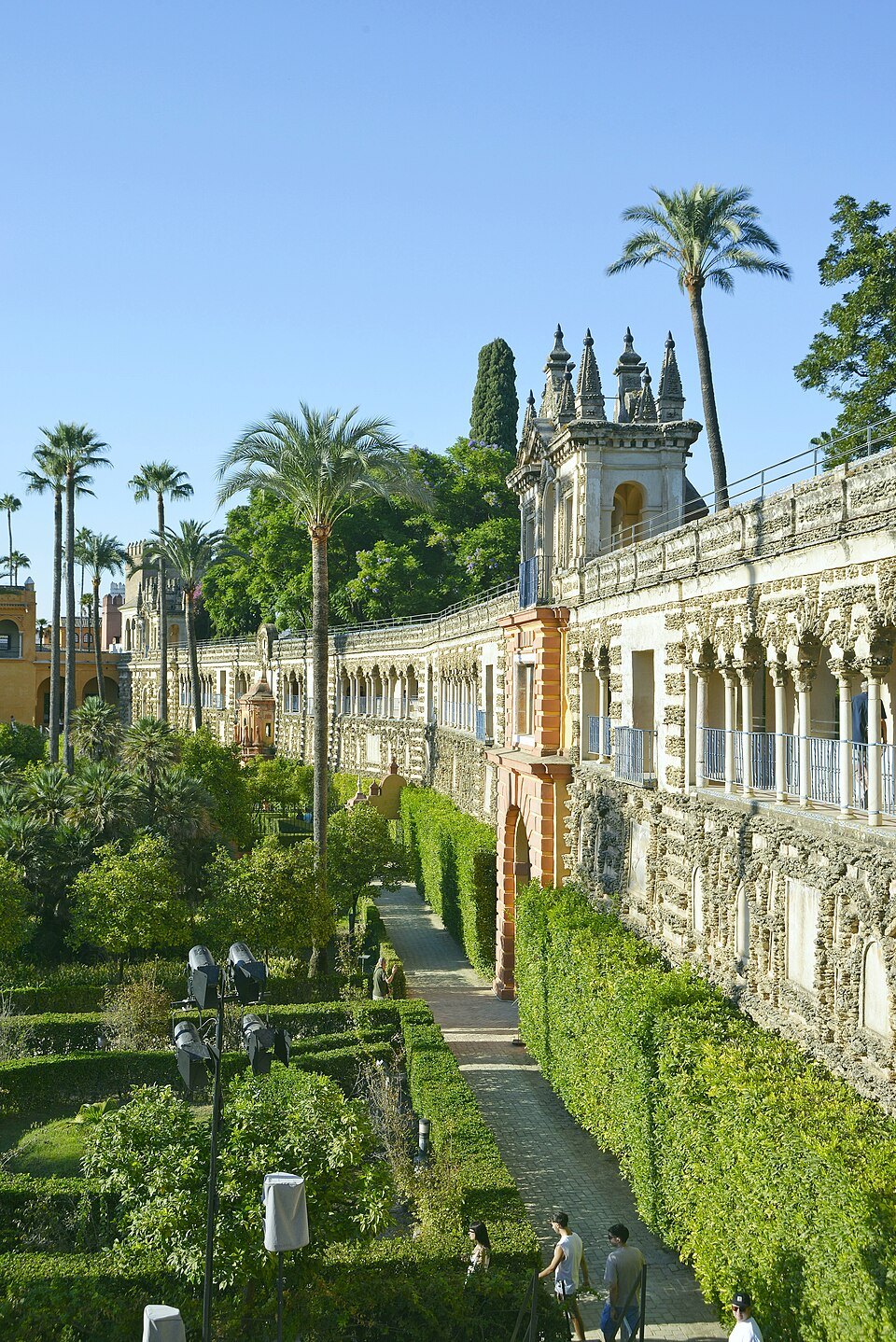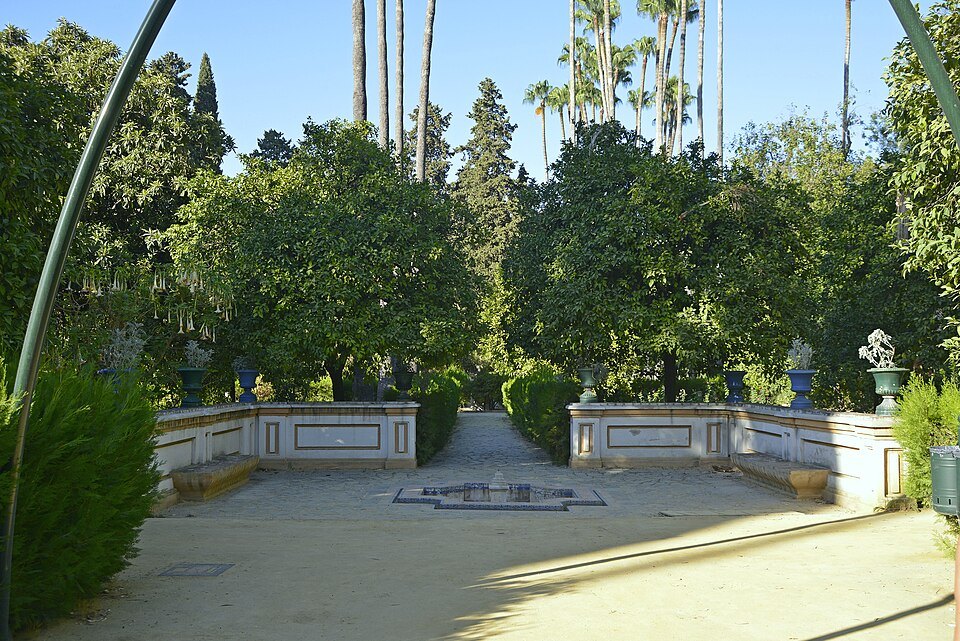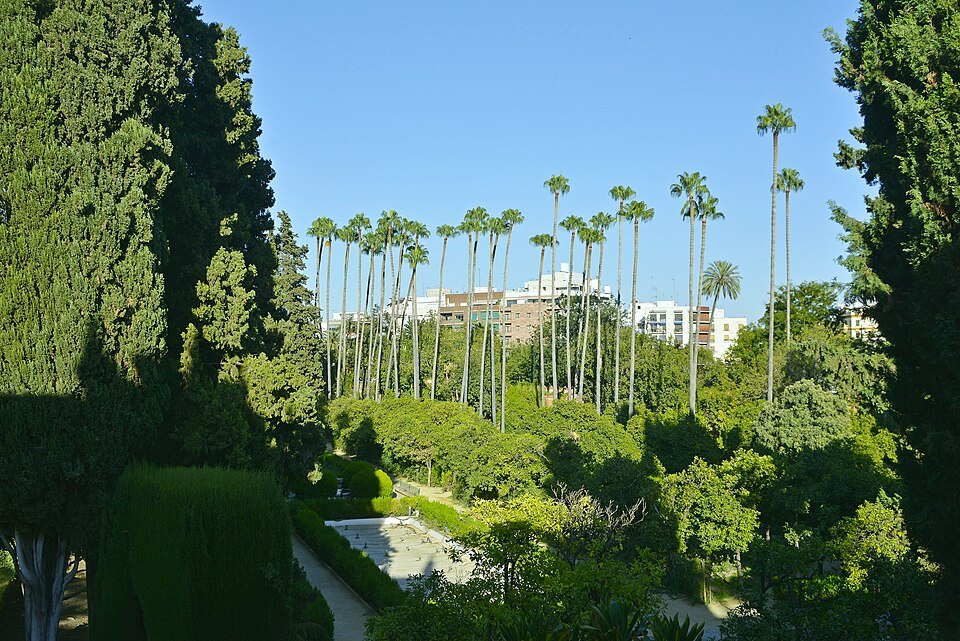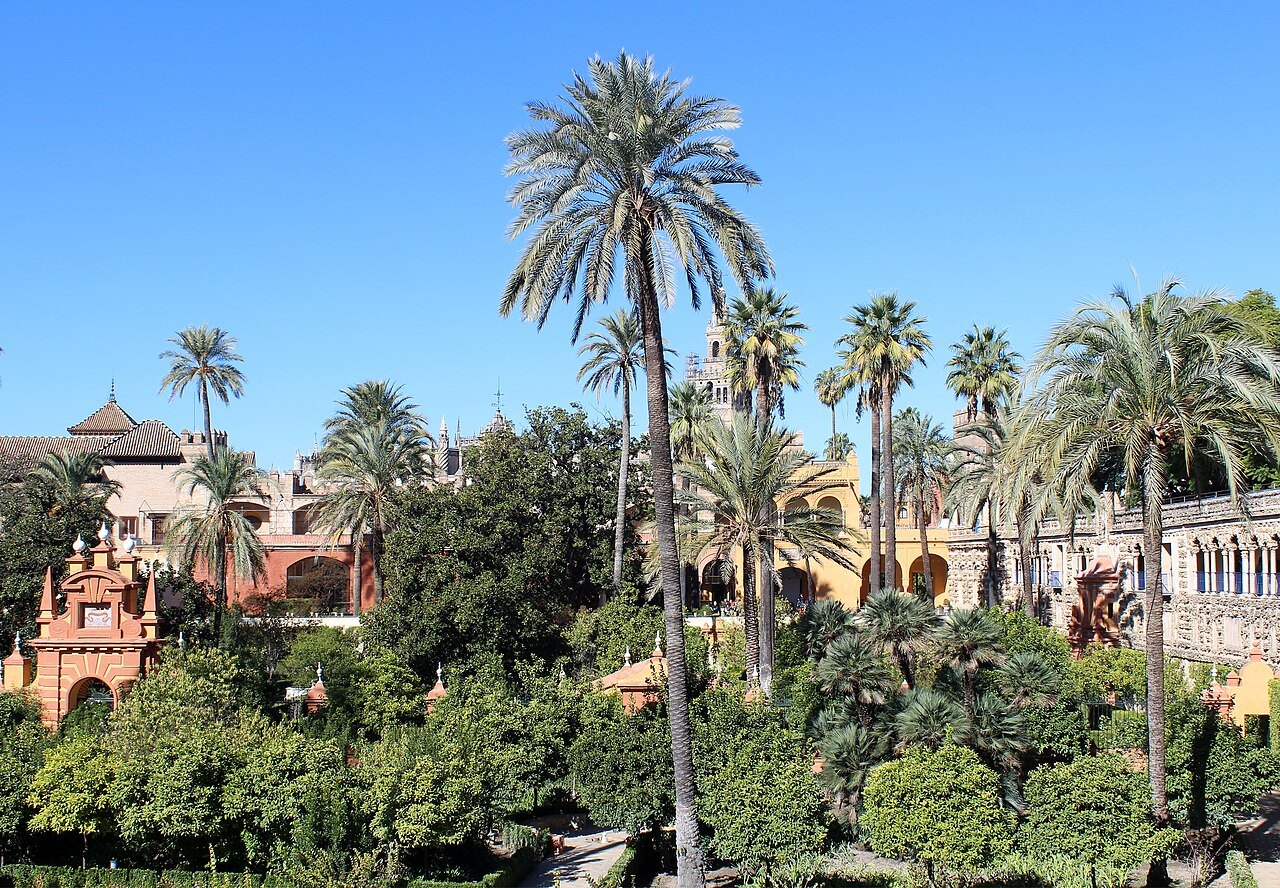
The gardens run back from the palace in a series of walled compartments, each a different period: formal Renaissance parterres near the buildings, looser planting further out, and a long raised gallery — the Galería del Grutesco — built into the old defensive wall.
⭐ There are hydraulic tricks. The órgano de agua plays on a schedule the operator publishes, and there are concealed jets in some of the paving that were designed to soak guests.
Peacocks live here and are entirely unbothered by visitors.
Walk the raised gallery for the plan — from up there the compartments make sense in a way they do not at ground level.
The oldest gardens in the city
These are the oldest gardens in Seville. In the late Middle Ages the Alcázar was a cluster of buildings from different periods with small garden courtyards and large kitchen gardens; in the sixteenth and early seventeenth centuries they were remade in the Renaissance manner, but they kept the Islamic idea of separate walled compartments, low fountains, tiles and orange trees. Today they cover about 60,000 square meters and hold more than 170 species of plants gathered from all over the world. The bitter oranges were used, it is said, for the marmalade eaten by Queen Elizabeth II.
Mercury and the Grotto Gallery
Coming out of the Gothic palace you reach the Mercury Pool, probably built in the Islamic period as a reservoir to store and regulate water for the whole fortress. In the middle stands a bronze Mercury of 1576, designed by Diego de Pesquera and cast by Bartolomé Morel, who also made the railing, the lions holding shields at the corners and the 18 balls with pyramid tips around the edge.
Behind it runs a wall 160 meters long that divides the old gardens from the former kitchen gardens, which became gardens too at the end of the nineteenth century and are full of orange and lemon trees. The wall began as a stretch of Almohad rampart of the twelfth century that guarded against attack and against the floods of the Tagarete stream. In 1612 the architect Vermondo Resta turned it into the Galería del Grutesco, facing one side with rough courses of different stones and painted false marble and frescoes of classical myths by Diego Esquivel. You can walk along the gallery on top for the view.
Leaving the Gothic palace, the first small garden is the Jardín de la China, its beds edged with myrtle hedges; it was separated from the Mercury Pool in the sixteenth century, in the reign of Philip II. From it the fifteenth-century Gothic Marchena Gate, bought by Alfonso XIII at the sale of the Osuna family's property and brought here in 1913, leads into the garden of the Marquis of la Vega-Inclán, a grid of paths and fountains laid out early in the twentieth century on the old Retiro orchard.
Garden by garden
Down a flight of steps beside the pool is the Garden of the Dance, laid out in the 1570s and named for two statues of a satyr and a nymph dancing that once stood on its entrance columns; they were last photographed by Jean Laurent in the nineteenth century and have since disappeared. A passage leads from here to the vaulted Baths of María de Padilla. The Garden of Troy is a Mannerist courtyard with a gallery by Resta of 1606, and the Galley Garden next to it has a marble column with an inscription honoring al-Mutamid, the poet king of Seville.
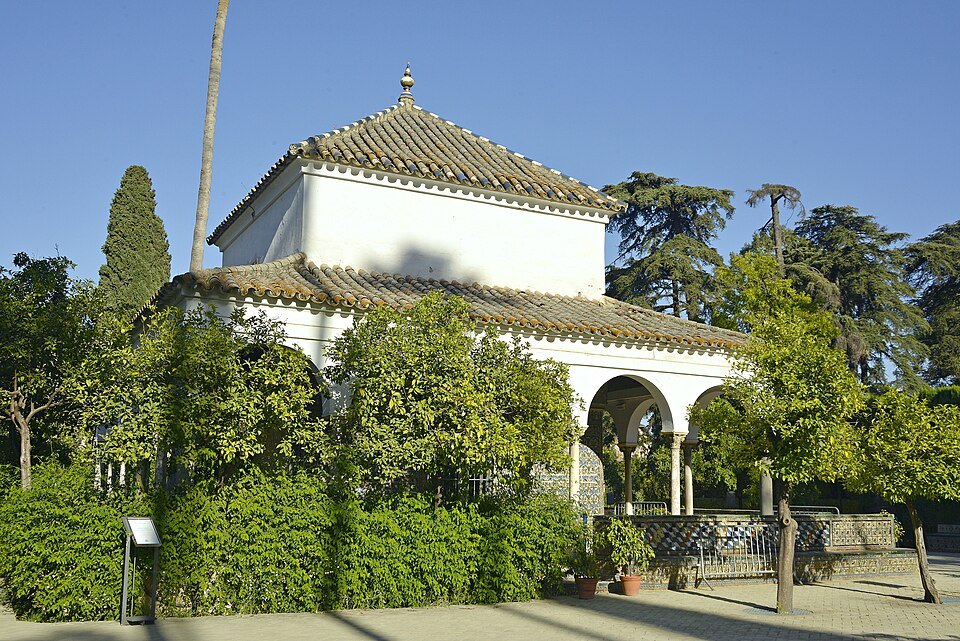
The Ladies' Garden was made in 1526 for the wedding of Charles V and Isabella of Portugal and enlarged by Resta early in the seventeenth century: a great rectangle in eight compartments edged with myrtle, low fountains along its side paths, and a monumental central fountain crowned by a bronze Neptune. On the Grotto Gallery beside it is the Fountain of Fame, the only fountain of its kind left in Spain, whose restored hydraulic organ sounds notes through its pipes as the water passes. Beyond is the Pavilion of Charles V, built between 1543 and 1546 by Juan Fernández, square, domed and covered inside and out in sixteenth-century tiles by Juan and Diego Polido.
The newer gardens
The maze south of the pavilion was planted in 1914 on the initiative of the Marquis of la Vega-Inclán, the royal commissioner for tourism, copying the pattern set into the pavilion's floor. The Cenador del León, a small domed pavilion with a lion fountain in front, was built between 1644 and 1645 by Diego Martín de Orejuela; a twin, the octagonal Cenador Ochavado, has not survived. The English Garden, on what was a medieval orchard until the twentieth century, was laid out in 1927 at the request of Queen Victoria Eugenie, and in 2008 Roman, Visigothic and Almohad remains were found under it. The Poets' Garden, with its two long pools, was created between 1956 and 1958 by the curator Joaquín Romero Murube as a summary of the Sevillian garden: Islamic, Renaissance and Romantic at once.
Sources
- Real Alcázar de Sevilla — Wikipedia (es)
- Jardines del Alcázar de Sevilla — Wikipedia (es)
- Alcázar of Seville — Wikipedia
The Alcázar Gardens, photographed