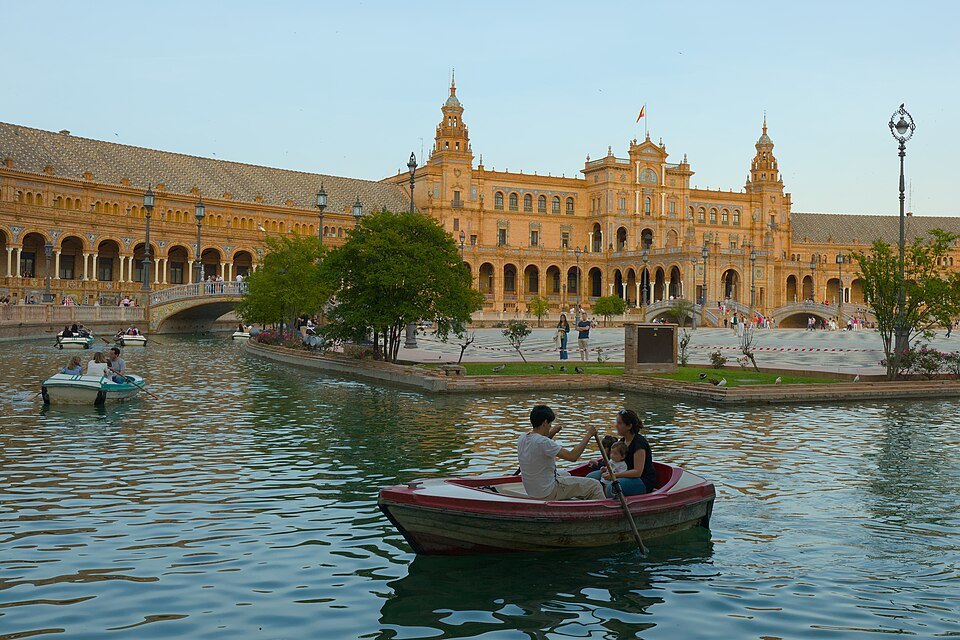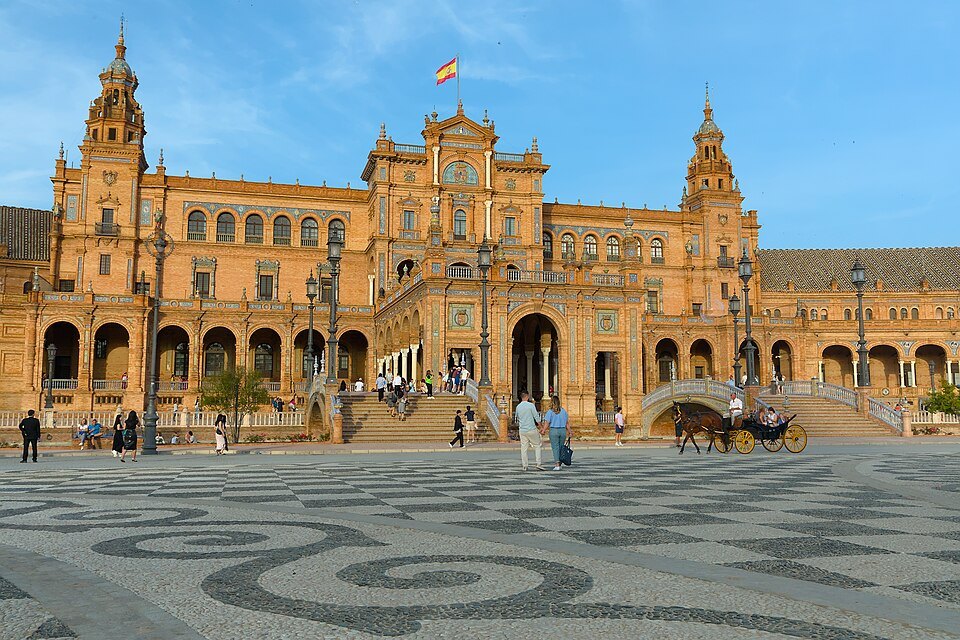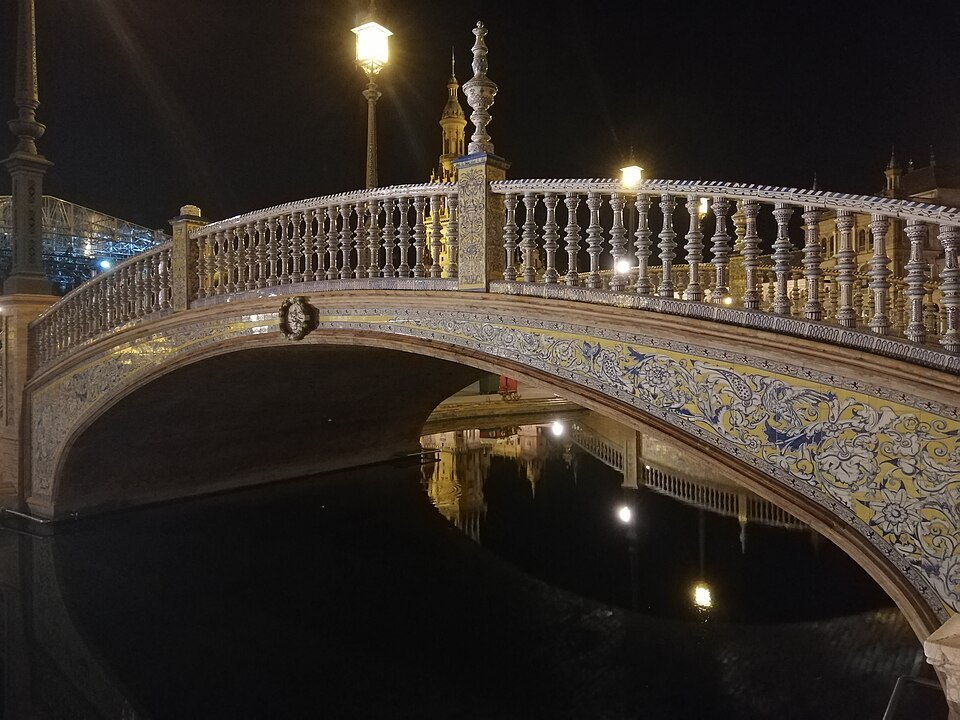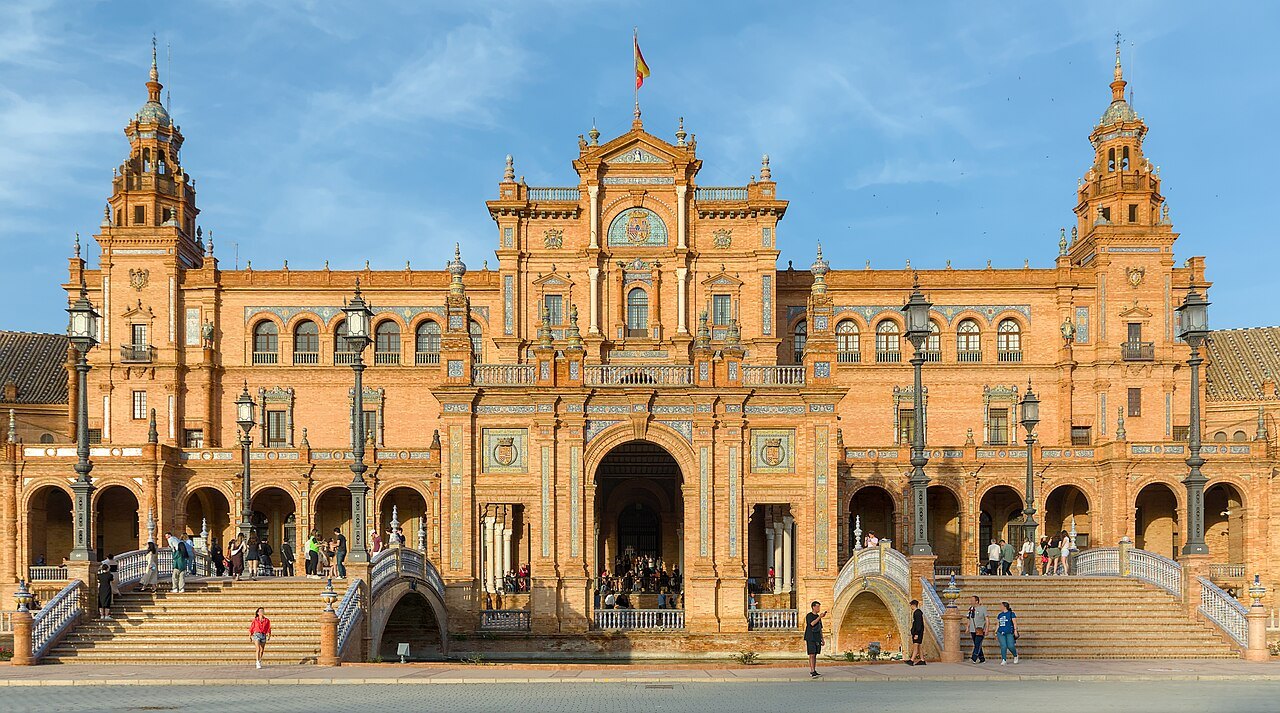
The plaza was built as Spain's own pavilion for the 1929 Ibero-American Exposition: a huge brick and tile crescent wrapped around a canal, with towers at each end and a bridge over the water at intervals.
⭐ Around the base runs a series of 48 tiled alcoves, one for each province of Spain except Seville itself, each with a map and a historical scene. Finding your province is what most people end up doing here.
It has stood in for other places on film more than once, which is why it can feel oddly familiar before you have ever been.
⚠️ It is enormous and almost entirely unshaded. In summer this is an early-morning or evening place, not a midday one.
Come at opening or near sunset. The brick goes orange in low light and the space is survivable.
The biggest building of the 1929 fair
Seville began planning its Ibero-American Exposition as early as 1910, and the architect Aníbal González won the competition to design it. The Plaza de España grew out of a change of plan: a stadium was first meant to stand here, and when it was moved elsewhere in 1913 the site was given to a great hall for ceremonies and festivities around a square. González presented the first design on July 14, 1914, and work began that August. When Alfonso XIII visited in December 1915 he suggested it should be permanent, and the final design of 1918 intended the buildings to become a workers' university and school of arts and crafts after the fair.
Building it took fifteen years. Strikes by bricklayers and rising prices slowed the work; the canal and its bridges were finished in 1919, the ceramics of the central building were going up in 1923, and the cost and the push for ever more grandeur caused more delays before the exposition finally opened in 1929. González himself resigned in 1926, with the design settled, and others finished it; the Academy of Fine Arts objected to the towers in case they rivaled the Giralda. The exposition was inaugurated here, in the plaza, on May 9, 1929, in the presence of Alfonso XIII and Queen Victoria Eugenie. It is the largest construction of the whole fair.
Reading the plaza
The plaza opens west toward the park in a vast half-circle. In the middle stands the central building, now an army headquarters; galleries with monumental staircases run out on either side to two end buildings with tall towers, the North and South towers, which house government offices. In front runs a canal 15 meters wide and some 500 meters long, crossed by four bridges dedicated to the old kingdoms of Aragon, Castile, León and Navarre, where you can hire a rowing boat, and in the center is a fountain by Vicente Traver. The French engineer Jean-Claude Nicolas Forestier, who designed the surrounding park, opposed the canal because Seville was short of water; it was built anyway.
González mixed Renaissance, Baroque and Neo-Mudéjar revival styles with touches of the 1920s into what is called Regionalist architecture. Besides the 48 provincial alcoves, with tiled benches set out like theater boxes, the facades carry 52 medallions of famous figures from Spanish history and many coats of arms. Beside each alcove a pair of little covered bookshelves now works as a free library, where visitors leave books about the province or novels for others to read. One of the galleries is the entrance to Seville's Military History Museum.
The whole ensemble covers about 50,000 square meters, of which 19,000 are built on. The alcoves run in alphabetical order, in four runs of twelve, each with a large tile panel showing an event from the province's history, a tiled map of it on the ground and its coat of arms above. Seville, as host, has no alcove of its own; instead, panels at the start and end of each run show scenes of the province, from bulls being driven across the countryside to the dance of the Seises in the cathedral. The canal's balustrades were originally all ceramic; the inner ones were replaced in red marble in 1946, and the outer ceramic ones were restored in 2009.
Restored and protected
Between 2007 and 2010 the city council restored the plaza to González's original design, rescuing ceramic streetlights, benches and paving and recreating lost pieces from old photographs and postcards. In July 2023 it was declared a Bien de Interés Cultural, Spain's highest heritage protection.
It has been a film set many times: Lawrence of Arabia was shot here in 1962, it became the city of Theed on the planet Naboo in Star Wars: Episode II – Attack of the Clones in 2002, and it appeared in The Dictator in 2012 and in the Netflix series Kaos in 2023.
Sources
Plaza de España, photographed