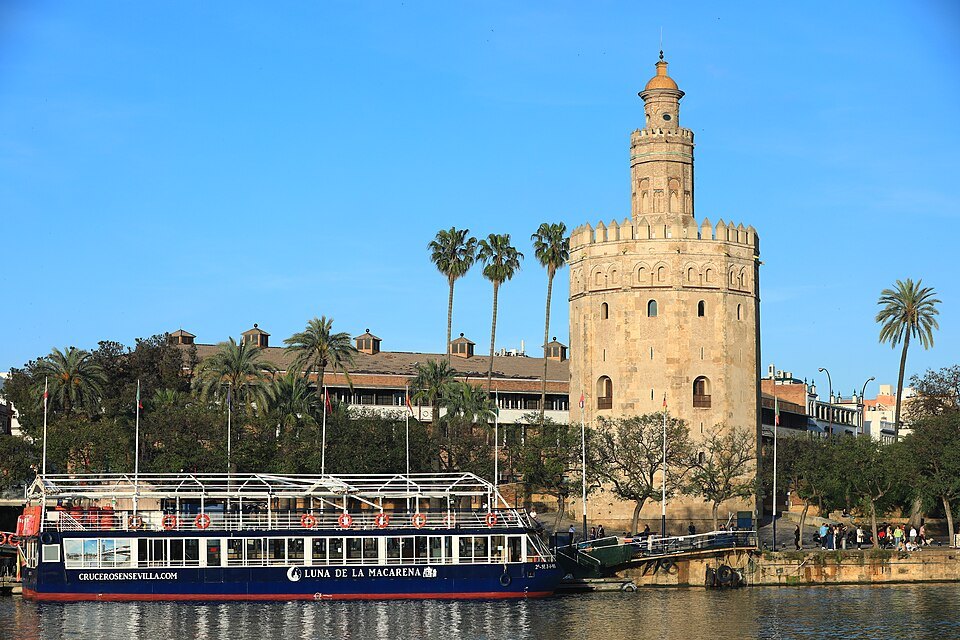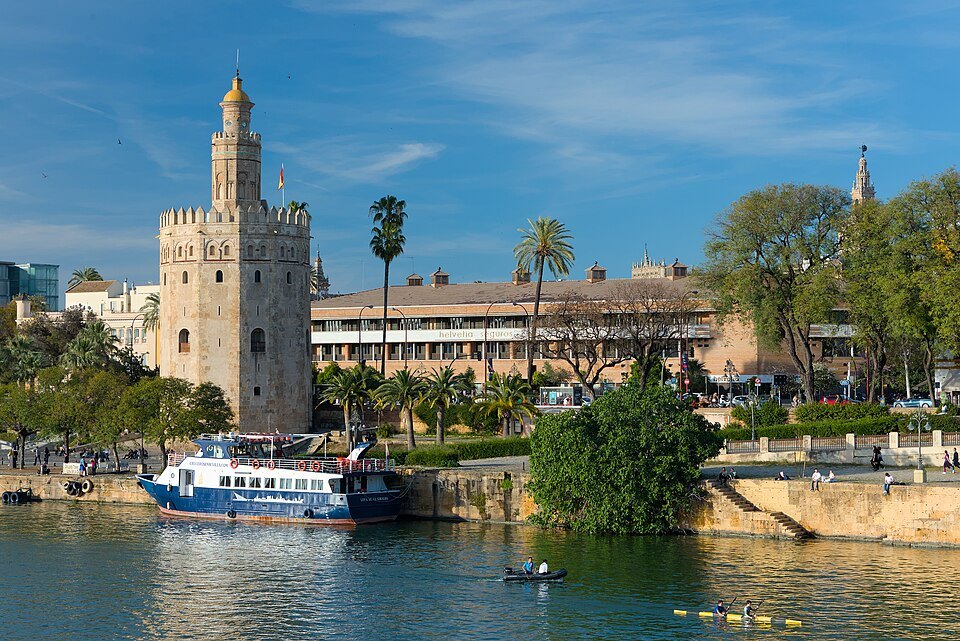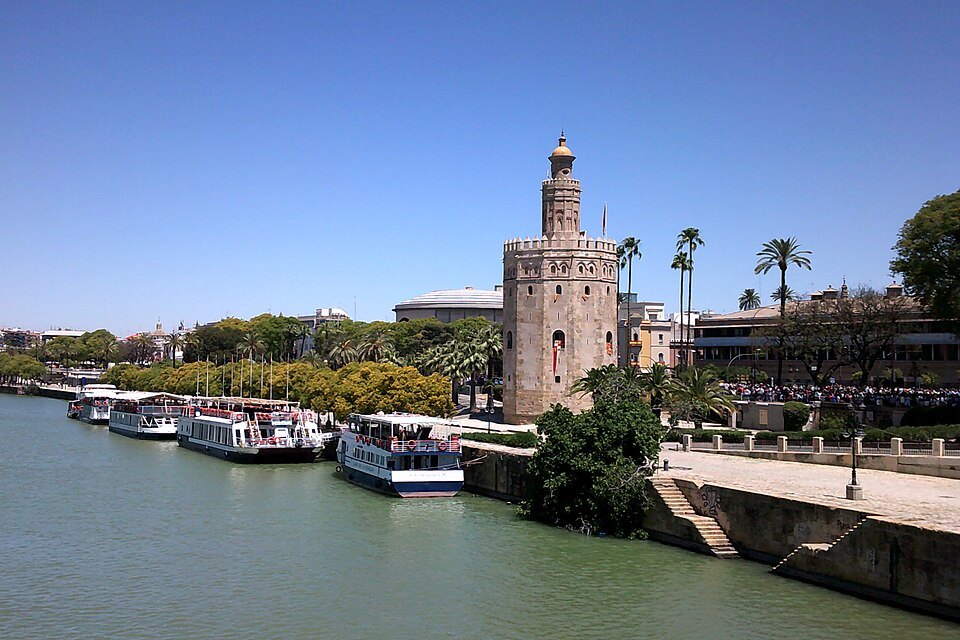
The tower is Almohad, built to guard the river approach to the city. Guides often say a chain ran from here to the far bank to close the river; historians now say no such chain existed.
⚠️ The name means 'tower of gold' and is usually explained by the gold landed here from the Americas. The likelier explanation is duller: a facing of lime mortar and pressed straw that gave it a golden shine on the river.
⭐ Inside is a small naval museum; the reason to go up is the river view along both banks toward Triana.
It is small and it is quick. Twenty minutes, mostly for the top.
An Almohad tower
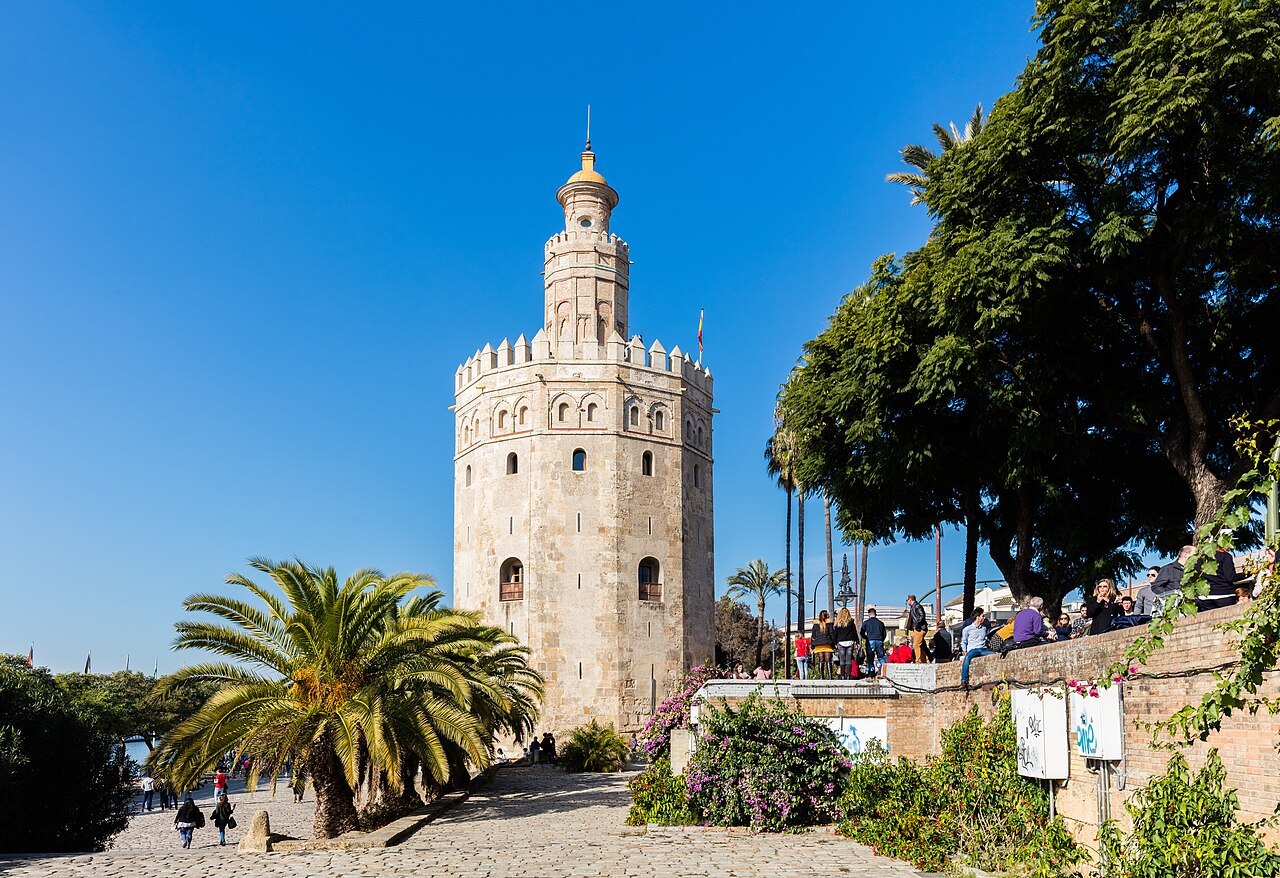
The Torre del Oro was built by the Almohads in the year 617 of the Hegira, between March 1220 and February 1221, on the orders of the governor of Seville, Abu l-Ula. It was a torre albarrana, a tower standing forward of the walls: a defensive wall ran from the southern corner of the Alcázar down to the river, guarded by towers including the octagonal Torre de la Plata, which still stands nearby, and ended here at the water's edge, barring the way into the Arenal. Arabic sources already called it Burj al-Dahab, the Tower of Gold. Its twelve-sided lower body is just over fifteen meters across, the whole tower stands just under thirty-seven meters high, and it rests on a slab of lime concrete about 5 meters thick, reinforced with pine timbers because the riverside ground is soft.
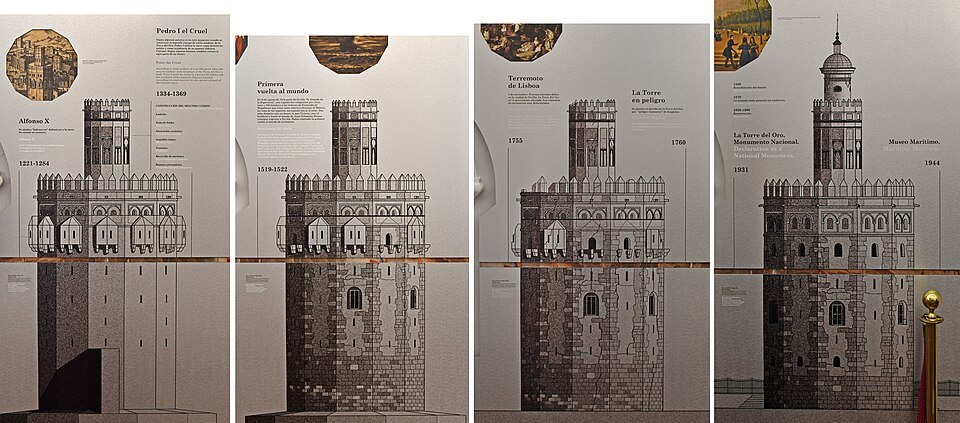
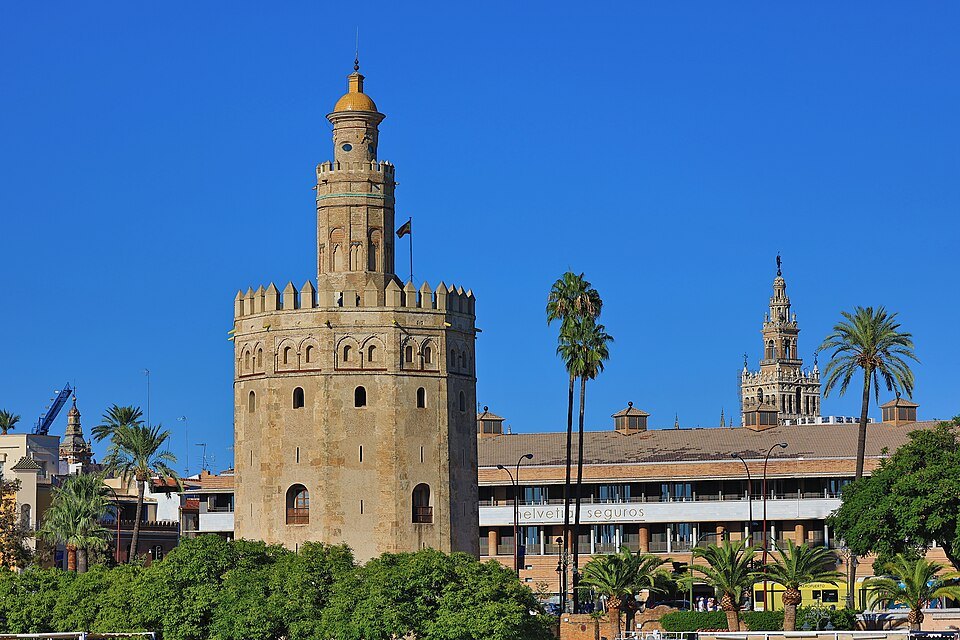
The tower is built in three stages. The twelve-sided base is Almohad; the second stage, only 8 meters high and also twelve-sided, is a Mudéjar addition from the reign of Pedro I in the fourteenth century, as archaeology has confirmed; and the small cylindrical top with its round windows and dome of golden tiles dates only from 1760.
1248 and the chain that wasn't
When Ferdinand III besieged Seville in 1248, the Castilian fleet under Admiral Ramón de Bonifaz sailed up the river and broke the pontoon bridge that joined Seville to Triana, cutting the city off; the chronicles say arrows were shot at the ships from the Torre del Oro as they passed. A seventeenth-century historian added the story of a great chain of linked timbers stretched from the tower to the far bank, and it has been repeated ever since, but historians are now sure it never existed: the chain the ships broke was the one that held the boats of the pontoon bridge together. A ship breaking that chain appears on the coats of arms of several towns on Spain's northern coast, whose sailors took part, and since 1984 on the coat of arms of Cantabria.
Prison, ruin and rescue
In the early fifteenth century the tower served as a prison for noblemen. It was shaken by earthquakes in 1504, 1522 and 1531, and by around 1535 it was held together by a thick iron belt. The Lisbon earthquake of November 1, 1755, on top of damage from floods, left it in such a state that in 1757 the options presented were to pull it down altogether or keep only the first stage, and the Marquis of Monte Real proposed demolishing it to straighten the road to the Triana bridge. The people of Seville objected and appealed to the king. Instead, restoration began on March 17, 1760, under Sebastian Van der Borcht, the builder of the Royal Tobacco Factory: the ground floor was filled in solid, adding about 6 meters to the foundations, and the present lantern and dome were built that summer. On the west face, three tiles mark how high the river rose in the floods of 1856, 1876 and 1892.
The museum
Since 1944 the tower has housed a maritime museum run by the Spanish Navy, with old navigational instruments, ship models, documents, engravings and charts telling the story of Seville, the Guadalquivir and the sea. The tower was declared a historic-artistic monument in 1931 and last restored in 2005. On August 13, 1992, during Seville's Universal Exposition, it was twinned with the Belém Tower in Lisbon.
Why gold?
Nobody is quite sure where the name came from, and Seville has offered several answers. Luis de Peraza, who wrote the first history of the city in 1535, said the tower was covered in tiles that shone in the sun, and also that Pedro I kept his treasure there; the chronicler Pedro López de Ayala tells the treasure story too, but it is more legend than fact. When the tower was restored in 1900, José Gestoso looked for the original golden tiles and found none. Because it stands by the old customs quay, it is often said that the gold of the Americas was stored here, but that is false: the gold was kept in a treasure room of the Casa de Contratación and processed at the mint. After the restoration of 2005 the name was put down to a golden sheen from its coating of lime mortar and pressed straw.
The tower also turns up in medieval records. In 1253 Alfonso X granted an oven in Calle de Francos to a certain Nicolás "of the Torre del Oro", perhaps its keeper, and a letter of 1271 shows there was a chapel in the tower where the feast of Saint Ildefonsus, the king's patron, was celebrated every year.
Sources
Torre del Oro, photographed