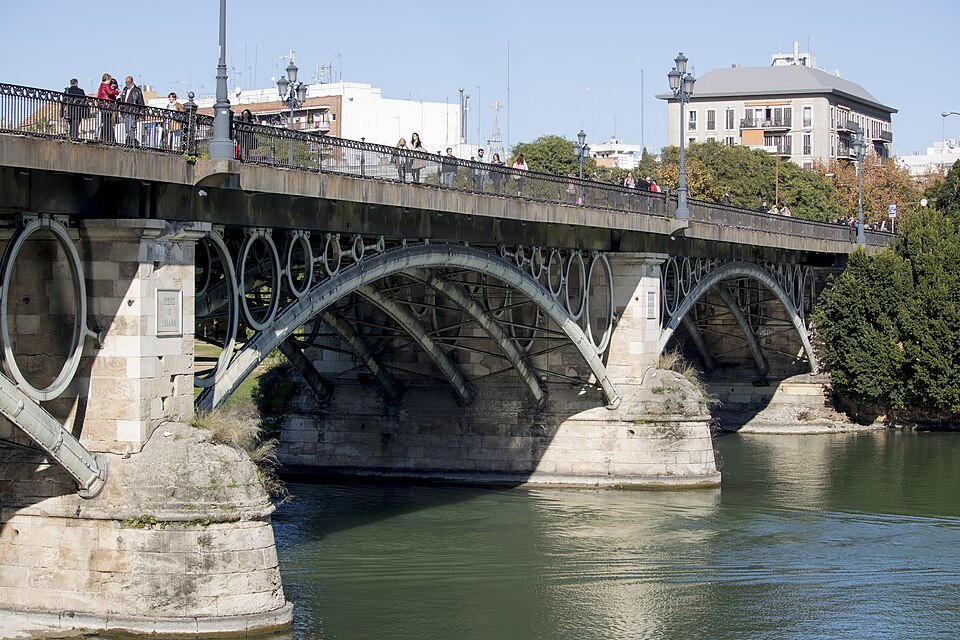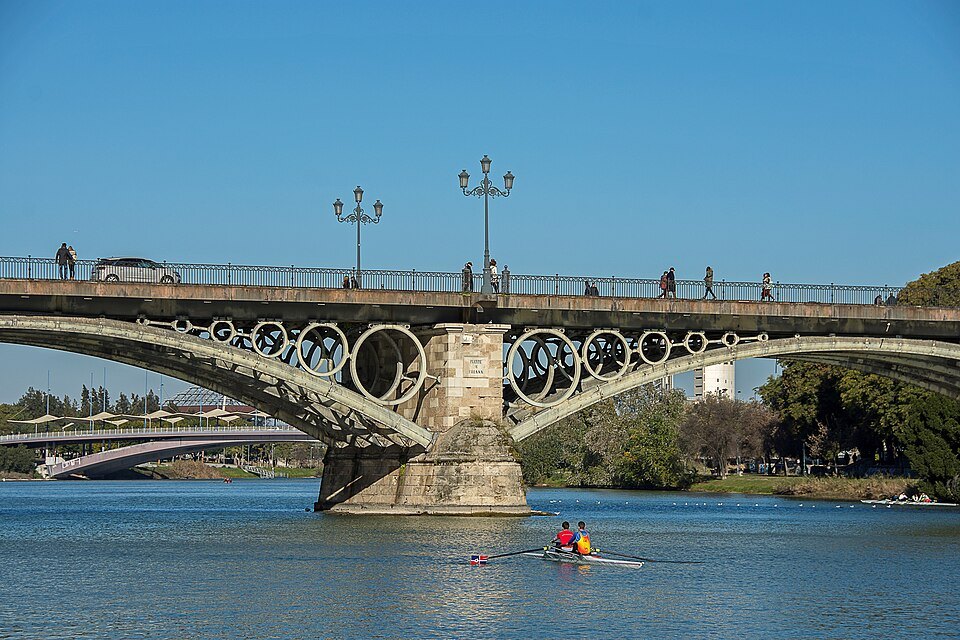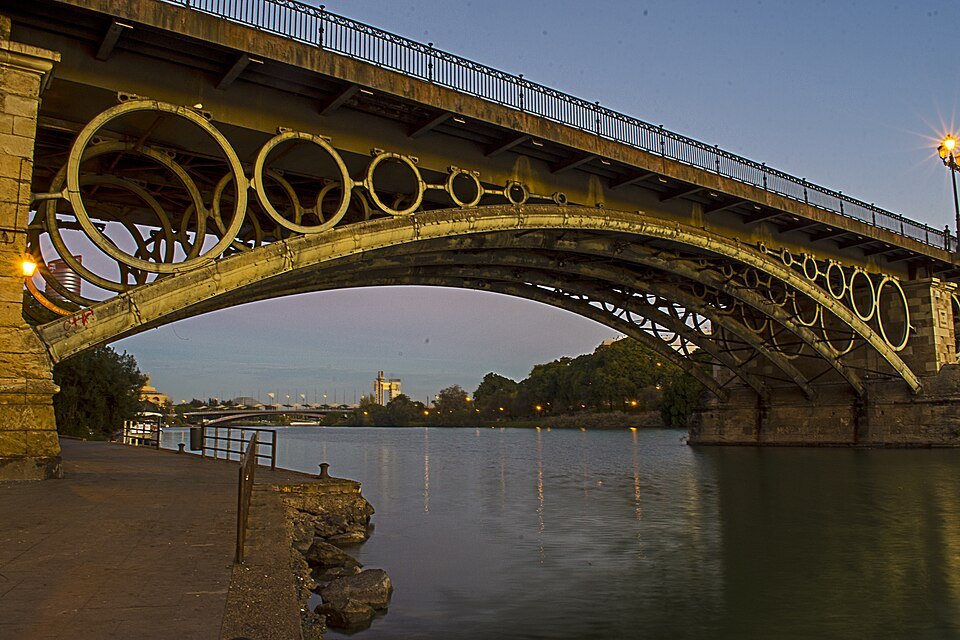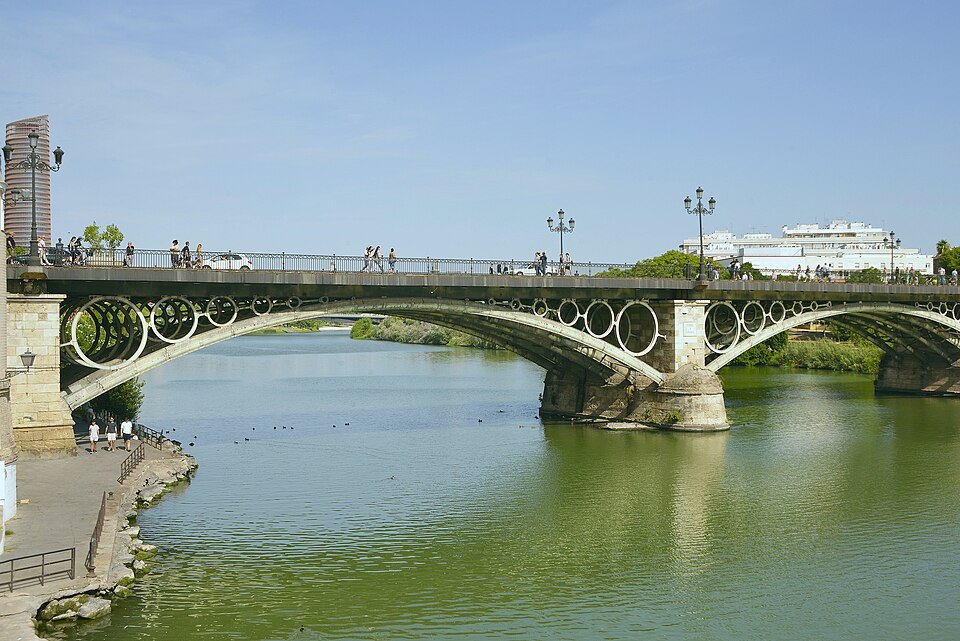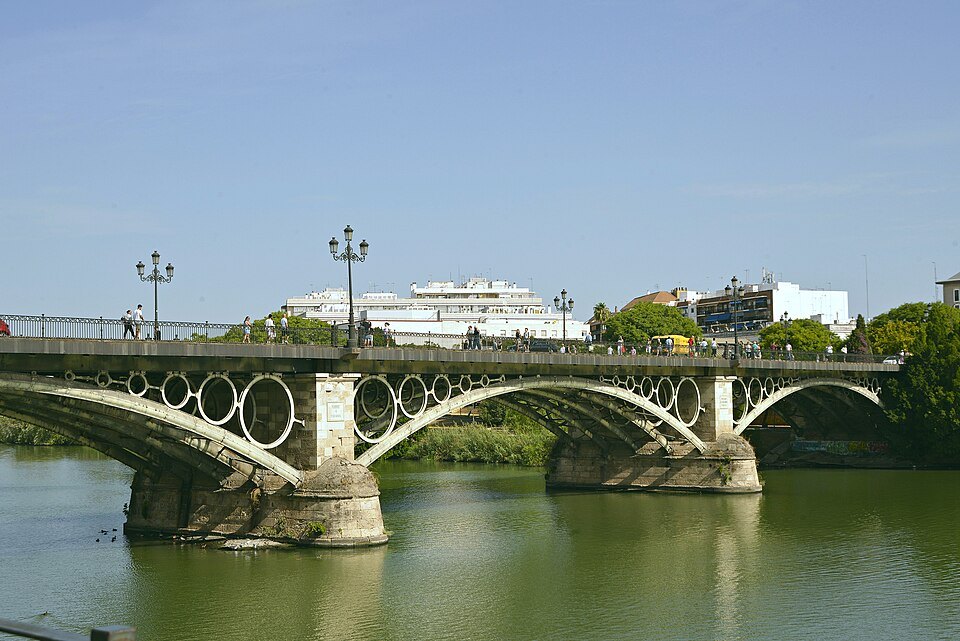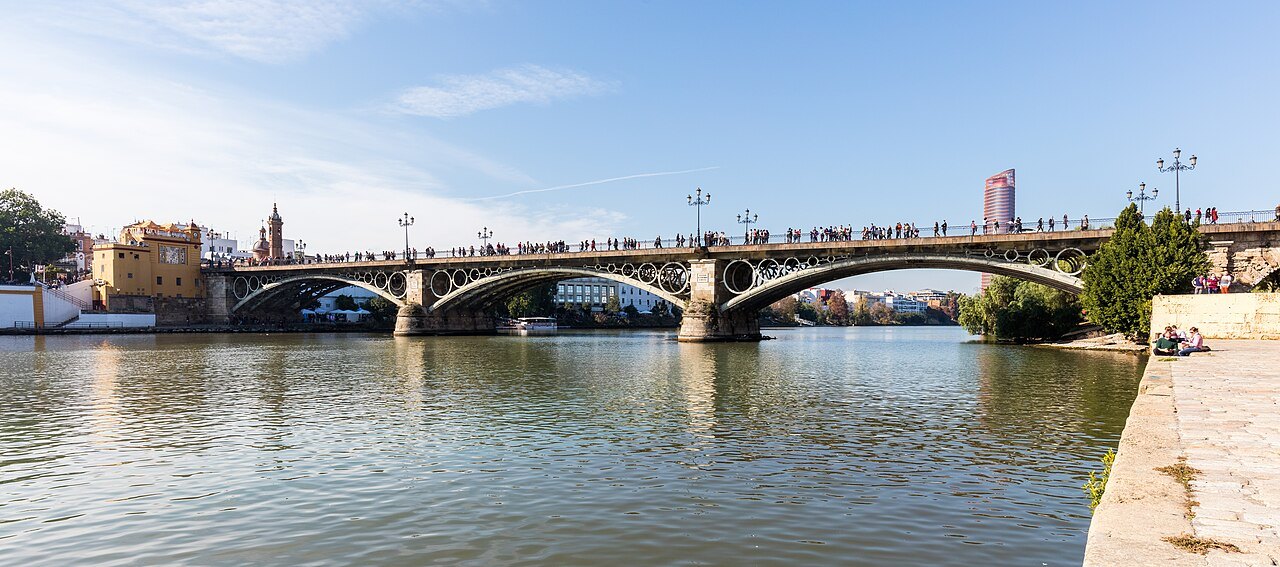
Finished in the mid-19th century and usually called the Puente de Triana, it replaced a pontoon bridge of boats that had served the crossing for centuries. Its arches are modeled on a Parisian bridge of the period.
⭐ It is the best place to photograph Triana's riverfront, and the walk across it is the proper way to arrive on the far bank.
Stand at the Triana end at dusk. The whole eastern bank lights up and the bridge frames it.
Seven centuries on boats
For most of Seville's history there was no fixed bridge anywhere on the Guadalquivir between Córdoba and the sea. The Romans never bridged the river here, probably because the banks were too soft and sandy for foundations. In 1171 the Almohad caliph Abu Yaqub Yusuf built a bridge of boats instead: moored boats chained together, with heavy planks laid across them and a section that opened to let ships through. It stood where the present bridge stands, between the castle on the Triana side and a gate in the city wall.
That pontoon bridge, repaired again and again, lasted for seven centuries. It saw two great battles: in 1248, when Admiral Ramón de Bonifaz's fleet broke its chains during the conquest of Seville, and in 1812, during the war against Napoleon. It also needed constant work; in 1842 it was made of 10 boats, and one had to be replaced every year. Proposals for a fixed bridge of wood and iron, of stone, or hung on cables came and went from the sixteenth century onward, including one in 1831 for a single great stone arch with no piers at all.
Building the iron bridge
In 1844 the French engineers Ferdinand Bernadet and Gustave Steinacher, who were building two bridges at El Puerto de Santa María, offered Seville three designs, and the city chose cast-iron arches on two piers in the river, for strength and beauty. The design followed the Pont du Carrousel over the Seine, built by the engineer Polonceau in 1834 and since demolished; the Seville bridge had to be bigger, because the Guadalquivir here is half as wide again as the Seine was there. On June 30, 1845, the old bridge of boats was moved downstream, and the first stone of the new one was laid on December 12, 1845.
The city paid for it with tolls collected on the roads into Seville, and the contract required the cast-iron pieces to be made in Spain. The stone first planned, from San Fernando near Cádiz, was rejected for looks in favor of stone from Matasanos in the province of Badajoz; the cast iron came from Guriezo in Cantabria, and the wrought iron for the forged parts from foundries at El Pedroso, Marbella, Vizcaya and Scotland. On the Triana bank a long retaining ramp was built, running back as far as Calle San Jorge. Over the following decade the walls on either side of the approaches were added, and for years afterward the council debated crowning the bridge with an iron statue of the queen or a pair of lions bearing the arms of Spain and Seville, but nothing came of it.
The iron came in 27,248 pieces, cast at the San Antonio foundry, which Narciso Bonaplata had set up in a convent closed in 1835. There was no wood in the structure at all, only stone and iron. Bernadet left in 1846, Steinacher fell out with the banker financing the works and was removed in 1849, and the engineer Canuto Corroza took over in 1851 and finished the job the following year. After load tests on January 29, 1852, the bridge was inaugurated on February 23 with a procession from the church of Santa Ana; the archbishop blessed it in the middle with the name of Queen Isabel II, and the day ended with greasy-pole contests, swimming races and band concerts. It opened to the public on June 30, 1852, and the old boats were sold off for their materials.
Keeping it standing
The oldest iron bridge surviving in Spain has needed care ever since. Scour was found under its foundations in 1871, and again in 1880 as dredging changed the river; an English-flagged steamer, the Adela, rammed it in 1874; and in 1889 a steam roller crossing to flatten Triana's dirt streets broke a beam. That same year a horse-drawn tram line opened across it, electrified later, and the deck was strengthened and then entirely replaced in the early twentieth century to cope with the weight.
On the Triana end stands the little Neo-Mudéjar chapel built by Aníbal González in 1927. Together the bridge and the chapel are the symbol of Triana, and they were declared a national monument in 1976 after a proposal to demolish them was defeated.
Sources
Puente de Isabel II, photographed