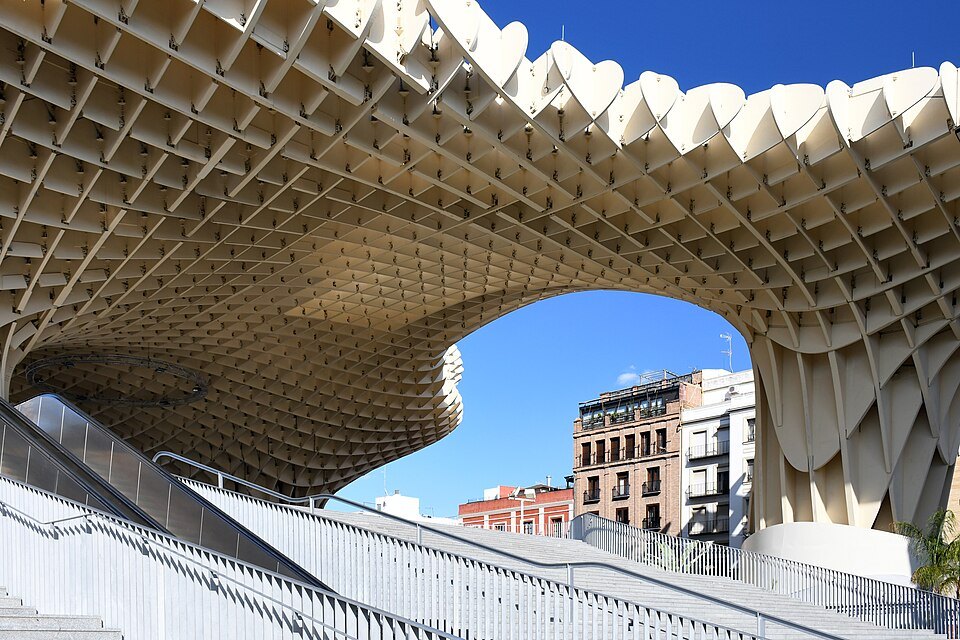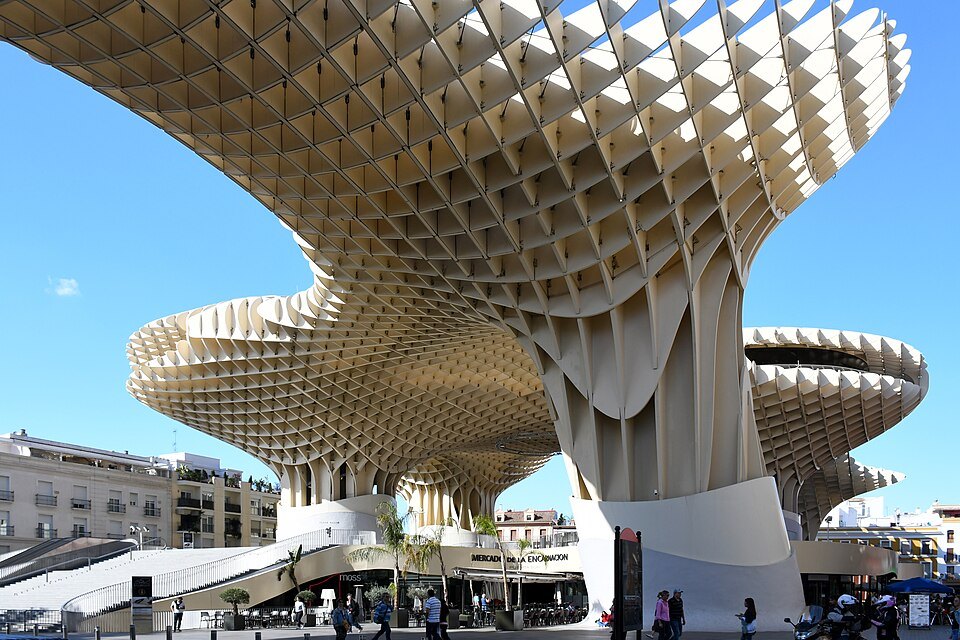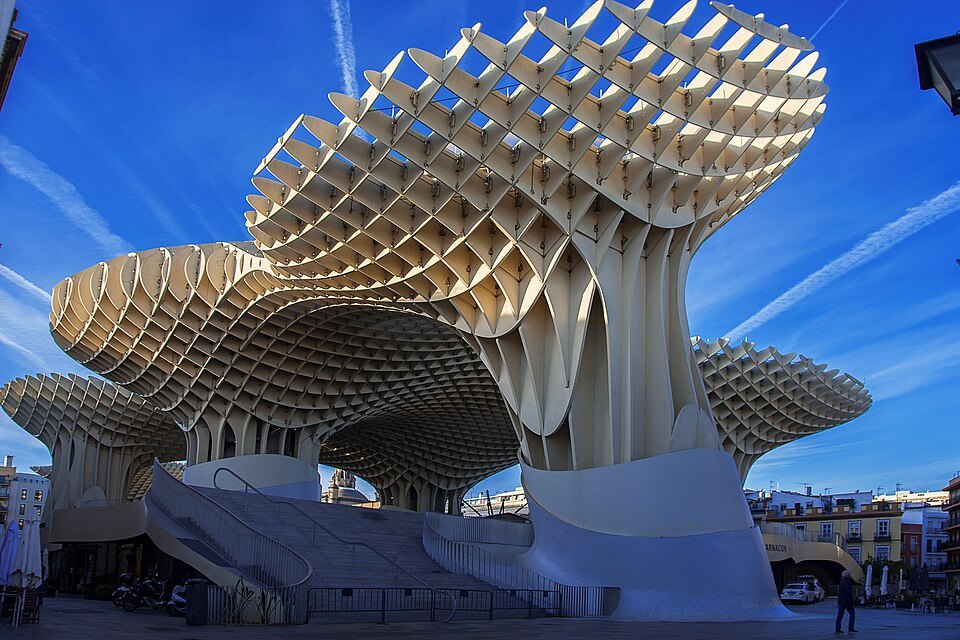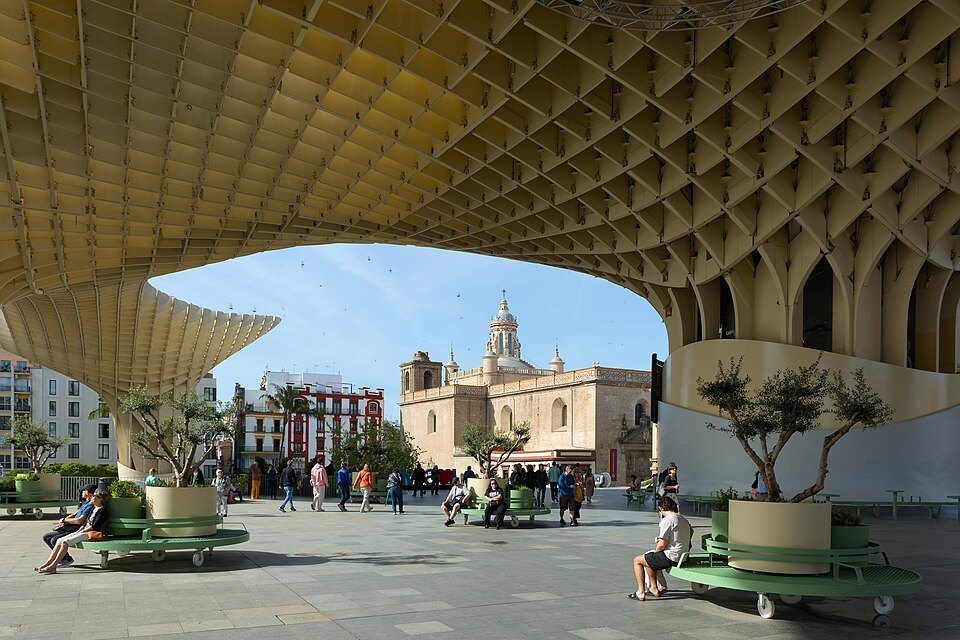
Officially the Metropol Parasol, universally 'the mushrooms'. It went up over a square where the old market had stood, after Roman remains found while digging an underground car park stopped the works.
⭐ Those remains are in the Antiquarium underneath — mosaics and walls of Roman Hispalis, in situ, below the market and the square.
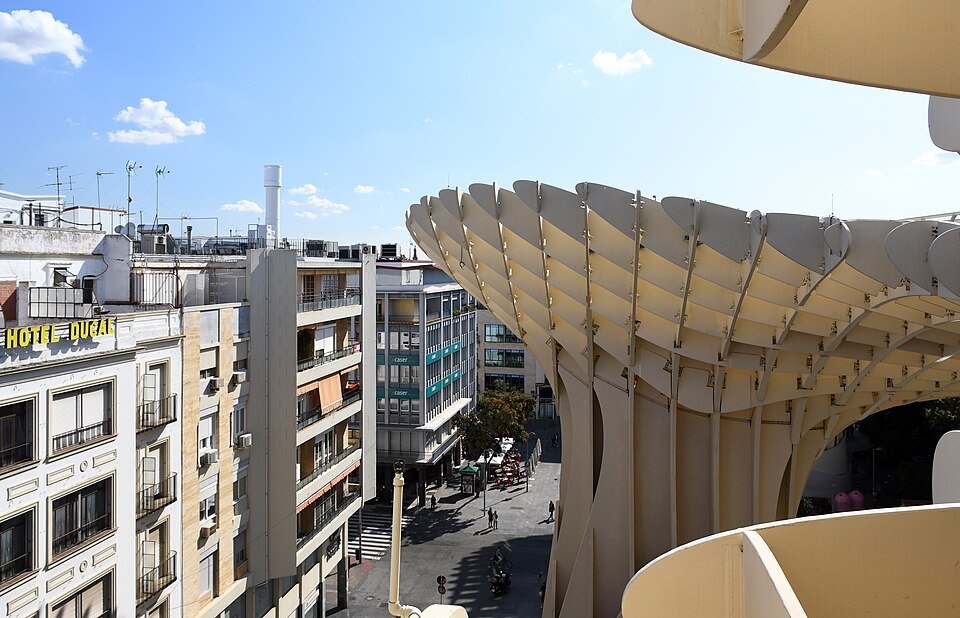
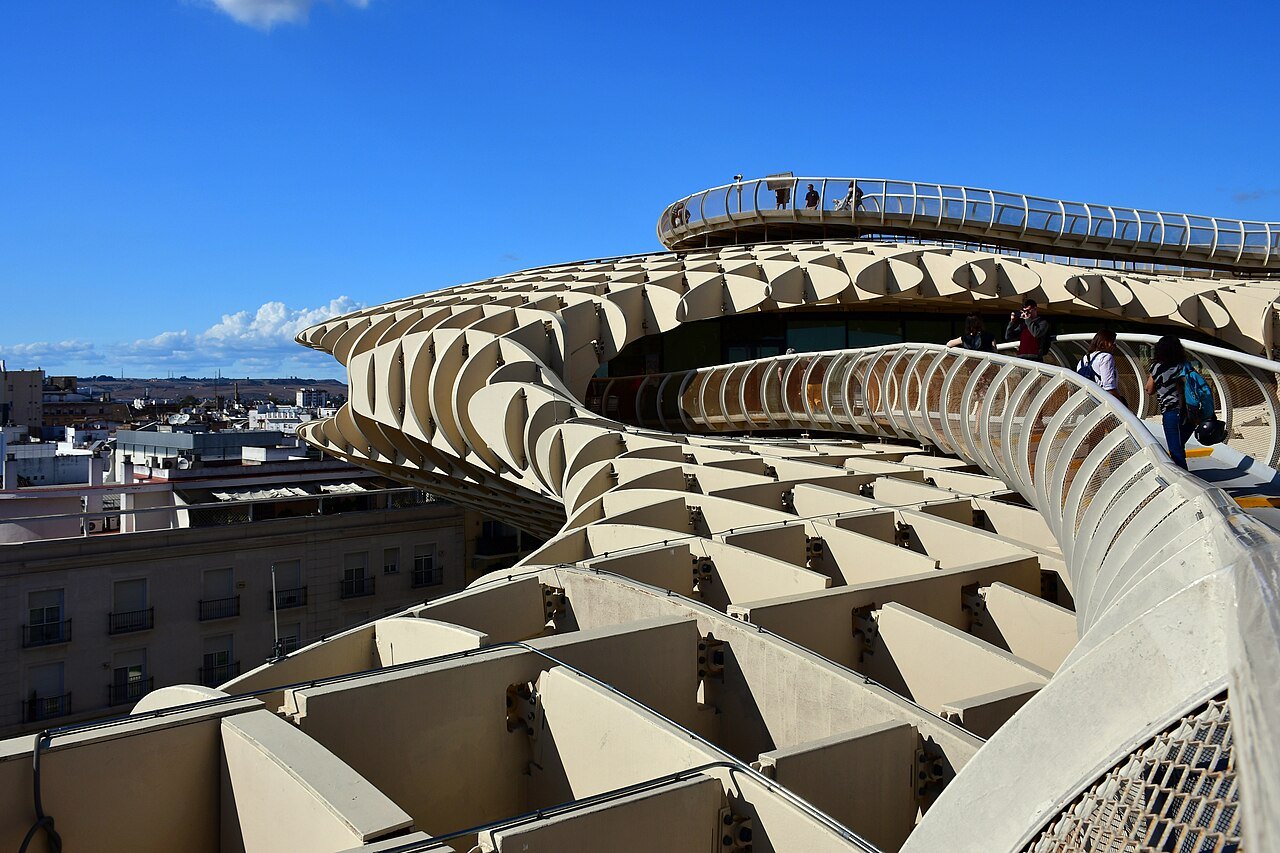
⚠️ The rooftop walkway is ticketed and is the reason most people come: a winding path across the top with the cathedral and the Giralda on the skyline.
It was controversial, expensive and late. It is also now one of the most photographed things in the city.
Go up at sunset, then come down and see the Roman level. Doing it in that order makes the layering obvious.
A square with a long history
The Plaza de la Encarnación takes its name from an Augustinian convent that once filled part of it. The square grew out of smaller ones from the sixteenth century, where the Dukes of Medinaceli and other noble families had their houses. During the French occupation early in the nineteenth century the convent was demolished and a market of three covered arcades was built in the middle. A third of it was knocked down in 1948 to widen a main street, and the rest, by then in ruins, in 1973. For years the site was a surface parking lot and bus depot.
In the 1990s the city began digging an underground car park with a new market on top, and found some of the most important remains of Roman and Islamic Seville. The works stopped, heritage officials required in 2003 that the remains be kept where they were, and in 2004 the city held an international competition for a building that could hold a market, a public square and a museum of the ruins, and become an icon of the new Seville at the same time.
Building the mushrooms
From 65 entries the jury chose Metropol Parasol by the Berlin architect Jürgen Mayer. Work began on June 26, 2005, and was meant to finish by 2007, but by then only the six concrete cores were up, and the engineering firm Arup warned that the design as drawn could not carry its own weight and stresses. The answer, found by 2009, was to build the parasols in glued laminated Finnish wood instead of metal. The cost roughly tripled, and in 2010 a candidate for mayor even proposed scrapping the wooden roof and four of the six mushrooms to save money and open sooner. Mayor Alfredo Sánchez Monteseirín finally inaugurated it on March 27, 2011.
The six parasols, inspired by the vaults of the cathedral and by the giant ficus trees of the nearby Plaza del Cristo de Burgos, stand on cylindrical pillars and join overhead into a single canopy about 150 meters long, 70 wide and 26 high, covering some 3,500 square meters. Locals called it Las Setas, the mushrooms, from the start, and when the city discovered the architect had trademarked the name Metropol Parasol, it made the nickname official in 2013. It is promoted as the largest wooden structure in the world.
Four levels
Underneath, at the lowest level, is the Antiquarium, opened with the rest on March 27, 2011, and run by the trust of the Real Alcázar: the most important surviving Roman site in Seville, spread over 4,879 square meters. Its Roman houses, from the first to the sixth century, keep their floor mosaics — the House of Bacchus, the House of the Nymph, a Medusa mosaic in the House of the Column — along with the Hospitium of the Dolphins and a three-meter mural in the Ocean Courtyard. A second part shows an Almohad house of the twelfth and thirteenth centuries.
At street level is the Mercado de la Encarnación, the heir of the old market, and above it the Plaza Mayor, a raised open square shaded by the parasols and reached by a wide flight of steps, used for events. Elevators rise from the basement to the top, where a concrete walkway winds across the parasols to a lookout over the old city. In 2013 the building was one of five finalists, out of 335, for the European Union's Mies van der Rohe Award, and studies by the University of Seville have found it is now the city's third most visited monument, drawing a million visitors in its first year.
The same studies credit it with doing what the city hoped: spreading visitors north from the cathedral into the center of the old town and bringing new shops, bars and cultural life to the streets around it. Look too at the edges of the square: the Renaissance church of the Anunciación stands on the Calle Laraña side, and the fountain in the garden, placed in the eighteenth century, survived every change around it.
Sources
- Metropol Parasol — Wikipedia
- Setas de Sevilla — Wikipedia (es)
- Antiquarium (Sevilla) — Wikipedia (es)
- Plaza de la Encarnación (Sevilla) — Wikipedia (es)
Las Setas, photographed