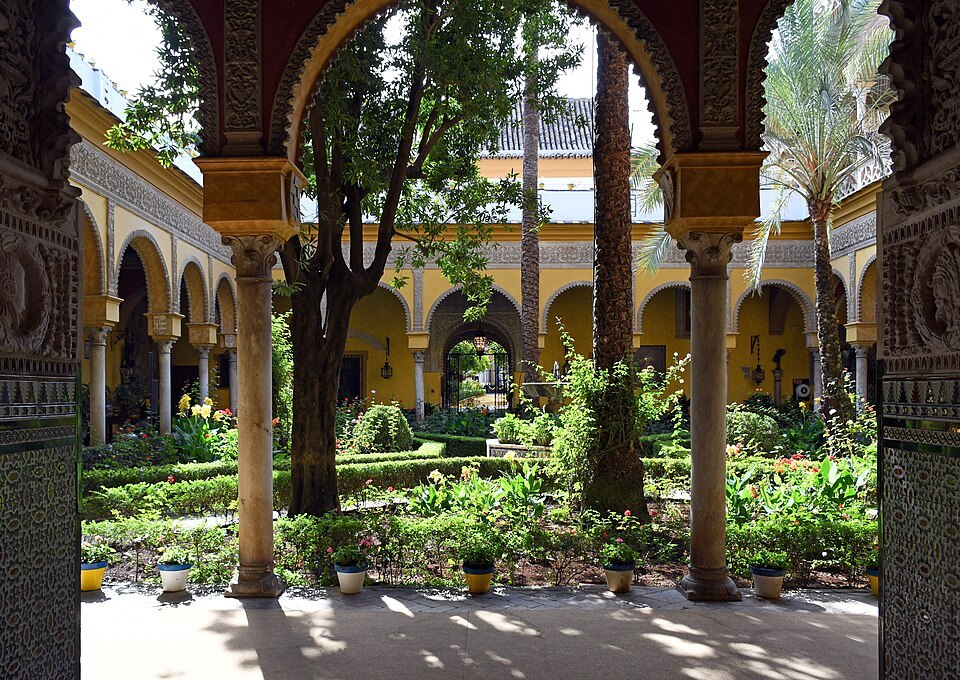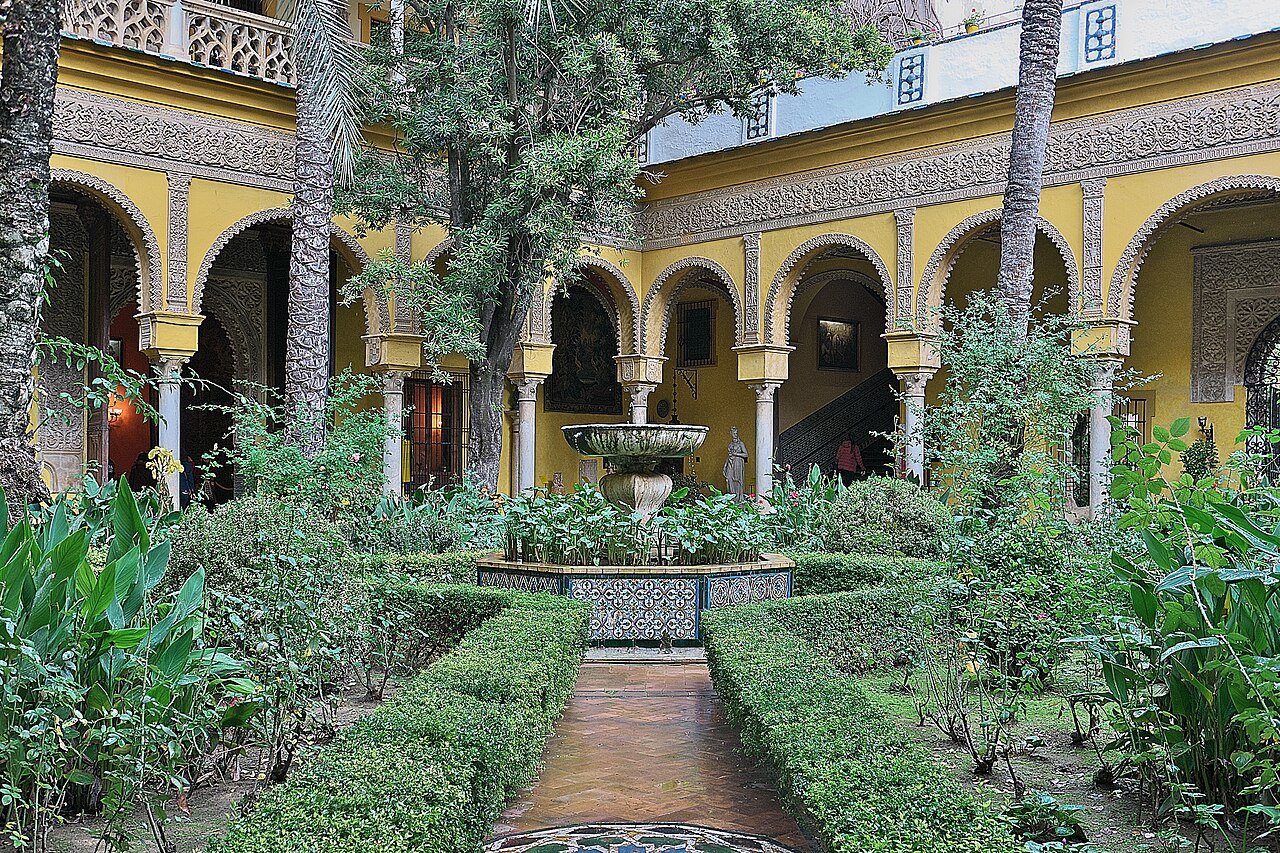
A 15th-century palace built around a central courtyard, still owned by the ducal house of Alba and opened to the public relatively recently. The poet Antonio Machado was born in a part of the building his family rented.
⭐ It is a house rather than a monument — furnished, hung with family portraits, and full of the accumulated objects of a family that never left. That makes it a different experience from the Alcázar even where the architecture rhymes.
The gardens and courtyards are the best part and are what the visit is built around.
It is far enough north to be missed by most visitors, which is precisely the reason to go.
A ransom and a dowry
The palace was built in the late fifteenth century by the Pineda family, lords of Casabermeja, at a time when Seville's nobility were building on a grand scale; the Casa de Pilatos went up in the same years. In 1496 Pedro de Pineda and his wife María de Monsalve sold it to Catalina de Ribera, the widow of Pedro Enríquez, to raise the ransom for a member of their family held prisoner by the Moors. Catalina's descendants enlarged it into a Renaissance palace, and it passed to the House of Alba when Antonia Enríquez de Ribera, Marchioness of Villanueva del Río, married Fernando Álvarez de Toledo, the sixth Duke of Alba. It still belongs to the Alba family.
Its name comes from the monastery of Santa María de las Dueñas, a community of nuns that stood at the edge of the palace from the days of Ferdinand III and Alfonso X and was demolished in 1868. The palace itself was heavily renovated in the eighteenth and nineteenth centuries and was declared a national monument on June 3, 1931.
Machado's lemon tree
In the nineteenth century the fifteenth Duke of Alba, who lived mostly abroad, divided the palace into apartments and let them to about a dozen families. In 1875 the writer Antonio Machado Álvarez and his wife Ana Ruiz moved into one on the ground floor, and there, on July 26, 1875, their son Antonio Machado was born. The family stayed until July 1879. The lemon trees and the fountain of the garden became recurring images in the poet's work. Among the Machados' neighbors in the palace were the painter Gumersindo Díaz Pérez and his brother, the musician Cristóbal Díaz Pérez. The English politician Lord Holland, a great admirer of Spanish literature, also lived here for a time, and the palace saw other births too, among them Carlos Falcó, the Marquis of Griñón. Since it opened its doors, it has become one of the most visited monuments in Seville, though it is still a family home rather than a museum.
Courtyards and gardens
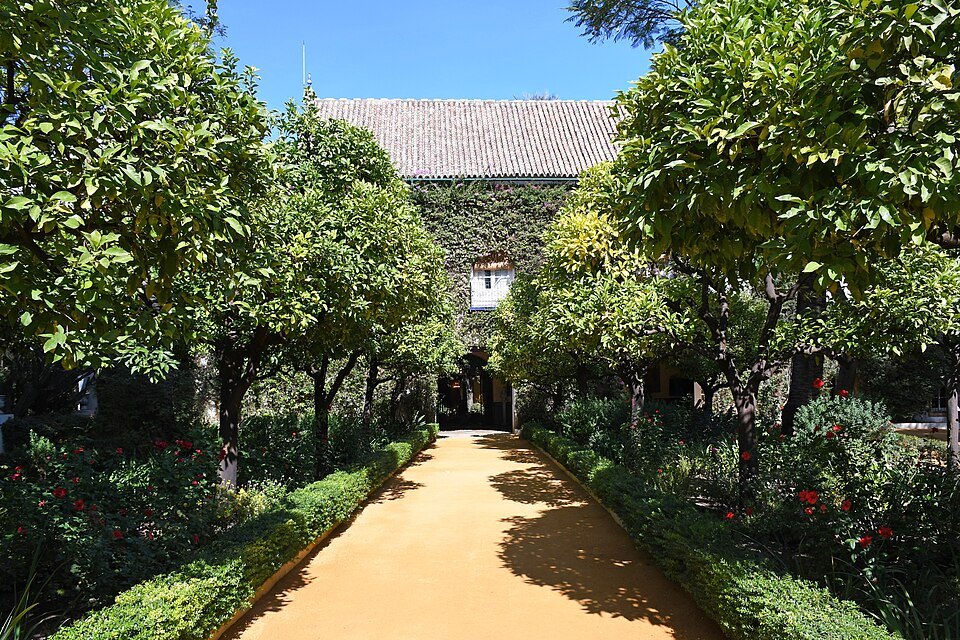
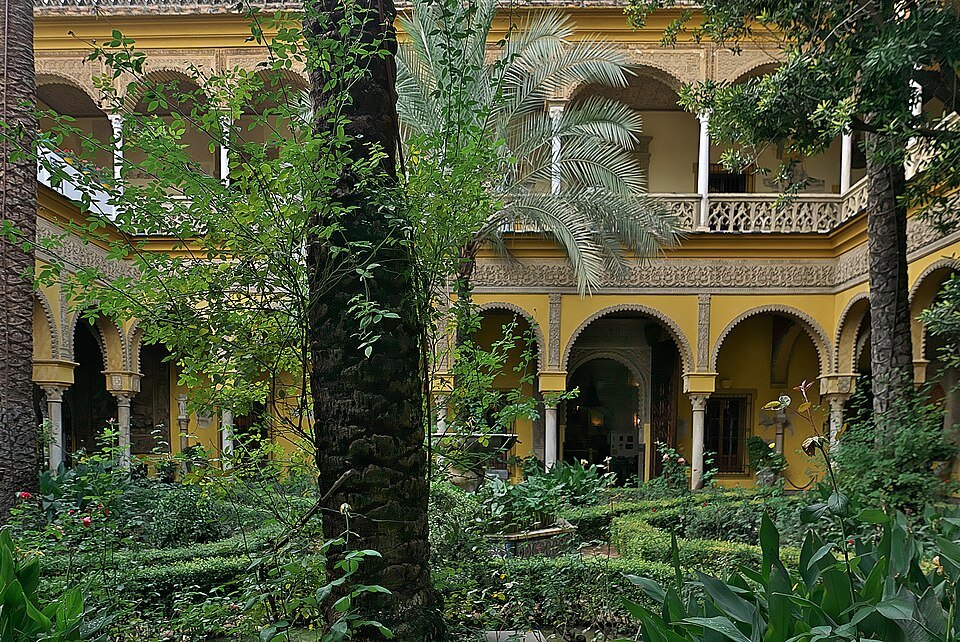
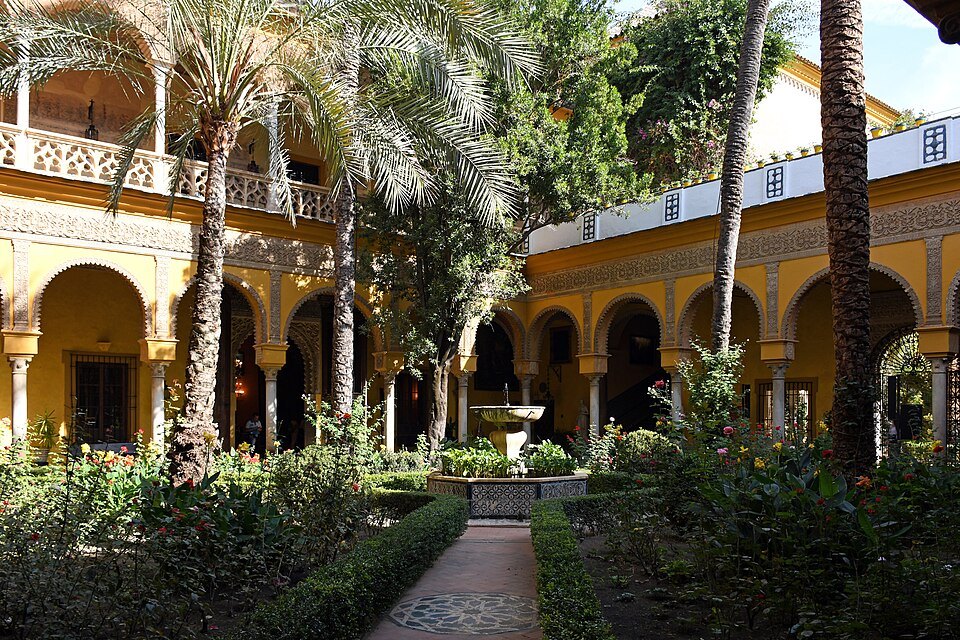
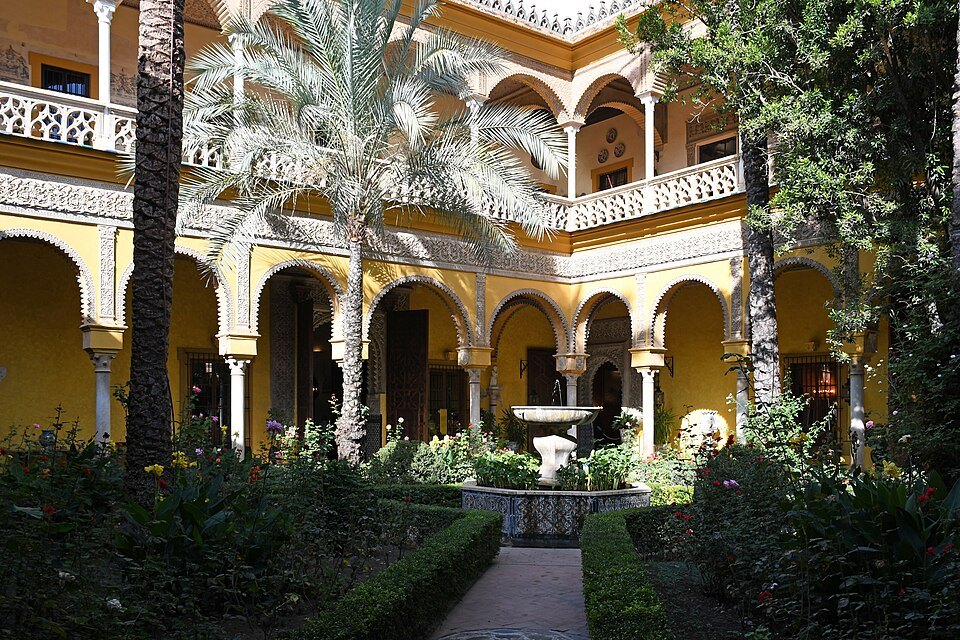
The palace is a sequence of courtyards and buildings in Gothic, Mudéjar and Renaissance styles, finished with local brick, tiles, whitewash and pottery, much like the Casa de Pilatos. It once had eleven courtyards, nine fountains and more than a hundred marble columns. You enter through a Mudéjar doorway under the Alba coat of arms in Triana tiles of the seventeenth or eighteenth century, and the facade is covered in bougainvillea. The main courtyard is surrounded by a gallery of white marble columns, and the garden is divided into four in the Islamic manner, with tiled paths and a raised fountain at its center; among its plants is one of the oldest sago palms, Cycas revoluta, in the world.
Inside, long corridors lead to a staircase under a vault, as at Pilatos, and an upper room with a gilded octagonal wooden ceiling. Off the courtyard is the fifteenth-century chapel, whose altar keeps tiles with a metallic sheen typical of sixteenth-century Seville; Amerigo Vespucci is said to have married María Cerezo here early in the sixteenth century.
The collection
The house holds 1,425 works of decorative art, protected by Andalusian law so that they cannot be sold or moved: Spanish and Italian paintings of the sixteenth and seventeenth centuries by artists such as Jacopo Bassano, Sofonisba Anguissola, Luca Giordano and Jusepe de Ribera, furniture and ceramics. In the main dining room hang Giovanni Paolo Pannini's view of the Roman Forum and Ignacio Zuloaga's equestrian portrait of the future duchess Cayetana as a child, painted around 1939. Even so, these are only a small part of the family's art; most of it is in the Liria Palace in Madrid. There is even a watercolor by Jacqueline Kennedy, painted on her visit in 1960, when she stayed in the bedroom once used by Empress Eugénie. The Duchess of Alba, Cayetana Fitz-James Stuart, married her third husband here on October 5, 2011, and the present duke, Carlos Fitz-James Stuart, opened the palace to visitors in 2016.
Sources
Palacio de las Dueñas, photographed