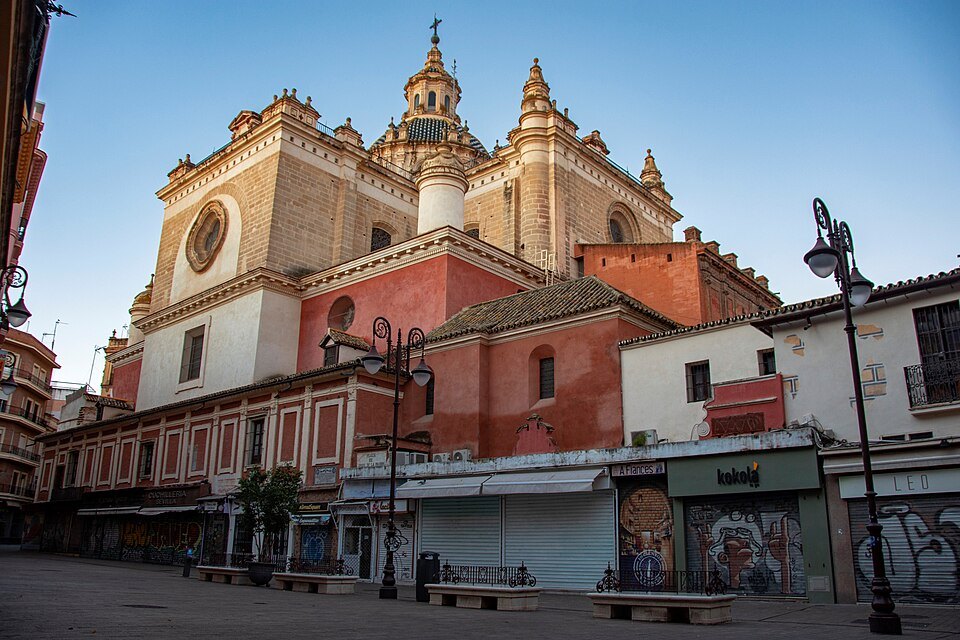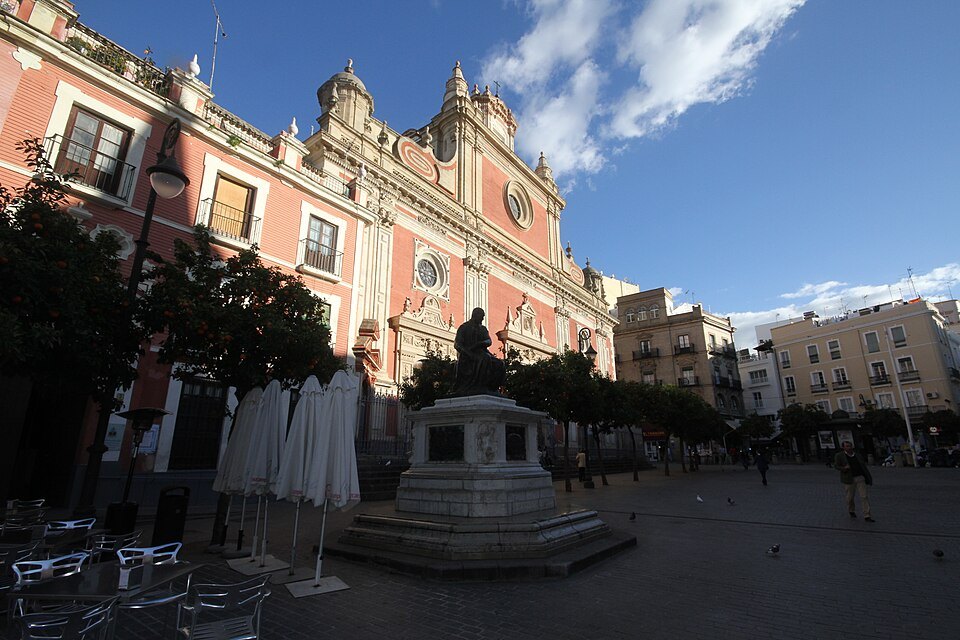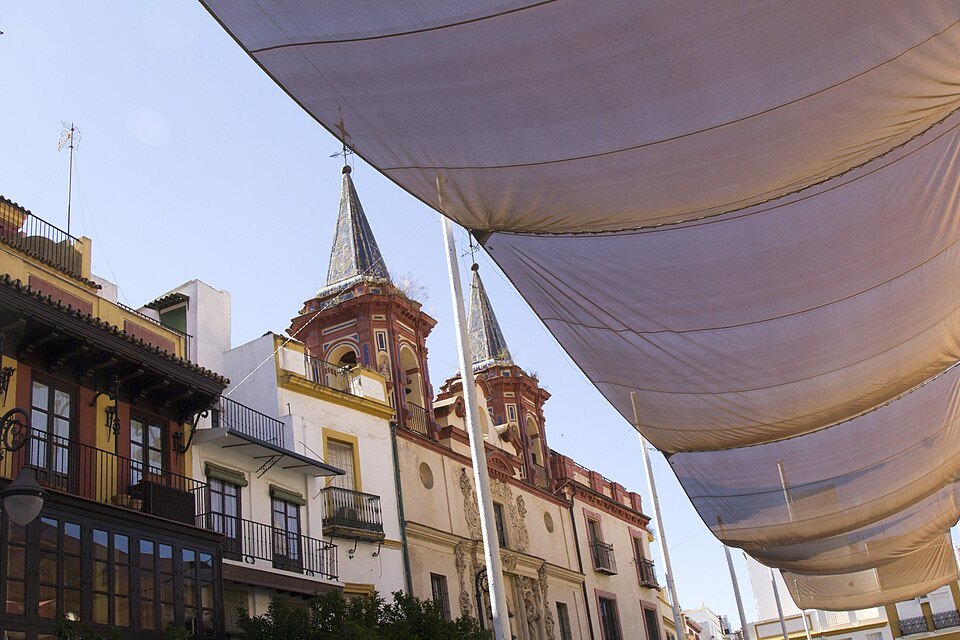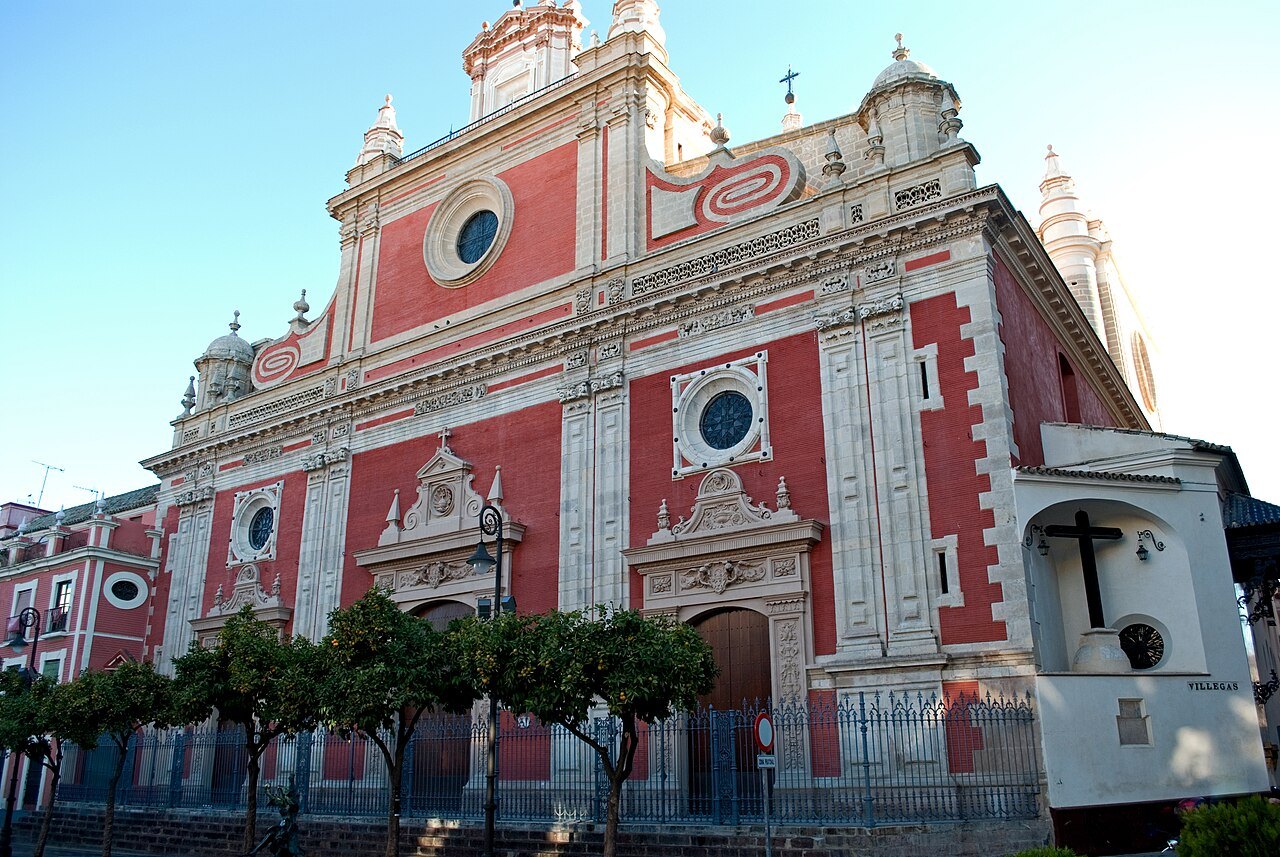
El Salvador stands where the main mosque of Muslim Seville stood before the Almohads built the larger one under what is now the cathedral. The Baroque church was finished in 1712.
⭐ Fragments of the mosque survive and are visible: part of its courtyard, with columns half buried in the ground, and the base of its minaret in the bell tower.
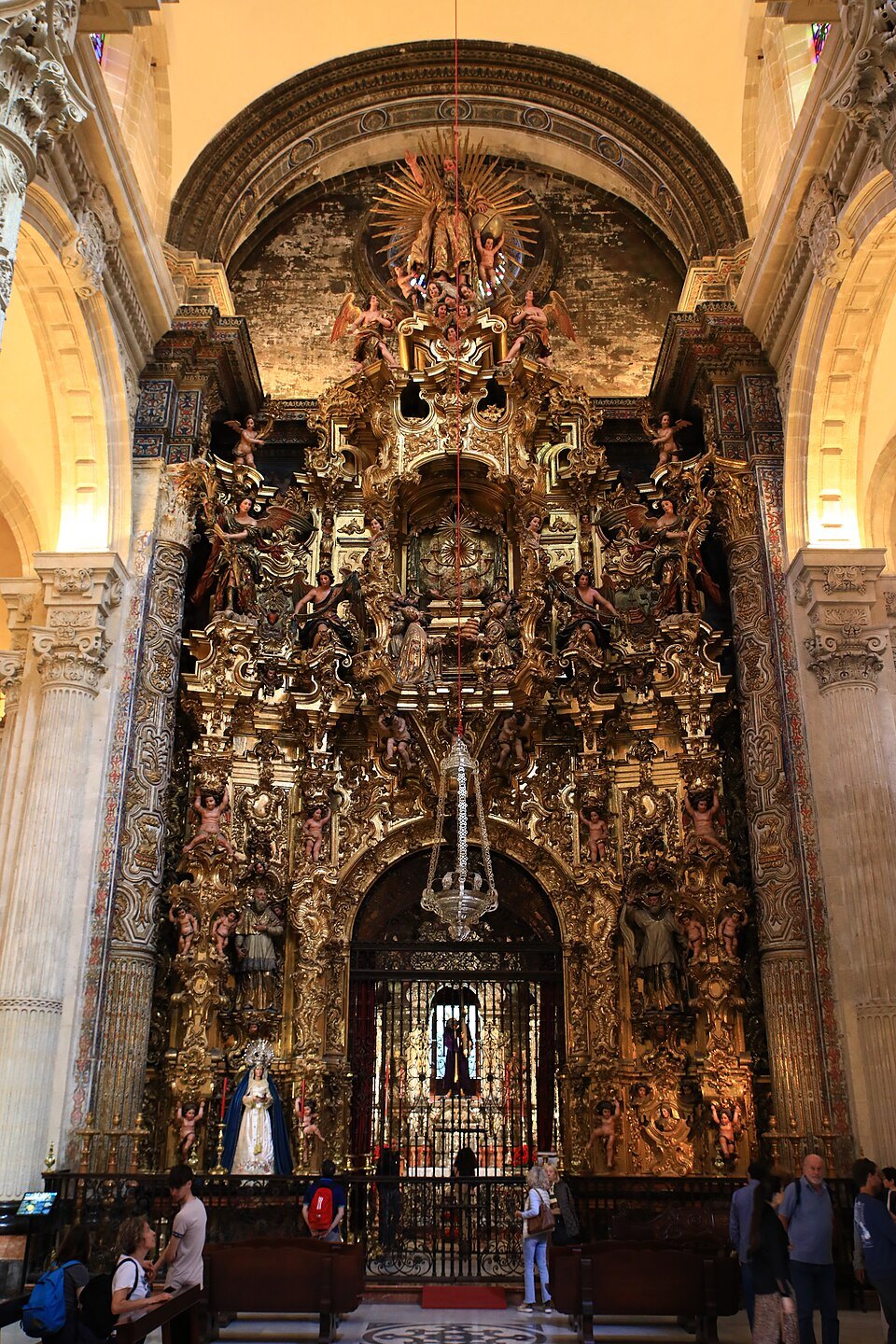
The interior is loud, gilded Baroque — a strong contrast with the cathedral's height and restraint a few minutes away.
The cathedral ticket often covers this too. Check before buying a second one.
Seville's first great mosque
This was the heart of Roman Seville, probably the site of a basilica on the forum, and the ground keeps the evidence: a Roman tombstone of the time of Augustus built into the old minaret, coins of Tiberius and Theodosius found in the foundations, and Roman capitals on the columns in the courtyard. Between March 11, 829, and February 27, 830, the qadi Umar ibn Adabbas built the city's main mosque here for the emir Abd al-Rahman II. A column shaft with its foundation inscription is now in Seville's Archaeological Museum. It remained the principal mosque until the Almohads opened their new one, on the site of today's cathedral, in 1182; the Almohad caliphs even closed it for a time to push people to the new building.
About 11 meters of the minaret survive as the base of the bell tower, a square of reused stone blocks nearly six meters a side. With the original mosque of Córdoba and the fortress at Mérida, it is one of the very few buildings left from the emirate of al-Andalus. An earthquake on August 24, 1356, brought down its upper part, which explains the pointed arches of the second stage, and Leonardo de Figueroa built the top in 1718–1719.
Church, collegiate church, parish
After the conquest of 1248 Ferdinand III turned the mosque into a church dedicated to the Divine Savior of the World and gave it an abbot and ten canons in imitation of the cathedral; it later became a collegiate church, one rank below a cathedral. The orientation was turned, a chapel to the Virgen de las Aguas was made where the mihrab had been, and the ablutions courtyard, with its fountain and arcades, became a cemetery and service rooms. Later chapels cut the courtyard down to two-thirds of its original size. The thirteenth-century Virgen de las Aguas, said to have been given by the king himself as the city's protector, was carried out in prayer processions for centuries in times of flood and drought.
Built twice
By the seventeenth century the old mosque was in ruins and sunk below the street, and the chapter decided in 1671 to build a new church. The first Baroque church went up in only five years, from 1674 to 1679, and on October 24, 1679, almost finished, it collapsed, leaving only the outer walls; its pillars, of mixed stone and brick, were too weak for the soft ground. The canons started again on the same plan, this time with pillars of solid stone on the advice of José Granados, the master of works of Granada cathedral. Leonardo de Figueroa took charge in 1696, closing the vaults, raising the dome and designing the interior, and the church was completed in 1712. The two towers planned for the facade were never built.
Inside, the church is a great hall of three naves with a transept, up to 34 meters wide, under an octagonal dome on a drum, with vaults rising to more than 24 meters. It holds 14 altarpieces. The high altar, by Cayetano de Acosta between 1770 and 1778, is an explosion of gilded wood around the Transfiguration, ringed by archangels. Look too for Juan de Mesa's Cristo del Amor of 1620 and Martínez Montañés's Jesús de la Pasión of 1615, both still carried in Holy Week processions. The stained glass was a gift of the Dukes of Montpensier.
Restored
El Salvador lost its collegiate status in 1852 and became a parish. With the canons gone, the choir in the middle of the nave was taken out in 1861 because the faithful could not see the altar, and the organ was moved above the main door. Having lost its property to the confiscations of church land, the church had no money for upkeep; after the Marquis of la Vega-Inclán's work on the orange-tree courtyard in 1918, almost nothing was done until 1987, when the Andalusian government began small repairs to keep it open. After a long restoration from 2003 led by the architect Fernando Mendoza, it reopened on October 22, 2008, in the presence of King Juan Carlos I. Members of the Bourbon-Two Sicilies family, the king's grandfather among them, are buried in its crypt.
Sources
- Collegiate Church of El Salvador: history — Catedral de Sevilla (official)
- Iglesia del Salvador (Sevilla) — Wikipedia (es)
Iglesia del Salvador, photographed