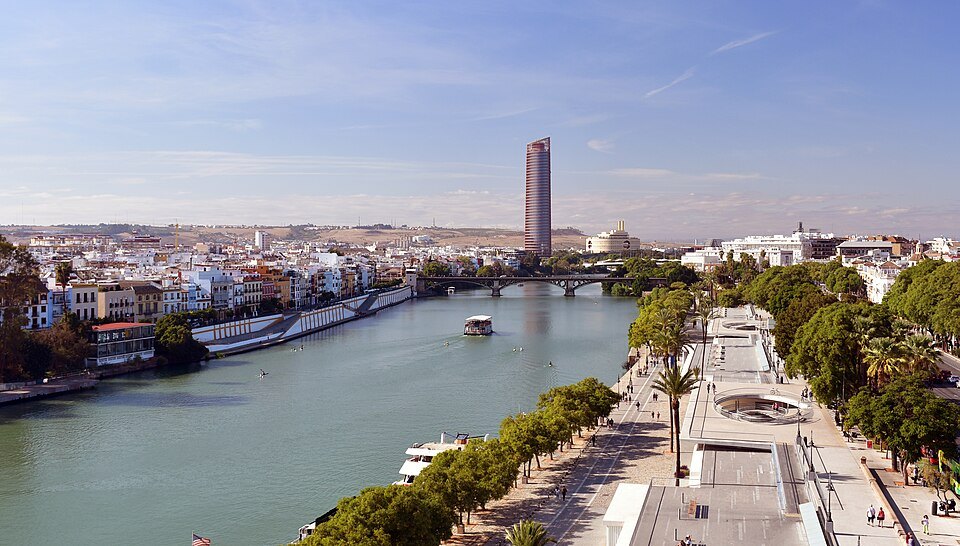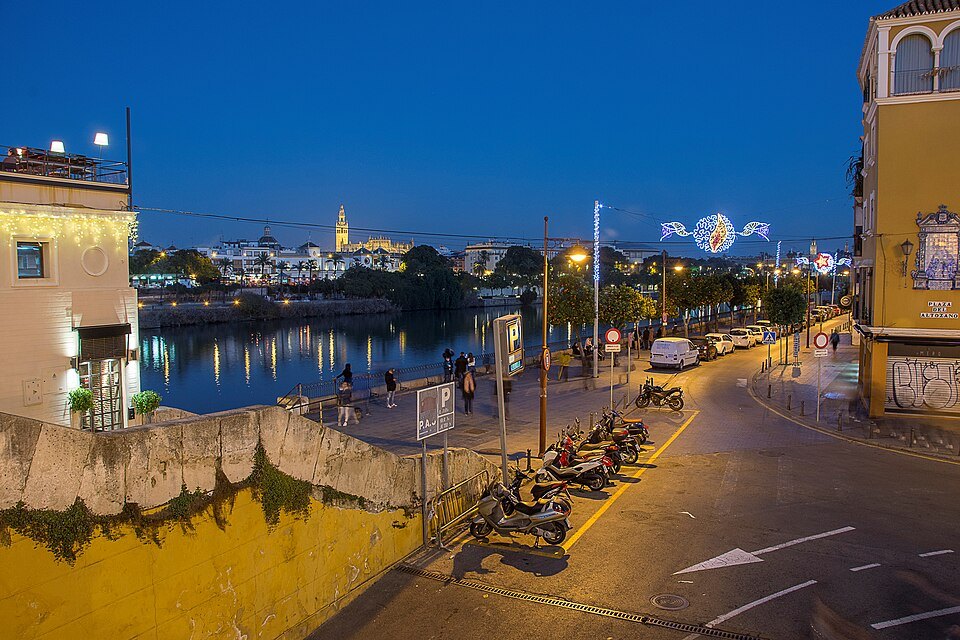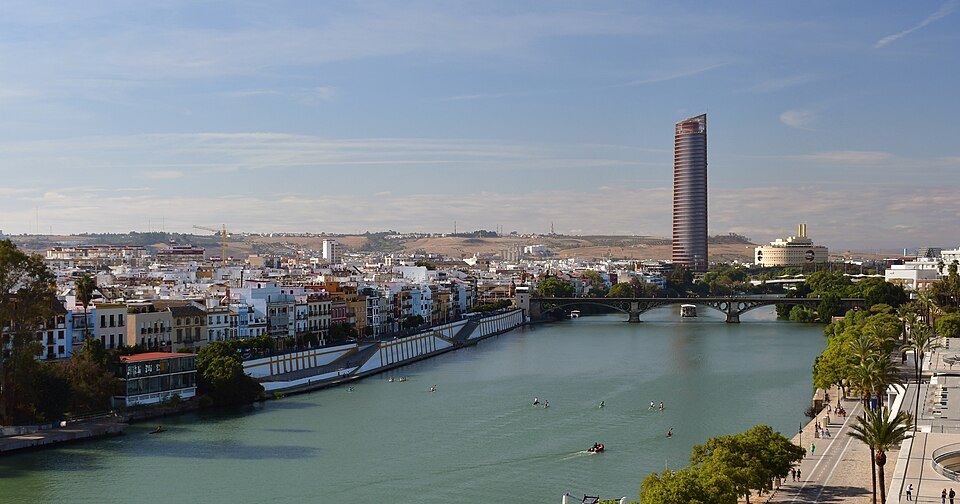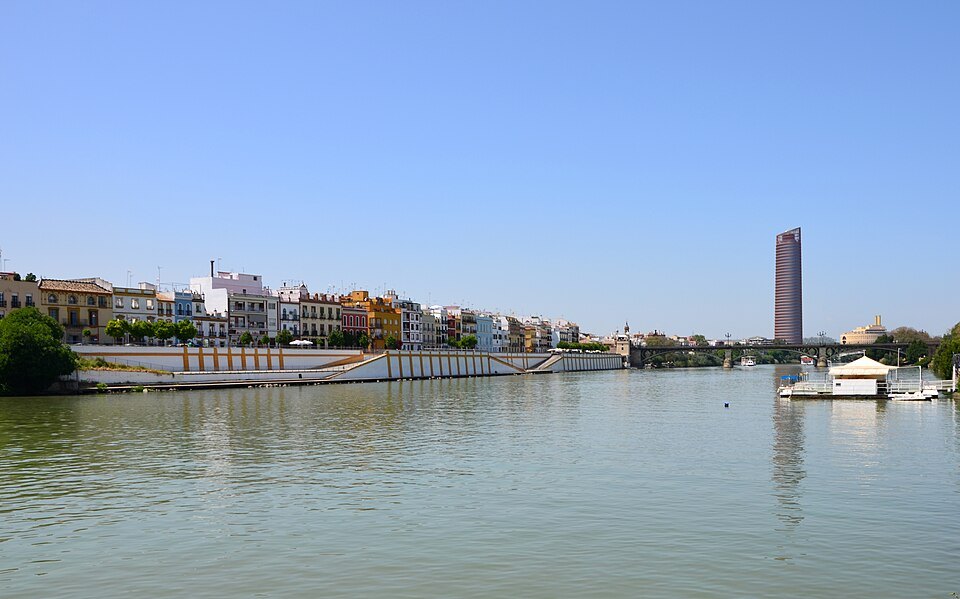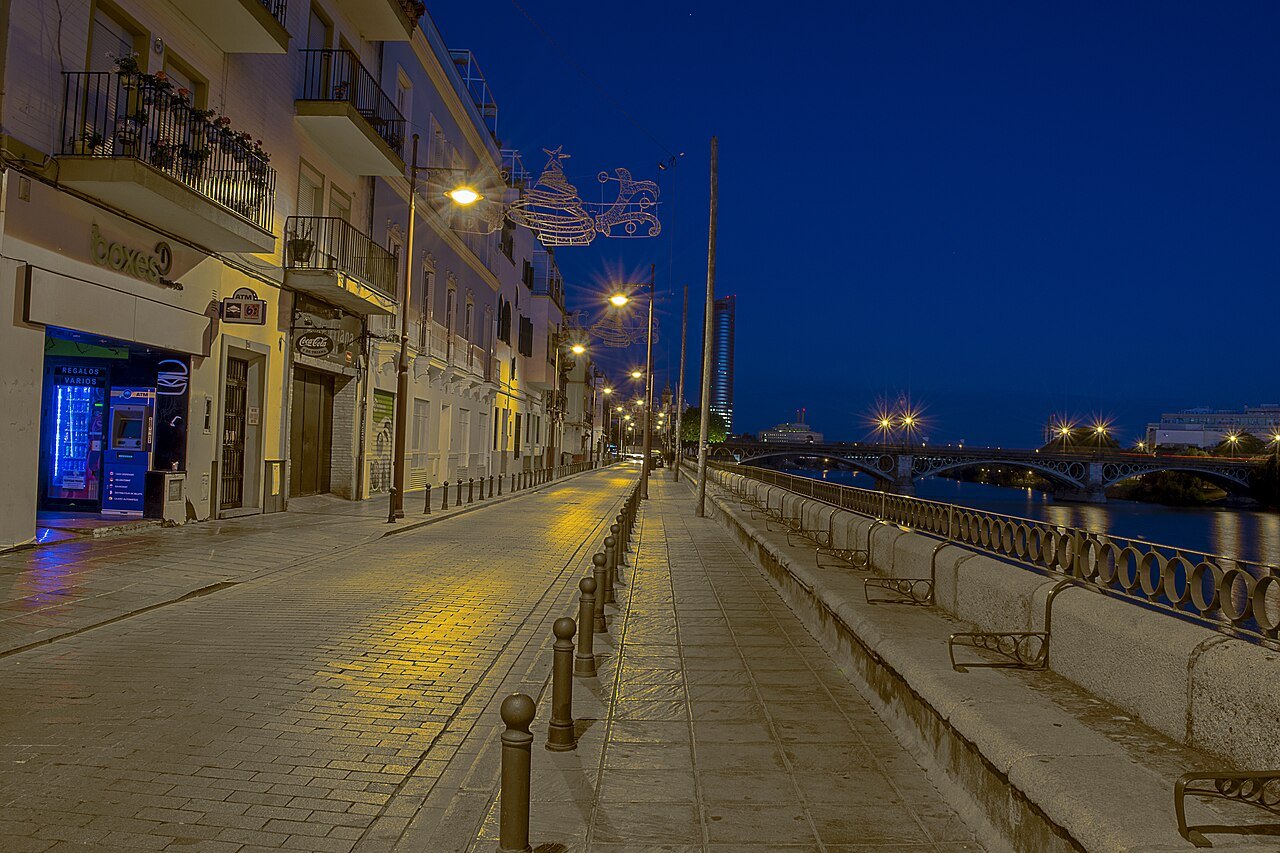
Triana sits on the far bank and thought of itself as separate for most of its history — a district of sailors, potters and flamenco families. Several of the forms and several of the names came from these streets.
⭐ The ceramic tradition is still working. Tile workshops and shopfronts line Calle Alfarería and Calle Antillano Campos, and the tiles on the buildings are advertisements for what is made inside.
The Mercado de Triana is built on the foundations of the castle of San Jorge, which housed the Inquisition — the excavated remains are underneath and open.
Cross at sunset for the view back at the city, then eat in Triana rather than returning.
Beyond the river
Triana lies on the west bank of the Guadalquivir, on a peninsula between two branches of the river. Its name has three competing explanations: a legend that it was founded by the emperor Trajan, born at nearby Itálica, as Trajana; a mix of Latin tri, three, and Celtiberian ana, river, for the three branches the river once split into here; or the Latin trans amnem, "beyond the river". Its people, the trianeros, still feel distinct from the rest of Seville, and like other districts outside the walls it was long known as an arrabal, a suburb.
There were settlements here in Roman times, and under Muslim rule the district grew around a castle built in the tenth century, the last defense of Seville to the west and the gateway to the farmland of the Aljarafe. In 1171 the caliph Abu Yaqub Yusuf joined it to the city with a bridge of boats, and Triana flourished. Its strategic role was such that Ferdinand III made a point of taking the castle and the bridge before Seville fell in 1248.
The castle of the Inquisition
Under Castilian rule the castle became the first Christian church in Triana, as the seat of the Order of Saint George, and took the name Castillo de San Jorge. In 1481, under the Catholic Monarchs, it became the headquarters of the Spanish Inquisition, which stayed until 1785. Its foundations now lie under the Triana market, built in 2005 in a Moorish Revival style at the end of the bridge, and they house a museum on the history of the Inquisition. The narrow Callejón de la Inquisición still runs down to the river nearby.
Being on the river, Triana flooded again and again, with no levees to hold the water back; its people took refuge in the castle and in the church of Santa Ana, and the worst floods came in 1435, 1440, 1545 and 1554. Only the re-engineering of the river in the second half of the twentieth century ended the danger.
Sailors, potters and flamenco
Triana was the home of sailors and potters, builders and craftsmen, and of many bullfighters and flamenco singers and dancers. It also had a large Roma community, concentrated in the street called Cava de los Gitanos, now Pagés del Corro, which was displaced by redevelopment in the 1970s. Many families lived in corrales, buildings of single rooms opening onto a shared patio with a fountain; most were lost to development in the late twentieth century, and the survivors, such as those at numbers 8–10 and 85 Calle Alfarería, are protected as cultural and ethnographic heritage.
The pottery tradition is best explained at the Centro Cerámica Santa Ana, opened in 2014 in part of the old Santa Ana tile factory, a Moorish Revival building on Calle San Jorge, with a section on Triana's people and traditions.
Coming off the bridge you land in the Plaza del Altozano, the traditional gateway to Triana, with modern monuments to the bullfighter Juan Belmonte and to the art of flamenco. From it the pedestrian Calle San Jacinto runs west past the church of San Jacinto, built for the Dominicans in 1676, while Calle Pureza leads south past the Casa de las Columnas, once home to the Universidad de Mareantes, the school that trained sailors for the voyages to the Americas.
Churches and festivals
The church of Santa Ana, which trianeros call their cathedral, was the first church built in Seville after 1248, on the orders of Alfonso X, in a mix of early Gothic and Mudéjar, and it has a painted altarpiece by Pedro de Campaña. Nearby are the Baroque church of Nuestra Señora de la O, built between 1697 and 1702; the Capilla de los Marineros, home of the Esperanza de Triana; and the basilica of El Cachorro, whose dying Christ, tradition says, was modeled by Francisco Antonio Ruiz Gijón on a Roma man known as El Cachorro whom he saw dying after a stabbing. Both images lead some of the best-loved processions of Holy Week. From July 21 to 26, the Velá de Santa Ana fills Calle Betis, the riverfront street, with sherry, sevillanas and grilled sardines; it dates from the thirteenth century and its high point is the cucaña, a scramble along a greased pole over the river.
Sources
Triana, photographed