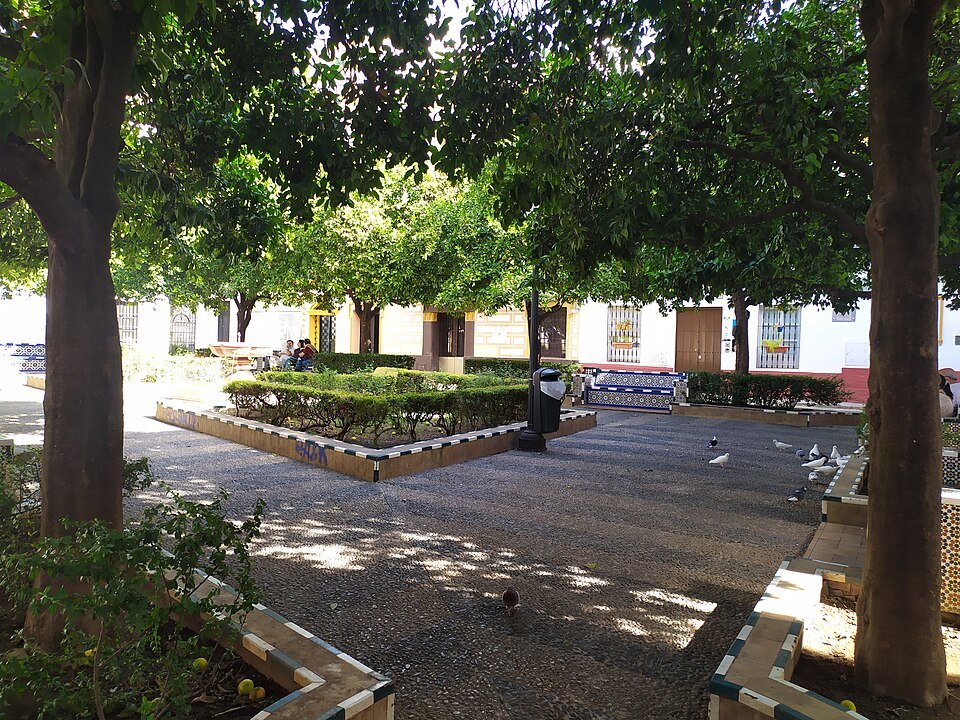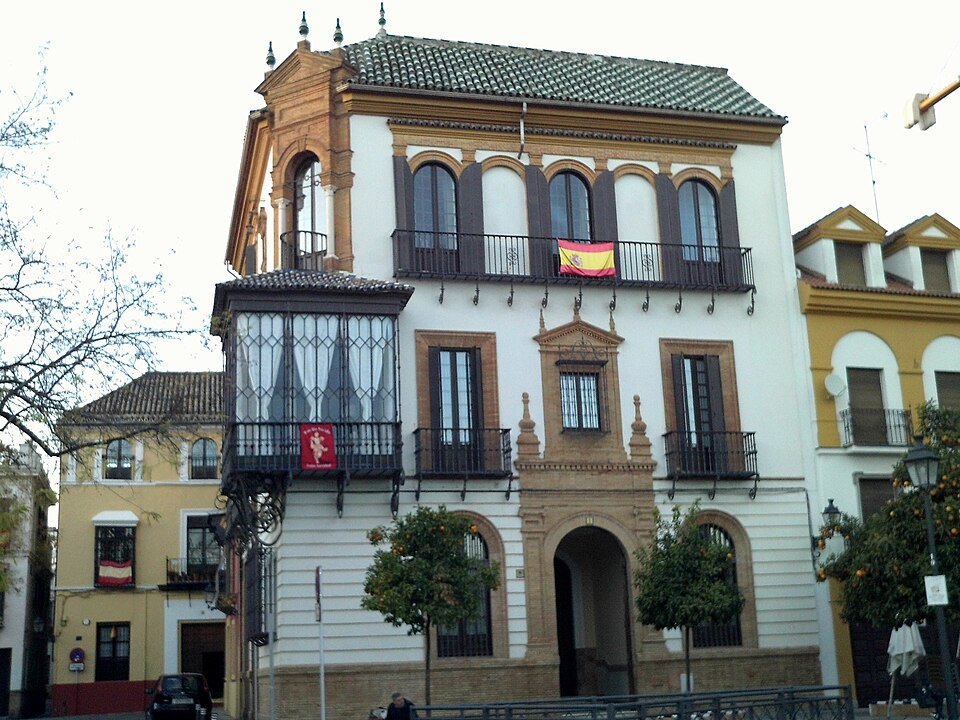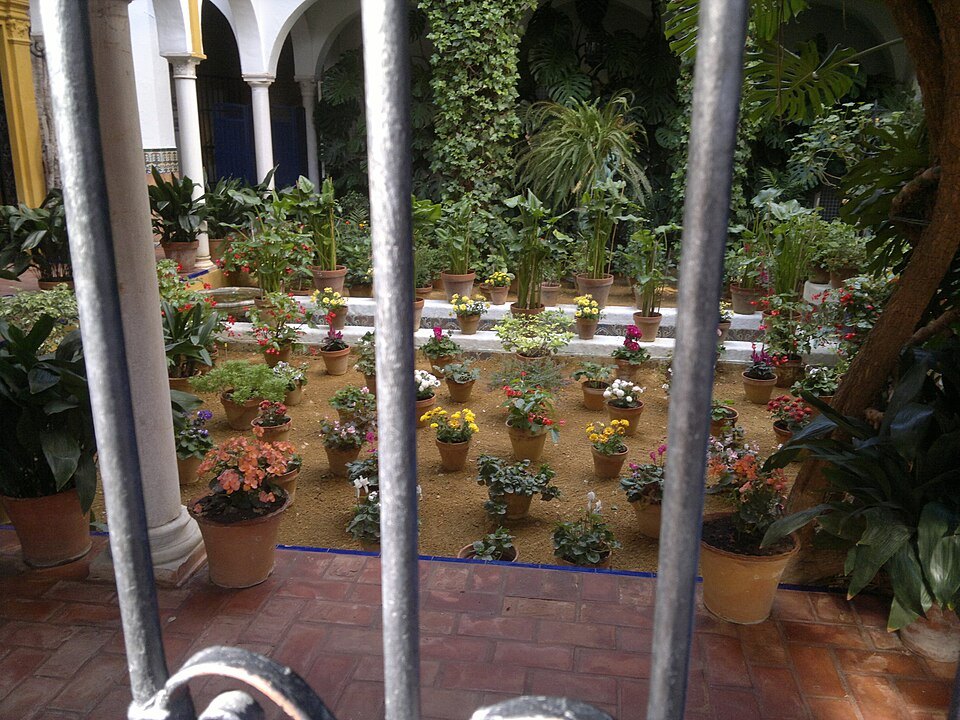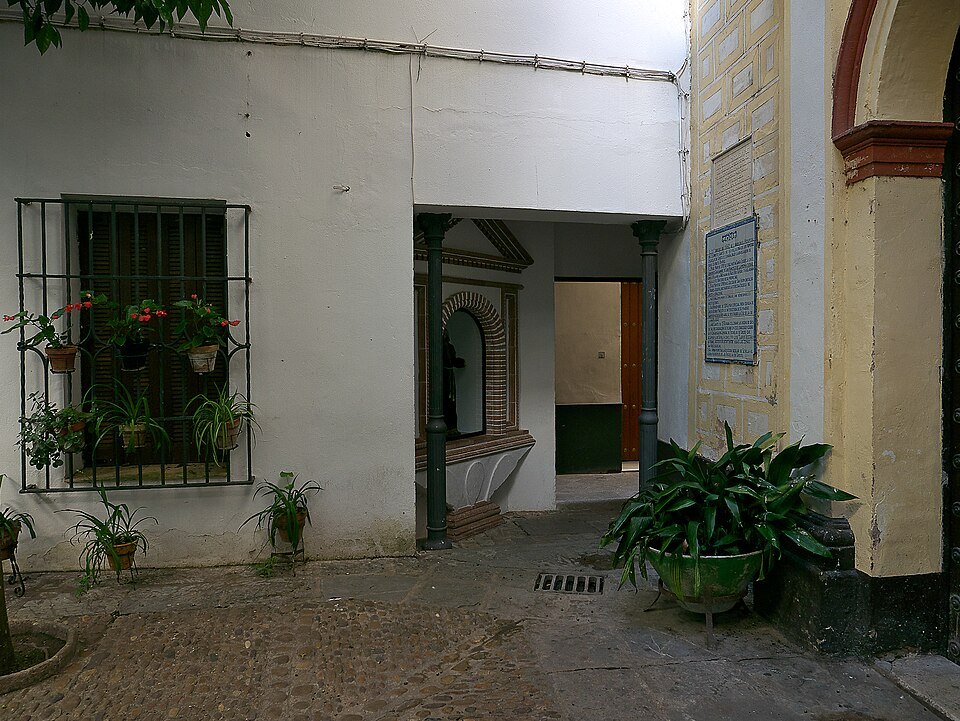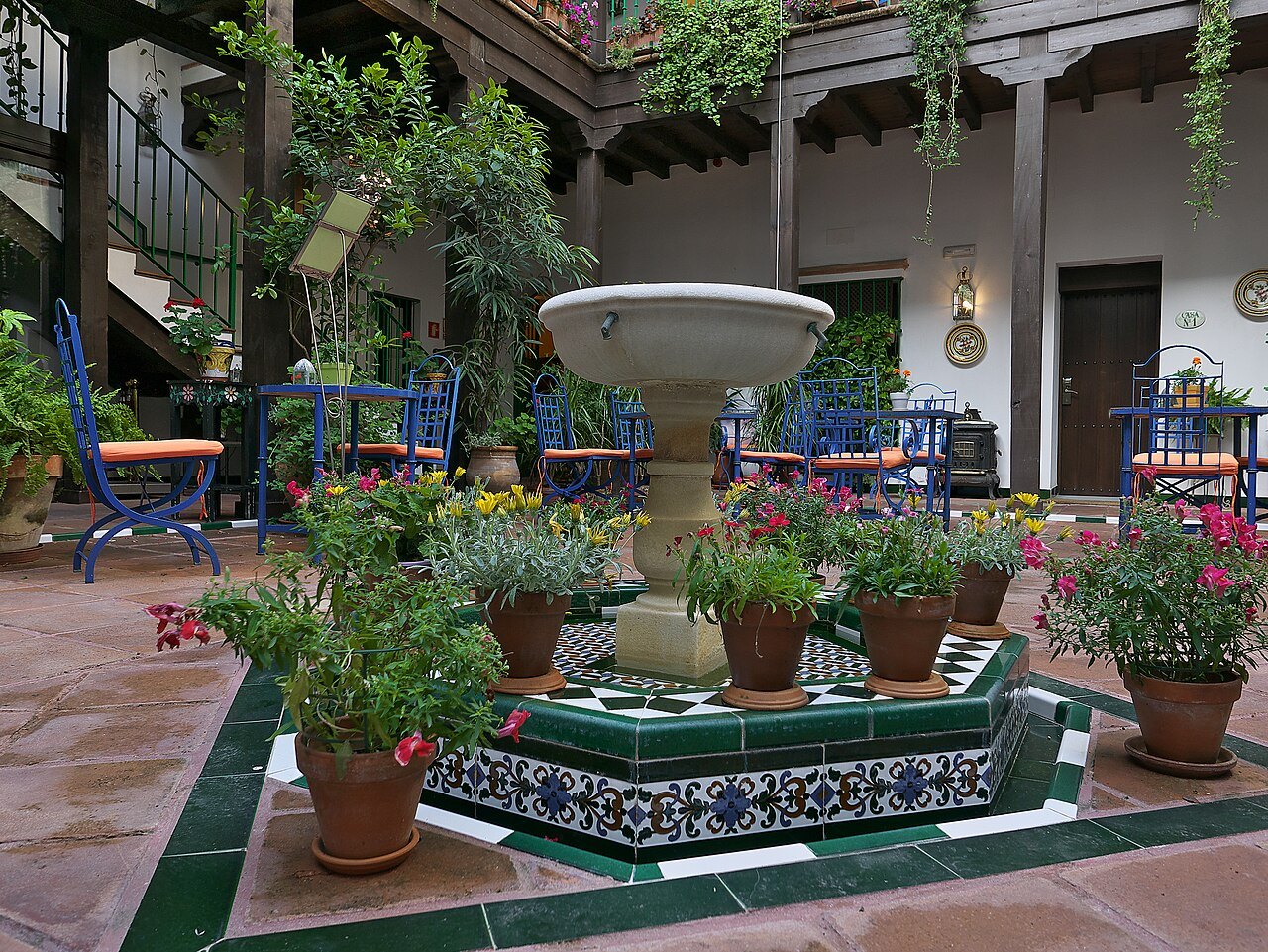
Santa Cruz was part of Seville's judería until the pogrom of 1391, and its tangled plan is medieval, though its look was largely remade in the 1910s: lanes narrow enough to touch both walls, small squares appearing without warning, orange trees and iron grilles.
⭐ The narrowness is functional, not picturesque — it is how you keep a street shaded in a city this hot. Walking it at midday is noticeably cooler than the open plazas.
⚠️ It is also directly beside the cathedral, so the outer lanes are wall-to-wall menus. Walk further in; the difference in price and quality over two hundred meters is remarkable.
Get deliberately lost, and eat at least four streets from the cathedral.
The Jewish quarter
When Ferdinand III took Seville in 1248, he settled the city's Jews in the area that is now Santa Cruz and San Bartolomé, and gave them three mosques to use as synagogues, a grant Alfonso X confirmed in 1252. It became the second most important Jewish community in Spain after Toledo's, and some of its members stood close to the Castilian kings: Judah Abravanel, founder of the famous Abravanel family, at the court of Ferdinand IV, or Samuel ha-Leví, treasurer to Pedro I. The community's cemetery lay out where the Calle Cano y Cueto and the Paseo de Catalina de Ribera are now.
The anti-Jewish riots of 1391 destroyed the community. The synagogues were turned into churches — San Bartolomé, Santa María la Blanca and the old church of Santa Cruz — and the oratory of the convent of Madre de Dios had been a synagogue too. In 1483 an edict of the Inquisition expelled the Jews from the dioceses of Cádiz, Seville and Córdoba, nine years before the general expulsion from Spain. Santa María la Blanca, just outside the quarter, is still recognizably a converted fourteenth-century synagogue.
Older than the Jewish quarter
Long before that, this corner was the edge of Roman Hispalis: the city wall ran here, and the main street, the cardo maximus, followed today's Calle Abades and Calle Don Remondo. Beside it stood a temple of the second century, three of whose columns survive in Calle Mármoles. There were six in the Middle Ages; Pedro I tried to move one to the Alcázar and it broke on the way, and in 1576 two more were taken to the Alameda de Hércules, where they still stand.
At the quarter's southern edge, inside the Alcázar walls, the Patio de Banderas is a public square named for banners once painted over its gate. In the 1970s the remains of a Christian basilica, possibly of the fourth century and used in Roman and Visigothic times, were found beneath it.
Murillo's square
The neighborhood takes its name from the church of the Holy Cross, a Mudéjar church built over a synagogue on what is now the Plaza de Santa Cruz. The French, who occupied Seville from 1810, closed it, and it was pulled down in 1814; the parish moved to the church of a seventeenth-century convent in Calle Mateos Gago, which now holds a Last Supper by Bartolomé Esteban Murillo. Murillo, who lived in the quarter, had been buried in the demolished church, and the Academy of Fine Arts put up a plaque in the square in 1848. The square was redesigned in 1918 by Juan Talavera y Heredia, with a seventeenth-century wrought-iron cross, the Cruz de la Sierpes, in the middle.
A village made for visitors
What you walk through today is partly a creation of the early twentieth century. Between 1912 and 1920 the Marquis of la Vega-Inclán, the royal commissioner for tourism, set out to give the quarter "local color": Andalusian-style squares were laid out and paved with bricks set on edge, and fountains, tiles, plants and climbing vines on the old wall were added, with the architect Juan Talavera y Heredia doing much of the work. The Plaza de Doña Elvira, on the site of an old playhouse, was laid out in 1826 and remade in 1924. The same campaign stopped a planned avenue that would have cut straight through the quarter and swept away several of its streets and squares. Next to it, the Murillo Gardens were created on part of the old Alcázar orchard between 1911 and 1917.
The result is one of the most visited places in Seville, so popular that the neighborhood has been declared saturated with tourist apartments and new licenses are restricted. Calle Mateos Gago, on its northern edge, was the street of the shoemakers in the thirteenth century and owes its present width to a widening of 1923. In Calle Santa Teresa stands the convent of Discalced Carmelites founded by Teresa of Ávila in 1575 and moved there by Saint John of the Cross in 1586.
Sources
Barrio de Santa Cruz, photographed