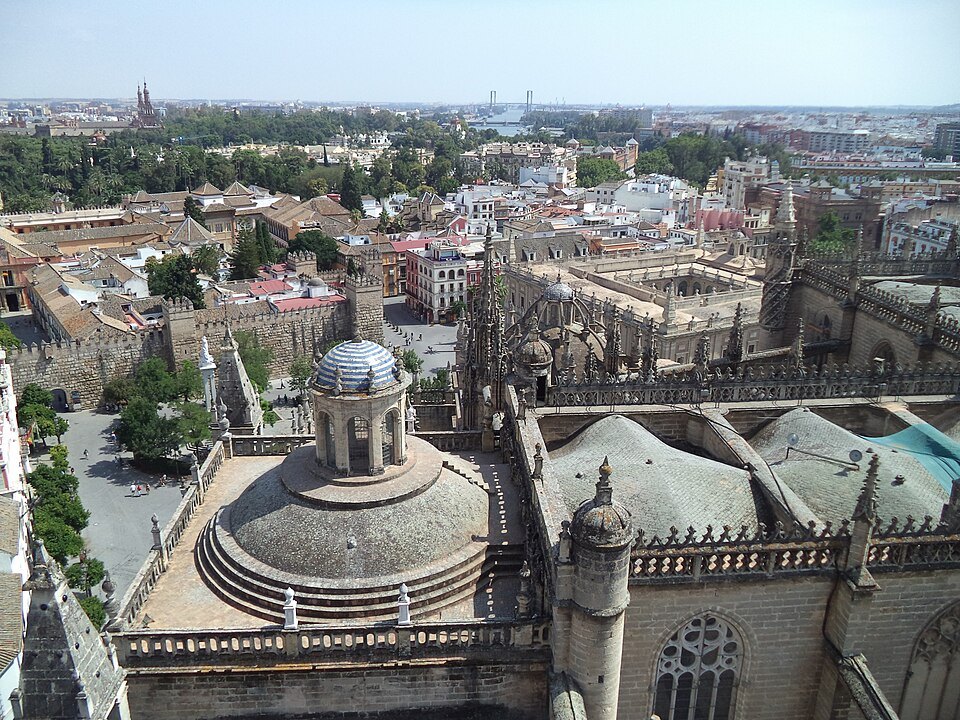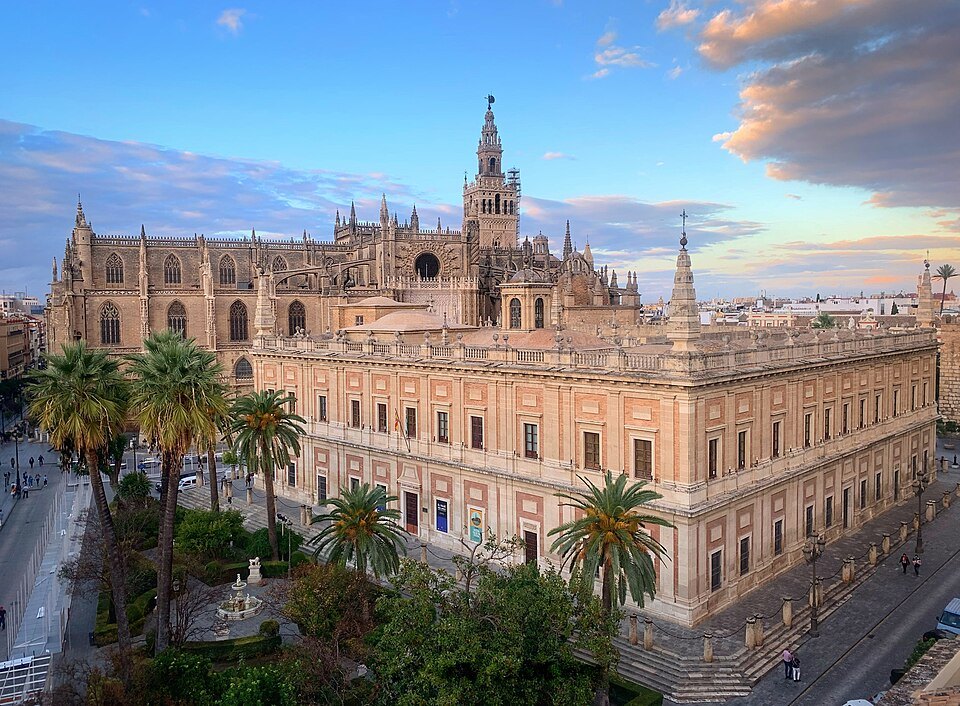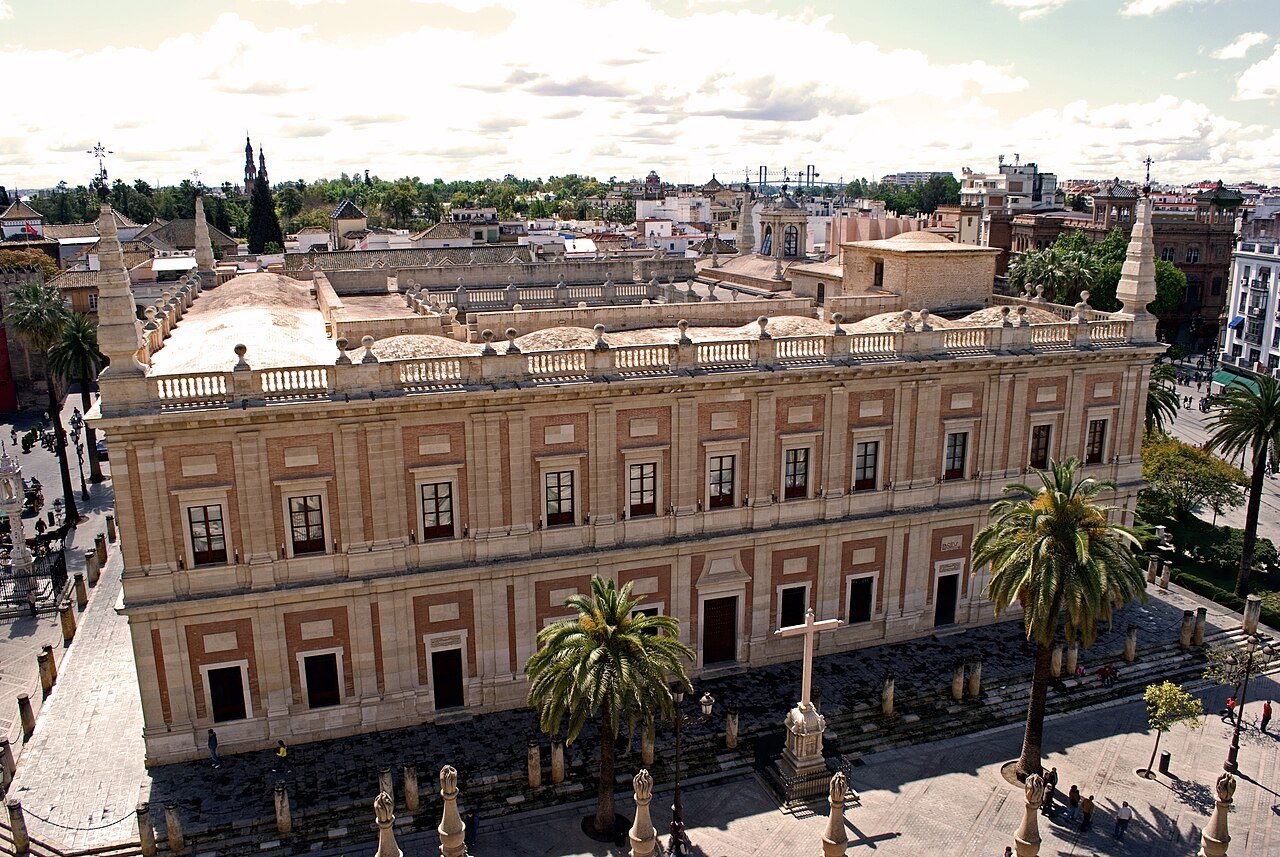
The building was the Lonja, built in the 16th century so that merchants would stop doing business in the cathedral. In the 18th century it became the repository for the records of Spain's American empire, which is what it still is.
⭐ It is free, it is rarely busy, and the staircase and upper gallery alone justify walking in. The displayed documents rotate.
⚠️ Most of the holdings are not on show and are not meant to be — this is a working archive used by researchers. Come for the building and take the exhibition as a bonus.
It is thirty seconds from the cathedral and it costs nothing. There is no reason to skip it.
Merchants on the cathedral steps
After 1492, and once the Casa de Contratación was set up in the Alcázar in 1503 to run trade with the Americas, Seville filled with wholesale merchants trading across the Atlantic. They organized themselves into a guild with its own commercial court in 1543, but they had nowhere to meet. They did business on the steps of the cathedral, and in the heat they moved inside it, even holding their elections there. On April 24, 1572, the archbishop wrote to Philip II to complain, and a month later the king announced he would build the merchants an exchange of their own.
Philip II chose the plans of Juan de Herrera, the architect of the Escorial, over a design put forward by the city. Work began in 1583 on land taken from the Alcázar's smithies and the old mint, paid for by a tax on goods entering and leaving the city. Juan de Minjares directed the building to 1599; an inscription over the central door facing the cathedral gives August 14, 1598, though only that side was finished. Money ran short after 1601, work resumed in 1609 under Miguel de Zumárraga, and Pedro Sánchez Falconete completed the building in 1646.
Zumárraga changed the design as he went, replacing wooden ceilings with shallow domed vaults, and in 1611 the merchants asked for two extra doors on either side of the central door on each facade. Outside, on the north side, stands the Cruz del Juramento, a stone cross inside an iron railing that stood for the merchants' habit of sealing deals by their word. In 1717, when the House of Trade and the merchant guild moved to Cádiz, the building lost its main purpose.
A severe Renaissance box
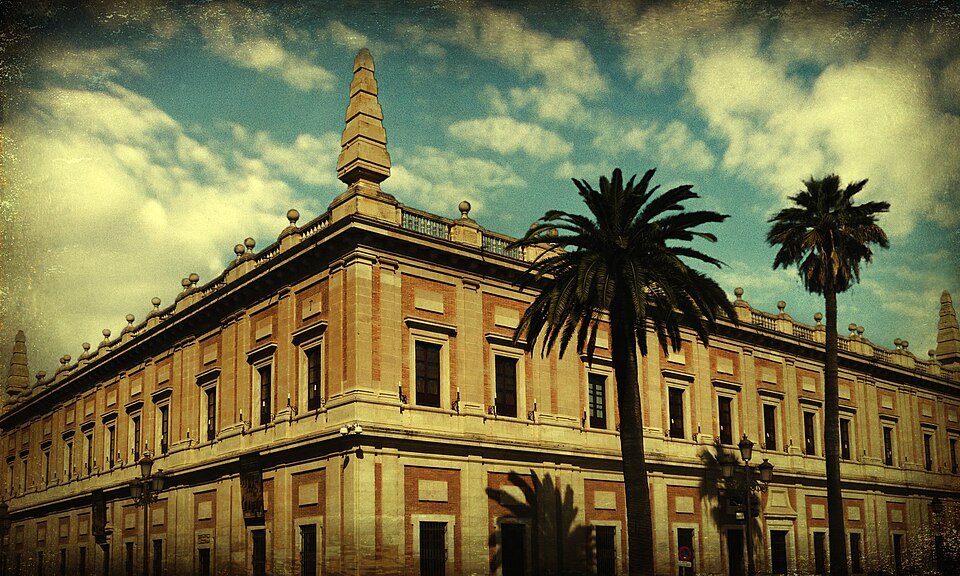
The Lonja is a square of two stories around a large central courtyard. It has almost no sculpture: the effect comes from the contrast between stone and plaster, flat pilasters framing slightly sunken window panels, plain square tablets floating above the windows, and a balustrade along the roof with obelisks at the corners. It is one of the purest examples in Spain of the Italian-influenced Renaissance style that Herrera brought to the court of Philip II.
Its life as an exchange was short. After the devastating plague of 1649 the merchants seem to have abandoned it by 1660; from 1660 to 1674 Bartolomé Esteban Murillo ran a painting academy in one of its rooms, and by the eighteenth century the upper floor had been divided into apartments.
The archive of an empire
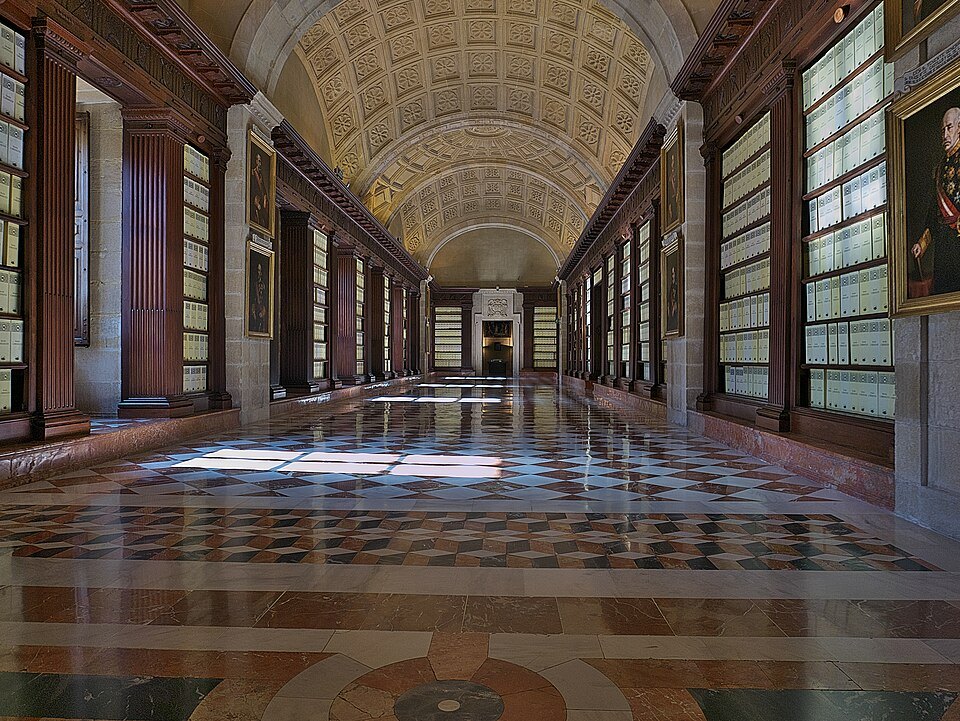
In 1784 the historian Juan Bautista Muñoz, who was trying to write a history of the New World, proposed a single archive for all the documents about the Americas, then scattered between Simancas, Cádiz and Seville. He toured the Lonja that May and wrote that it was solidly built of stone and big enough; the apartments only needed clearing out. Charles III approved the plan in February 1785 and the first carts of documents arrived in October 1785. Eleven families living upstairs were moved out; later additions were stripped away, walls and vaults blackened by kitchen smoke were cleaned, the floors were laid in marble and the skirting and stairs faced with jasper from Málaga, and the partitions were removed to make a single U-shaped gallery, lined with shelving of fine woods made by Blas Mölner and finished in June 1788. The grand marble staircase you climb today was added in 1787.
The archive holds some 43,000 bundles of documents and about 8,000 maps and drawings, filling roughly nine kilometers of shelving, produced by the Council of the Indies, the House of Trade, the merchant guilds of Seville and Cádiz and the other offices that governed Spain's territories in the Americas and the Philippines, from the first conquistadors to the end of the nineteenth century. Among them are the papal bull Inter caetera dividing the New World, the journal of Christopher Columbus, Miguel de Cervantes's application for a post in the Indies, and plans of colonial cities. The building was thoroughly restored in 2002–2004 without closing to researchers, and much of the collection has been digitized and can be consulted online. In 1987 it became a UNESCO World Heritage Site with the cathedral and the Alcázar.
Sources
Archivo de Indias, photographed