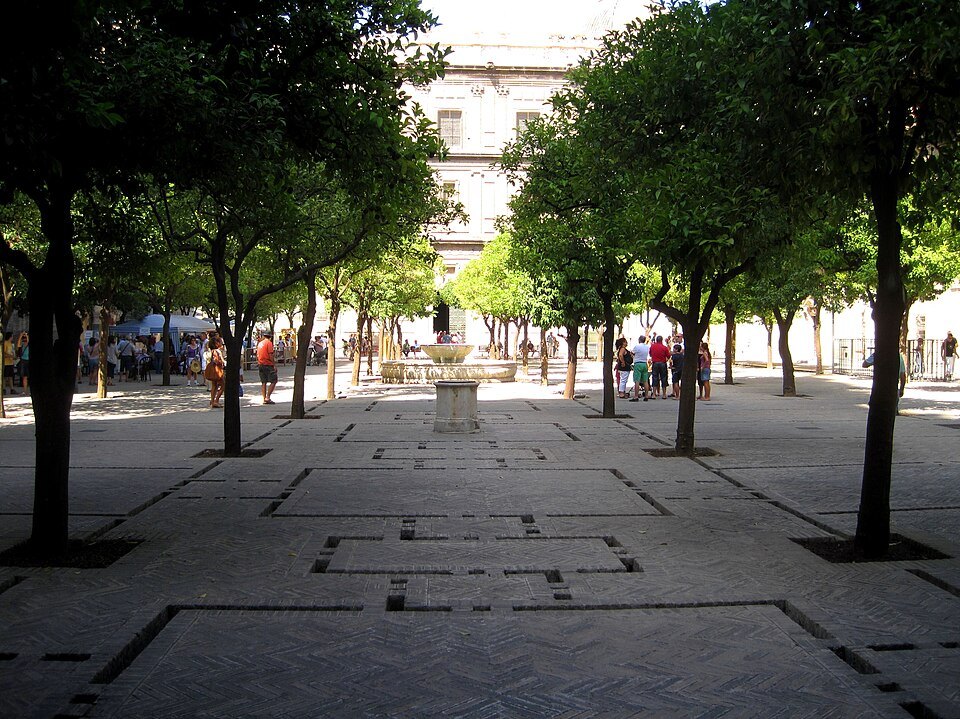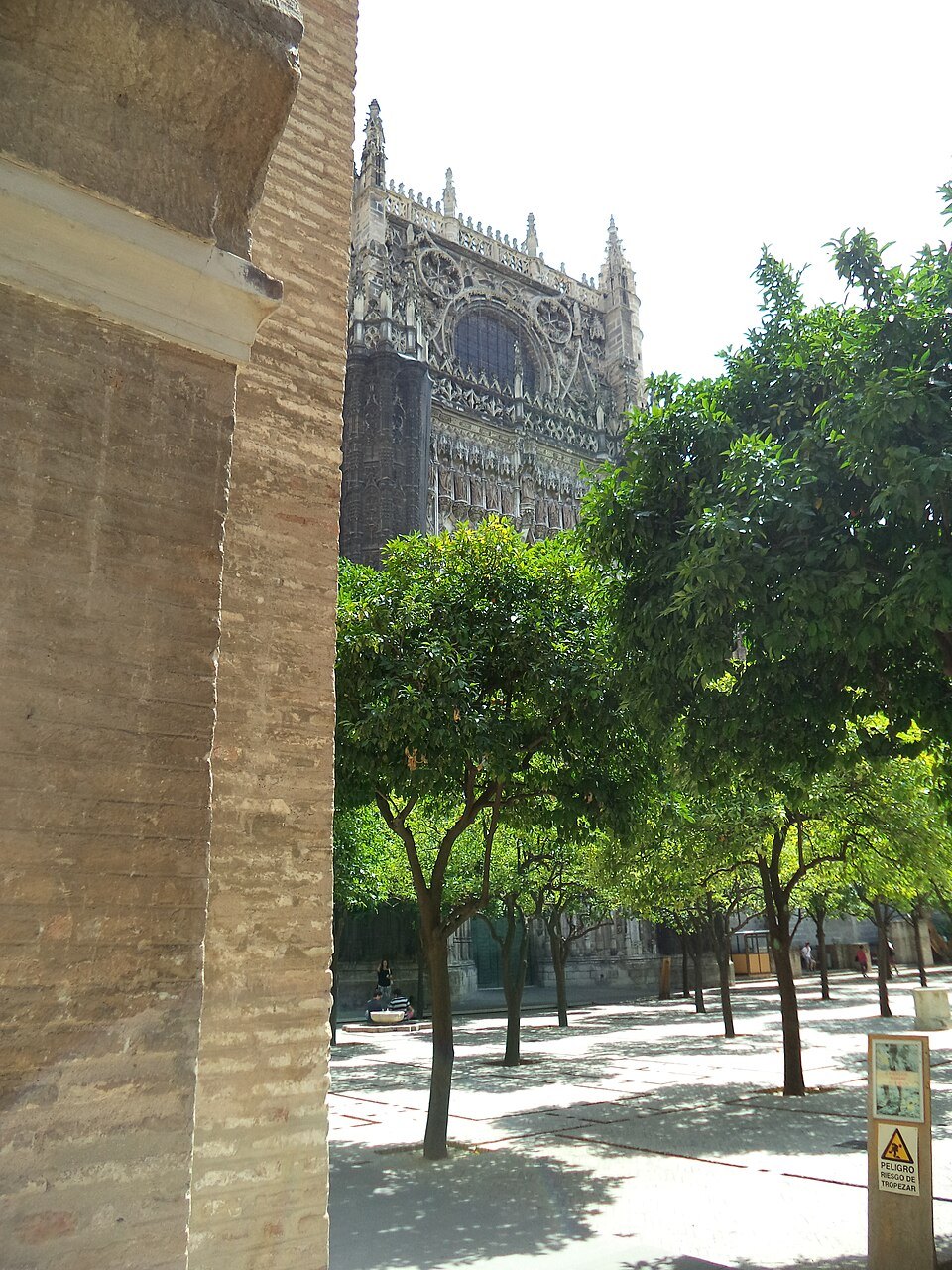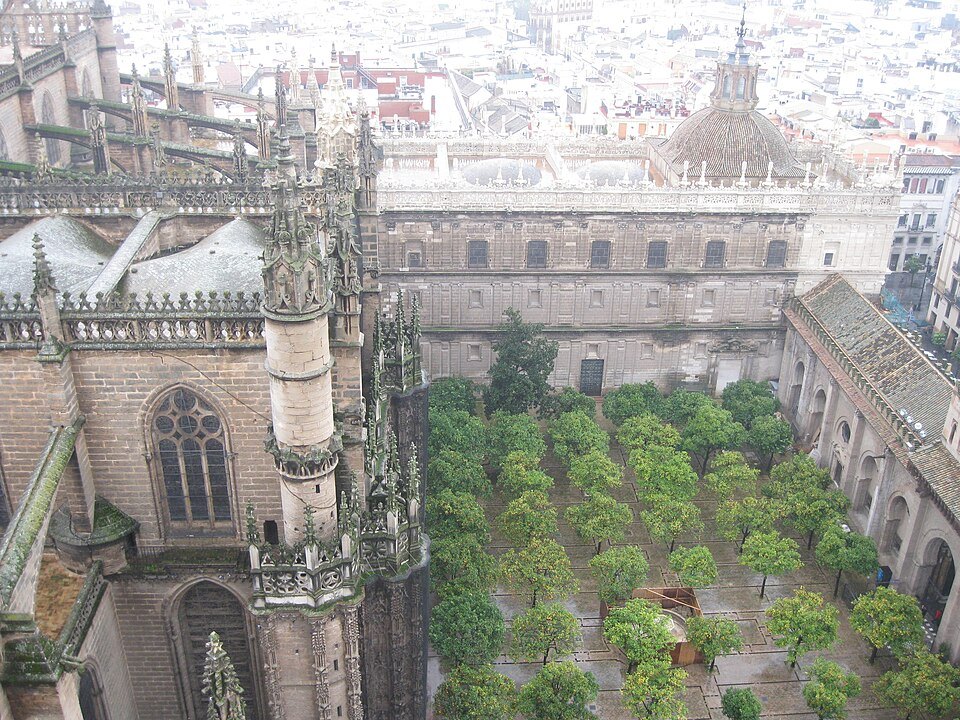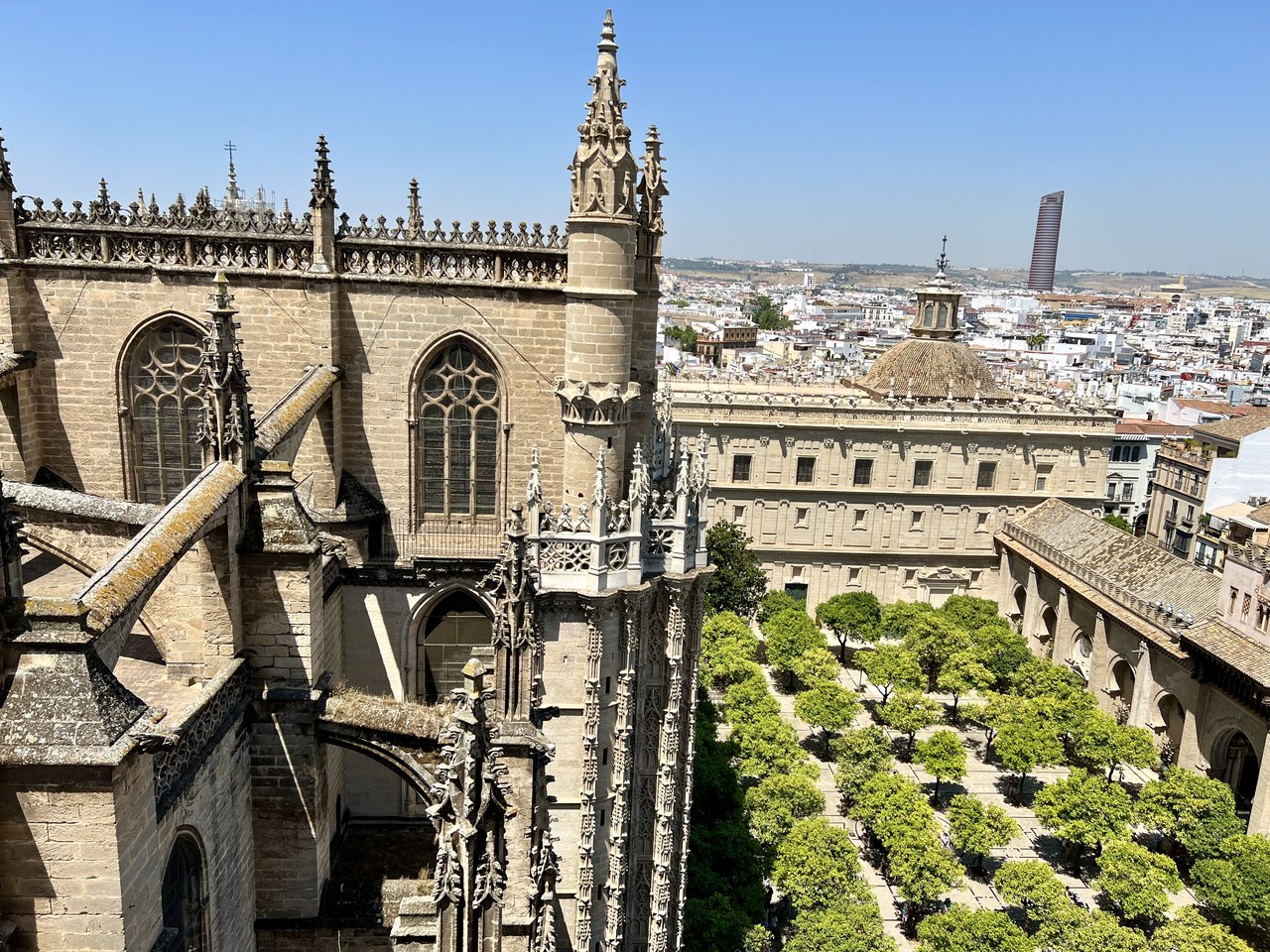
This is the surviving courtyard of the Almohad mosque, and its geometry is the mosque's rather than the cathedral's. The orange trees are planted on a grid, and the irrigation channels between them still run.
⭐ The fountain at the center is older than everything around it — a reused Visigothic basin, in place for the ritual washing that preceded prayer.
It is the one part of the complex where the building that stood here first is still legible as a plan rather than as a fragment.
Stand at the corner and look along the rows rather than across them. The grid only reads from the diagonal.
The mosque's courtyard
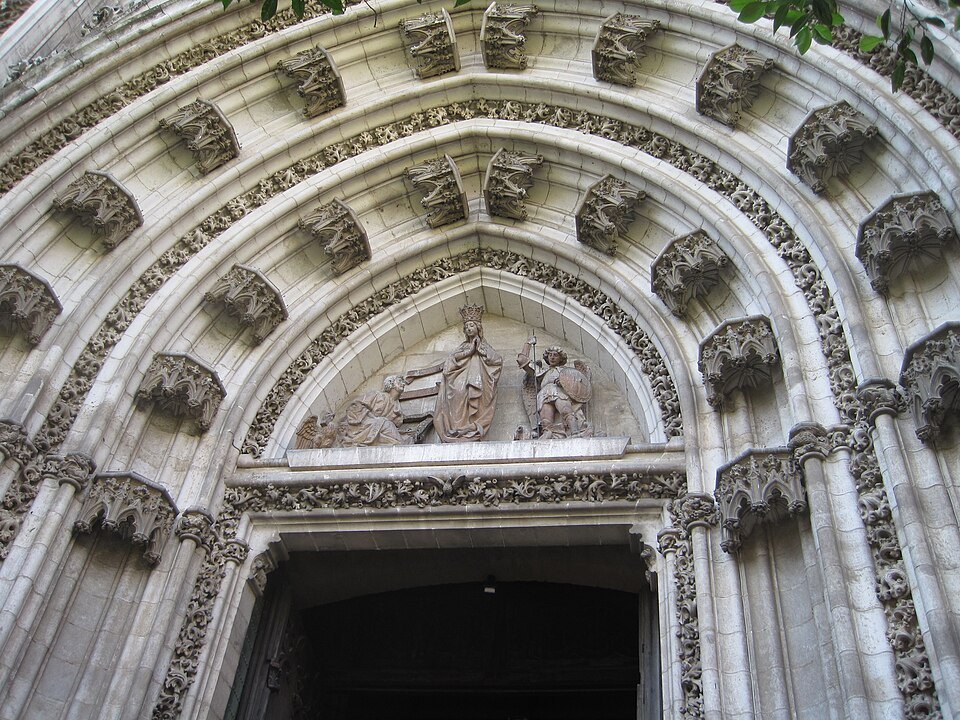
The Patio de los Naranjos was the sahn of the Almohad great mosque, the courtyard where the faithful washed before entering the prayer hall. It was built between 1172 and 1186 as a rectangle of 43 by 81 meters. Its short sides were originally lined with seven paired arches and its long sides with thirteen, in two runs of six either side of a great central arch. The prayer hall of the mosque stood where the cathedral's Door of the Conception now opens onto the courtyard.
After the Christian conquest of 1248 the courtyard took on other lives: it served as a cemetery, as the ground for the city's annual fairs and as a place for preaching. Over the centuries it lost much of its original character. In 1618 its west wing was pulled down to build the Baroque church of the Sagrario, which now fills that side, with an altarpiece carved by Pedro Roldán. Today it is fully absorbed into the cathedral and is no longer used for worship.
The Door of Forgiveness
From Calle Alemanes you enter through the Puerta del Perdón, which was the main entrance of the mosque in the twelfth century and is not strictly a door of the cathedral at all. It keeps its pointed horseshoe arch and its wooden doors sheathed in bronze, decorated with interlacing, plant ornament and Kufic inscriptions repeating two verses of the Quran, "Power belongs to God" and "Eternity belongs to God", with two cast and chased bronze knockers; the originals are now displayed inside the Giralda. In the early sixteenth century the gateway was dressed in terracotta sculpture by Miguel Perrin, with a large relief of Christ driving the merchants from the temple over the arch, and plasterwork by Bartolomé López dated 1522. It was restored in a project completed in January 2015.
The lizard and the library
In the covered gallery on the cathedral side hangs the lizard that gives the Door of the Lizard its name, an old votive offering that is in fact a stuffed crocodile. In the northeast wing of the courtyard is the Biblioteca Colombina, which unites the library given by Hernando Colón, the son of Christopher Columbus, with the cathedral chapter's own library and archive. Its manuscripts include Columbus's own Book of Prophecies, written in 1504, and the Cancionero de la Colombina, a songbook of the late fifteenth century.
Sources
- Patio de los Naranjos (Sevilla) — Wikipedia (es)
- Catedral de Sevilla — Wikipedia (es)
- Giralda — Wikipedia
Patio de los Naranjos, photographed