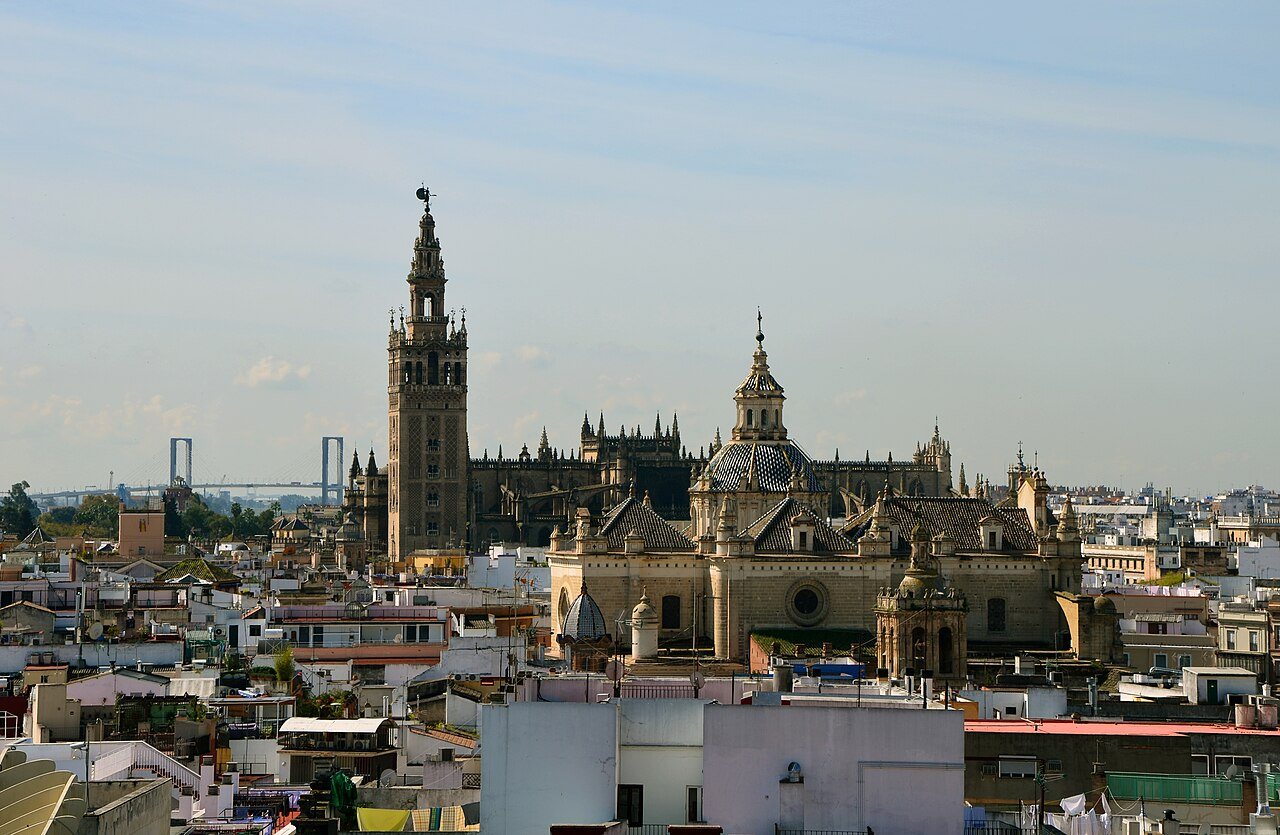
Walk north from the cathedral through the tangle of Santa Cruz and the shopping crowds of Calle Sierpes, and the city changes its mind about itself. Plaza de la Encarnación opens up, and overhead sits a structure that looks like nothing else in Seville: six honeycombed timber canopies, waxed brown-gold, rippling into each other like something grown rather than built. Locals call it Las Setas — the mushrooms. The official name, Metropol Parasol, is what you'll see on signage and almost nobody says out loud.
It is the newest thing in the oldest part of town, and that mismatch is precisely the point of this article. Underneath the mushrooms is a Roman and Moorish city that construction workers found by accident. Around the mushrooms is a long, bitter argument about whether any of this should have been built at all. Both are worth understanding before you go up, or down.
What you're actually standing under
Metropol Parasol, designed by the German architect Jürgen Mayer H. and completed in 2011, is usually described as one of the largest timber-structured buildings in the world — a claim worth taking as reported rather than verified on the spot, since nobody is measuring competing mushrooms. What's certain is the scale: the canopies rise high enough to be a fixture of the skyline from several streets away, visible over rooftops that have otherwise looked the same for centuries.
The structure works on levels, stacked like a layer cake with the oldest layer on the bottom. At street level is a conventional, slightly underused market hall, plus the open plaza itself, which has become one of the few genuinely flat, shaded public gathering spaces in the old quarter — teenagers skateboard on it, buskers set up under the canopy's shadow, and in the hottest part of the day it is one of the few places downtown offering real cover without a café bill attached. Climb up — by lift or stairs, through a ticketed entrance — and you reach the undulating rooftop walkway, a wavy platform strung between and across the mushroom caps with a bar near the top. The walk is the real draw: it threads you through and over the canopy structure itself, with gaps and lookout points aimed at the Giralda, the cathedral roof, and the river beyond.
⭐ Go in the last hour of daylight. The walkway catches the sunset directly over the rooftops of Triana and the structure's wood tone changes color as the light drops — it's a different and better experience than the same walk at midday, and queues tend to thin as the heat does.
The Roman level underneath
The project exists in its current form because of what turned up when they started digging. Plaza de la Encarnación was meant to get an underground car park and a conventional market renovation in the late 1990s. Excavation instead found a substantial stretch of Roman Hispalis — mosaic floors, the remains of houses, and sections of streets — along with later Moorish-era structures layered above them. The find was significant enough to stop the original plan and force a total rethink of what could go on the site, which is part of why the project ran for over a decade from conception to opening and attracted so much criticism along the way (more on that below).
That Roman and Moorish level is now the Antiquarium, a museum built into the excavated basement beneath the market and the mushrooms. It's an odd, slightly disorienting space — you're standing under a 21st-century wooden canopy, looking at mosaic floors and wall foundations that predate the cathedral by more than a thousand years, lit in a way that makes the walkways between them feel almost like a basement car park that happens to contain antiquities. It rewards people who like ruins read in context rather than roped off behind glass: you can see the street grid, work out where houses stood, and get a sense of a Roman neighborhood rather than a single excavated monument. It's a useful contrast if you've just come from the more polished Roman set-piece at Itálica outside the city — this is the version that turned up by accident under a shopping street.
The argument
Few buildings in Seville have generated as much public argument as this one, and the argument hasn't really stopped. The project's timeline slid for years as the Roman find was assessed and the design was reworked around it; costs grew well past the original budget, and by the time the parasols opened, they'd become a byword in the local press for public projects running over schedule and over money. Supporters point out that the alternative — a parking garage sitting on top of unrecorded Roman ruins — would have been worse, and that the structure gave the old quarter a modern public square it badly needed. Critics still argue that the scale and style of the canopies have nothing to do with the low, ochre-and-white streets around them, and that Seville's historic core was the wrong place for a statement piece of contemporary architecture.
Neither side has conclusively won, which is itself part of the experience of visiting. Ask a Sevillano who grew up nearby and you'll usually get an opinion fast, often negative about the cost and fond of the result anyway. It's one of the few sights in the city that locals actively argue about rather than simply live alongside, and it's worth having that context before you form your own view standing underneath it.
Visiting sensibly
The market at street level operates on normal shopping hours and is worth a walk-through even if you're not buying anything — it's a working market, not a tourist food hall, and a decent contrast to the more polished stalls elsewhere in the center. The Antiquarium and the rooftop walkway are run separately, with their own access points and hours set by the operator, so check current details before planning your visit around either. ⚠️ The rooftop walkway has no large shaded sections of its own — if you're going at midday rather than near sunset, bring water and a hat; there's very little relief up there once the lift doors close behind you.
Las Setas sits close enough to Santa Cruz and the shopping streets around Calle Sierpes that it slots easily into a half-day loop through the center — see itineraries for how it pairs with the cathedral and Alcázar circuit, and neighborhoods for what's actually around the plaza once you're back on the ground. For getting there and back, getting around covers the tram and walking routes from the river and from Triana across the bridge.
In pictures