Itálica sits about seven miles northwest of Seville, on the edge of the town of Santiponce, and it was a Roman city before Seville was much more than a river crossing. It was founded in the early second century BC to settle veteran soldiers, and it later produced two emperors: Trajan and Hadrian. That pedigree, plus an amphitheatre that once held tens of thousands of spectators, makes it the standard half-day trip out of the city. The thing nobody mentions until you're standing in the middle of it is that almost none of it has shade.
What's actually there
The site splits into two parts. The older quarter, down by the modern town, is mostly built over and not open for wandering — you glimpse it rather than walk it. What you pay to enter is the "nova urbs," the planned expansion Hadrian built, laid out on a grid with the kind of ambition that only makes sense if you already know two future emperors will come from this town.
The houses here are the real draw for a lot of visitors, more than the amphitheatre. Several retain their mosaic floors in situ, under modern roofing built to protect them: the Casa de los Pájaros (House of the Birds) has a floor patterned with dozens of bird mosaics in roundels, and the Casa del Planetario has a mosaic depicting the days of the week as planetary deities. These survive because the city was abandoned early enough, and gradually enough, that nobody ever got around to building over them. Seville itself buried most of its Roman layer under later cities; Itálica never had a later city on top.
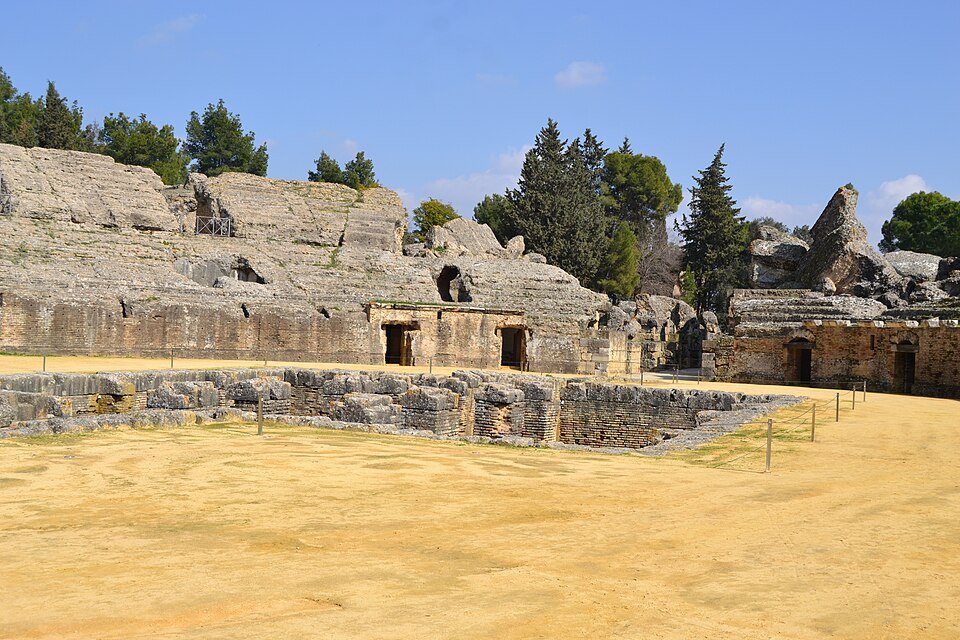
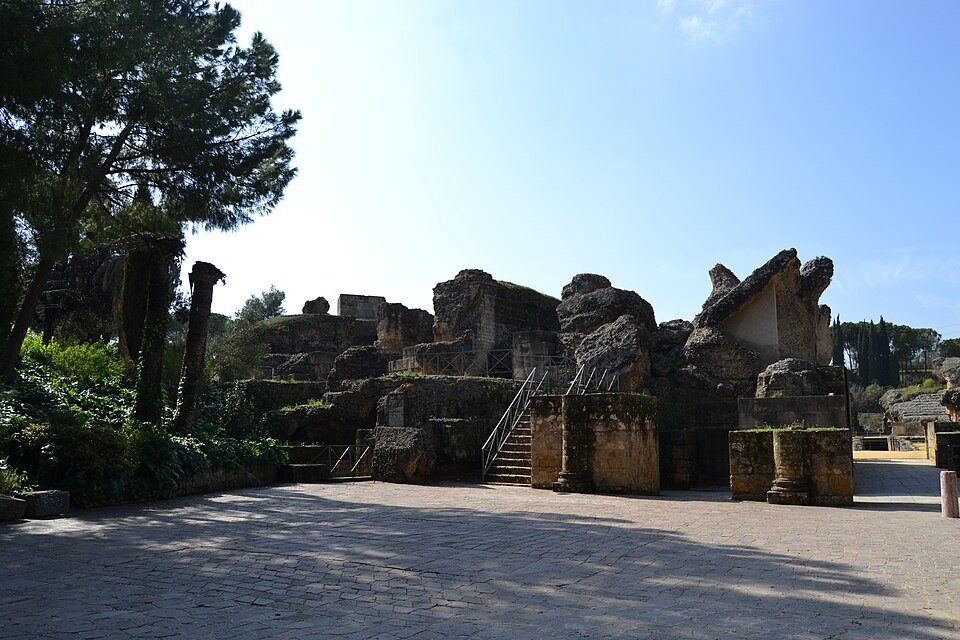
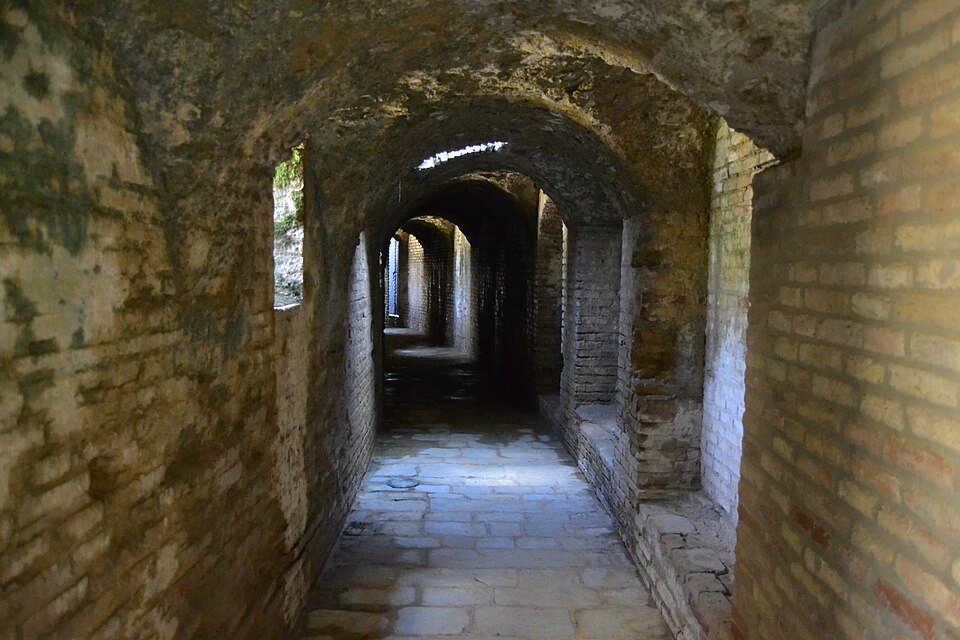
The amphitheatre is the thing you've seen in photographs, including for anyone who has watched prestige television shows filmed partly on Spanish locations. It's one of the larger Roman amphitheatres to survive anywhere, and its scale is the point: it was built to hold a population far bigger than Itálica itself likely had at its peak, which tells you something about Hadrian's sense of what a provincial capital needed. You can walk down into the underground service corridors where animals and equipment were once held before being raised to the arena floor, which is the coolest part of the whole visit, literally.
The shade problem
There is almost no shade in the nova urbs. The street grid is open ground, the house walls are low stubs, and the covered areas protecting the mosaics are small and often full. In summer the stone holds heat and throws it back up at you, and there's a real difference between visiting in the early part of the day and visiting after the sun is properly up. ⚠️ If you're there in July or August, this is not a site to treat casually — bring water, a hat, and sunscreen, and expect to want to leave sooner than your ticket allows.
⭐ Spring and autumn mornings are a much better bet, and they also tend to be quieter, which matters on a site with no crowds to hide behind when the sun is directly overhead. For general strategy on managing Seville's heat on day trips like this one, see our notes on shade.
Getting there and getting around
Itálica is reachable by a short bus ride from Seville's center, and it's a popular enough trip that the route is well signposted once you're at the right bus station; check current timetables and the pickup point with the operator before you go, since schedules are the kind of detail that changes without this guide knowing about it. Driving is also straightforward if you have a car, with parking near the site entrance. A taxi or rideshare is the easiest option if you'd rather not deal with bus timetables, though it costs more than the bus by a wide margin.
Once you're there, the site is flat and walkable, but it's larger than it looks from the entrance — plan for genuine walking distance between the houses and the amphitheatre, not a quick loop. There's an on-site interpretation center with models and information that's worth doing first, before the heat and the walking distance make you less inclined to read plaques.
For the logistics of fares and hours, go to the operator's own site rather than relying on secondhand numbers; opening arrangements and transport schedules shift with the season in ways that are easy to get wrong in print. This guide's day trips section has the general framework for organizing a half-day out of Seville if Itálica is one stop among several you're weighing.
Why it's worth the trip
Seville's old town is extraordinary but almost entirely post-Roman — Almohad, Gothic, Mudéjar, Baroque, layered on top of a Roman river port that's mostly invisible now. Itálica is the place where you can actually stand in a Roman street grid and look at Roman mosaic floors without imagining anything. It's a useful corrective to a city center that's so thoroughly medieval and early modern in its visible fabric that the Roman period can start to feel like a footnote in a museum case.
It also rewards a small amount of preparation. Knowing that Trajan and Hadrian were both associated with the town gives the amphitheatre's oversized scale a reason to exist beyond "the Romans liked things big." Knowing that the mosaics survive because the site was abandoned, not preserved on purpose, changes how you look at the empty grid around the house walls — this was a city that shrank and was left alone, not one that was curated.
Pair it, if you have the stamina, with an early start in Seville itself: a walk through the Barrio Santa Cruz or along the river before the bus out, so the day isn't entirely sun and stone. Back in the city, the shaded courtyards and narrow streets will feel very different after a morning spent somewhere so exposed and so empty.
In pictures