Seville Cathedral is routinely described as a building that replaced a mosque. That's true, but it undersells how much of the mosque is still there, hiding in plain sight, load-bearing and walked past by everyone who visits. The Almohad congregational mosque of Seville, finished in the late twelfth century, wasn't demolished and forgotten. Large pieces of it were kept, absorbed, and repurposed, because the people who built the Gothic cathedral on top of it were practical about labor and stone, even while they were making a theological and political statement.
The mosque was built under the Almohad caliphate, the Berber dynasty that made Seville its Iberian capital in the twelfth century. It was enormous by the standards of the time, oriented not toward the compass points a modern visitor expects but toward Mecca, which is why the whole cathedral complex today sits at an odd angle to the surrounding street grid — one of the few things about the site that has never been corrected in eight centuries of rebuilding.
What the Christians tore down, and what they didn't
After the city fell to Castilian forces in 1248, the mosque was consecrated as a church and used that way for about a century and a half, with only modest changes. The decision to demolish most of it and build a new cathedral wasn't made until the early 1400s, and the reasoning attributed to the cathedral chapter — that they wanted something so great that people would think them mad for attempting it — is one of the most quoted lines in Seville, whether or not the wording is exactly authentic.
Even then, the demolition wasn't total. The builders kept the mosque's outer walls along several sides, kept its ablutions courtyard whole, and kept the minaret standing rather than pulling it down, because a minaret of that scale represented an enormous amount of labor and stone that nobody wanted to redo unless they had to. The Gothic cathedral that rose inside and around these survivors is why the building's footprint is still roughly the rectangle of the old mosque, and why its orientation still doesn't quite match the city around it.
The minaret that became a bell tower
The clearest survivor is the tower now known as the Giralda, which was the mosque's minaret before it was anything else. Its lower two-thirds — the brickwork, the ramp inside that lets you climb without stairs, the proportions — are Almohad work from the twelfth century, built to a design associated with the same architectural tradition as the minarets of Marrakesh and Rabat. The upper section, the belfry with its bells and the bronze weathervane figure that gives the tower its name, was added by Christian builders in the Renaissance, on top of the Almohad structure, rather than replacing it.
⭐ Walking the ramp inside the Giralda, it's worth remembering that the incline underfoot is the original one, built so that the muezzin could ride a horse or mule to the top to call prayer rather than climb steps. That detail survives the change of religion, the change of language, and six centuries of additions on top, which is a fairly good measure of how much of the tower is still the mosque's.
The courtyard of orange trees
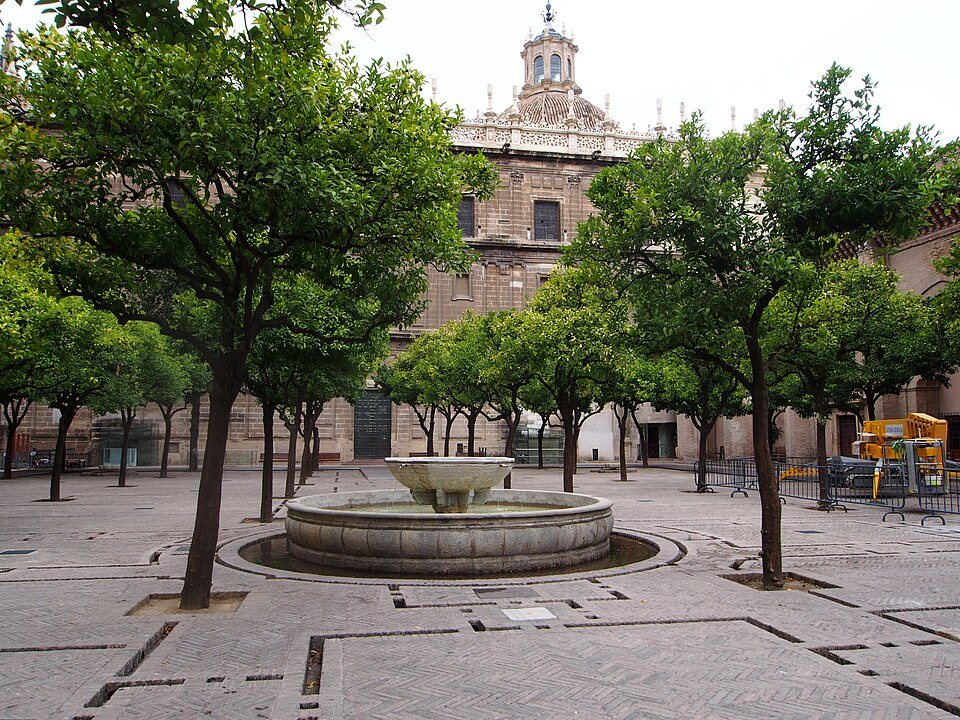
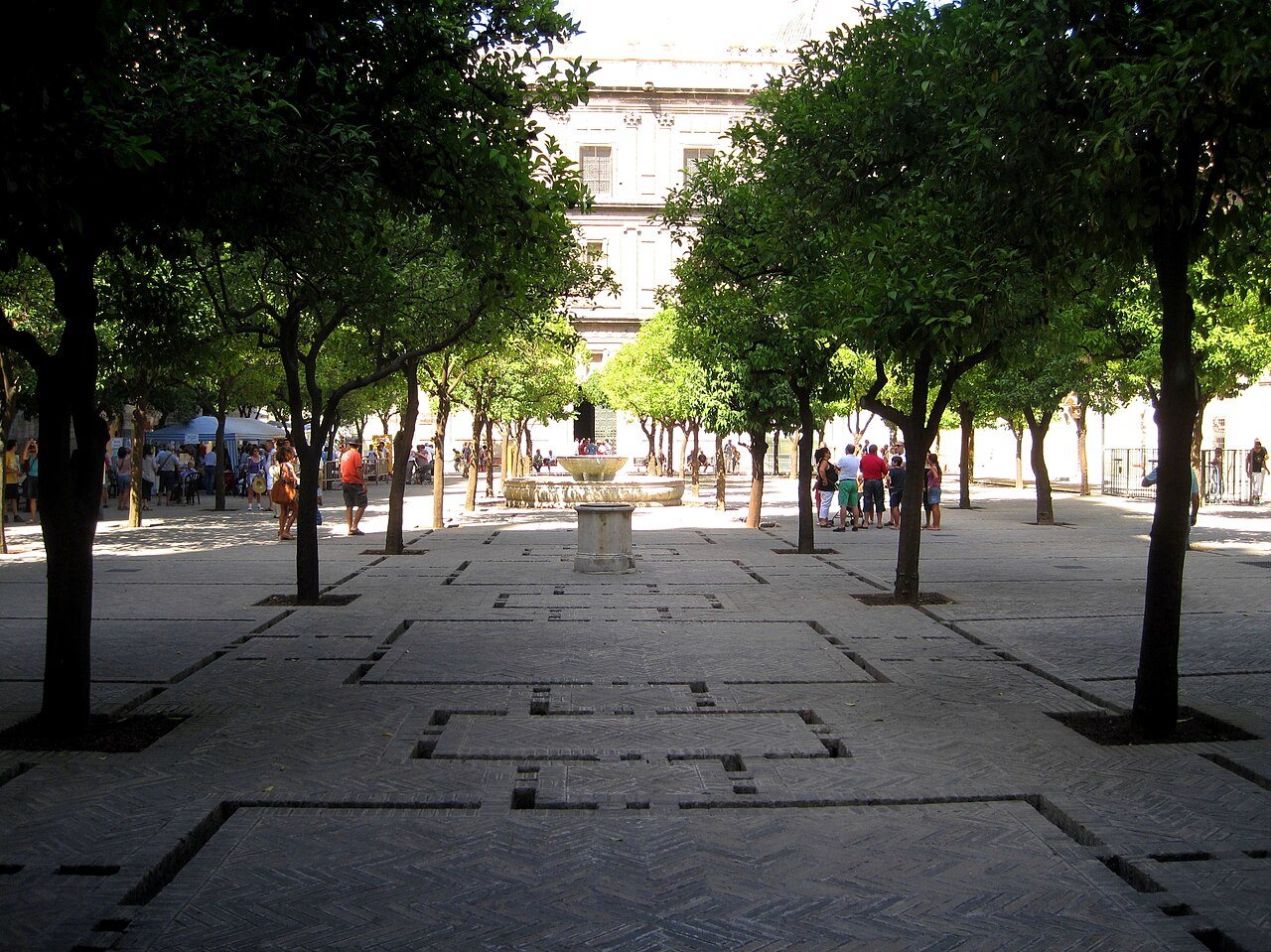
Attached to the cathedral's north side is a rectangular courtyard planted with orange trees, known today as the Patio de los Naranjos. This was the mosque's ablutions courtyard, where worshippers washed before prayer, and its layout — a walled rectangle, a fountain at the center, trees in rows — is essentially unchanged from the Almohad period, even though the fountain itself has been rebuilt more than once over the centuries. It connects to the interior of the cathedral and to the Giralda, and walking through it is the closest thing Seville offers to standing inside the mosque's plan rather than just looking at a fragment of it.
⚠️ The orange trees are the ornamental Seville orange, bitter and not eaten off the tree; the courtyard is worth visiting for the architecture and the shade, not for the fruit.
The gate that still shows the join
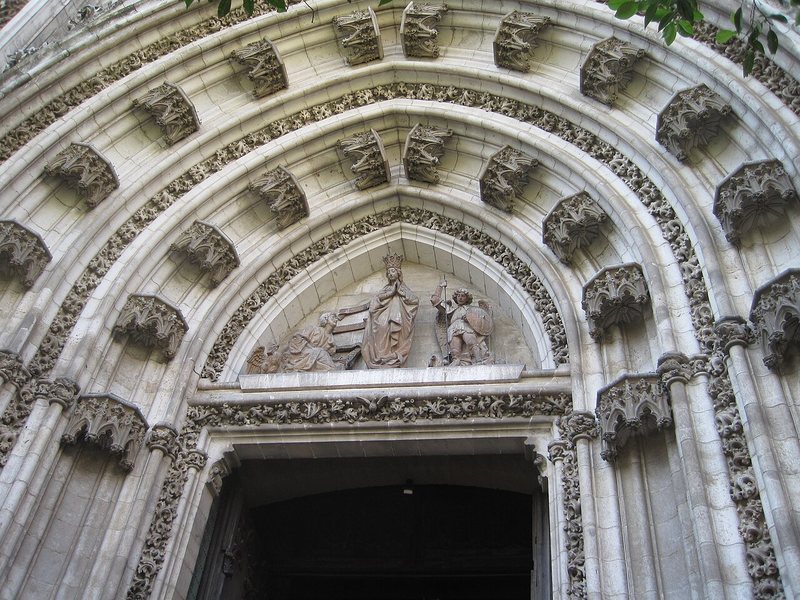
On the north wall, facing the Patio de los Naranjos, is the Puerta del Perdón, the Gate of Forgiveness — originally one of the mosque's principal entrances, later modified with Christian additions above and around the original horseshoe arch. It's one of the places on the building where the two building campaigns sit closest together without being fully merged into a single style, and it's easy to miss because it now functions as a side entrance rather than the main tourist approach, which typically runs through the south side of the building.
Other stretches of the old mosque's perimeter wall survive within the cathedral's outer walls, particularly along the sides facing away from the main entrance, though they're harder for a non-specialist to identify without knowing what to look for — mostly a change in brickwork or a horseshoe-arched blind niche embedded in later stonework.
Reading the building as two buildings
The practical way to see this on a visit to the cathedral is to treat the site as two structures superimposed rather than one building with an old name. Start outside in the Patio de los Naranjos, which is mosque plan and mosque walls. Look at the Giralda from the courtyard and again from Plaza Virgen de los Reyes, where its full height and the transition from Almohad brick to Renaissance belfry is easiest to see against the sky. Go in through the interior and the mosque disappears almost entirely — the nave, the vaulting, the chapels are Gothic and later, built for a different kind of worship and a different structural logic — and then walk out again through the Puerta del Perdón to be back in the older building.
None of this requires a guide to spot, but it helps to know in advance what you're looking at, since the cathedral's own presentation understandably emphasizes its Christian art, its scale, and the tomb associated with Christopher Columbus, rather than the building's first four centuries as a mosque. The Almohad structure is still doing real work holding the place up; it's just not what the building is chiefly remembered for by the people who come to see it.
In pictures