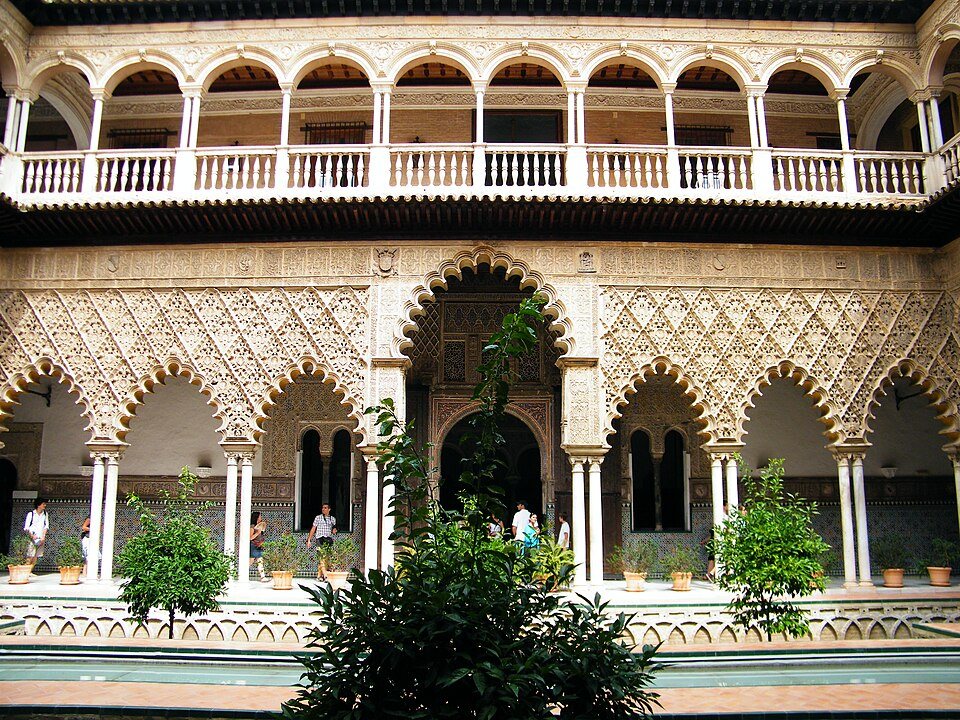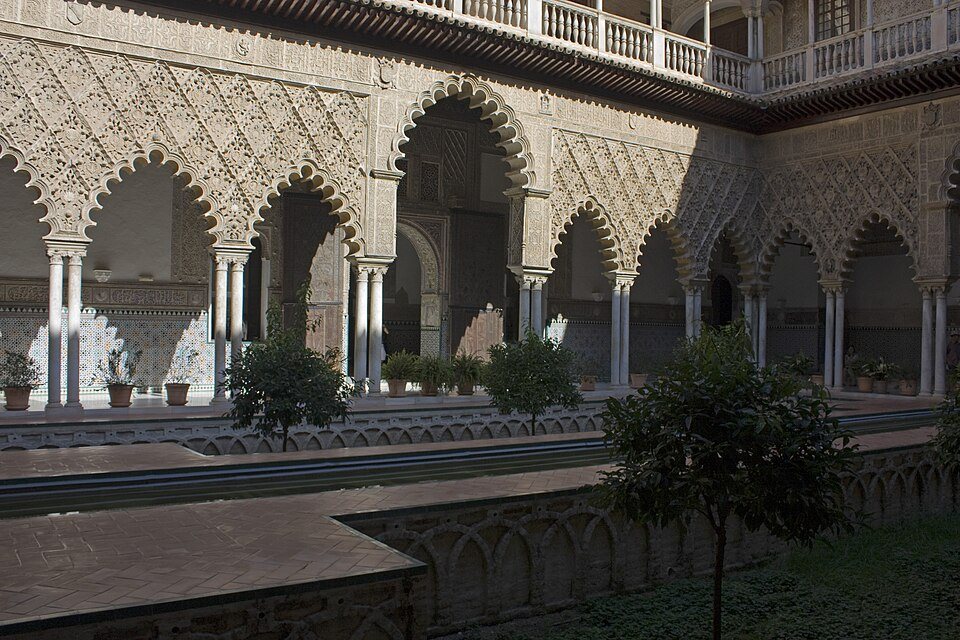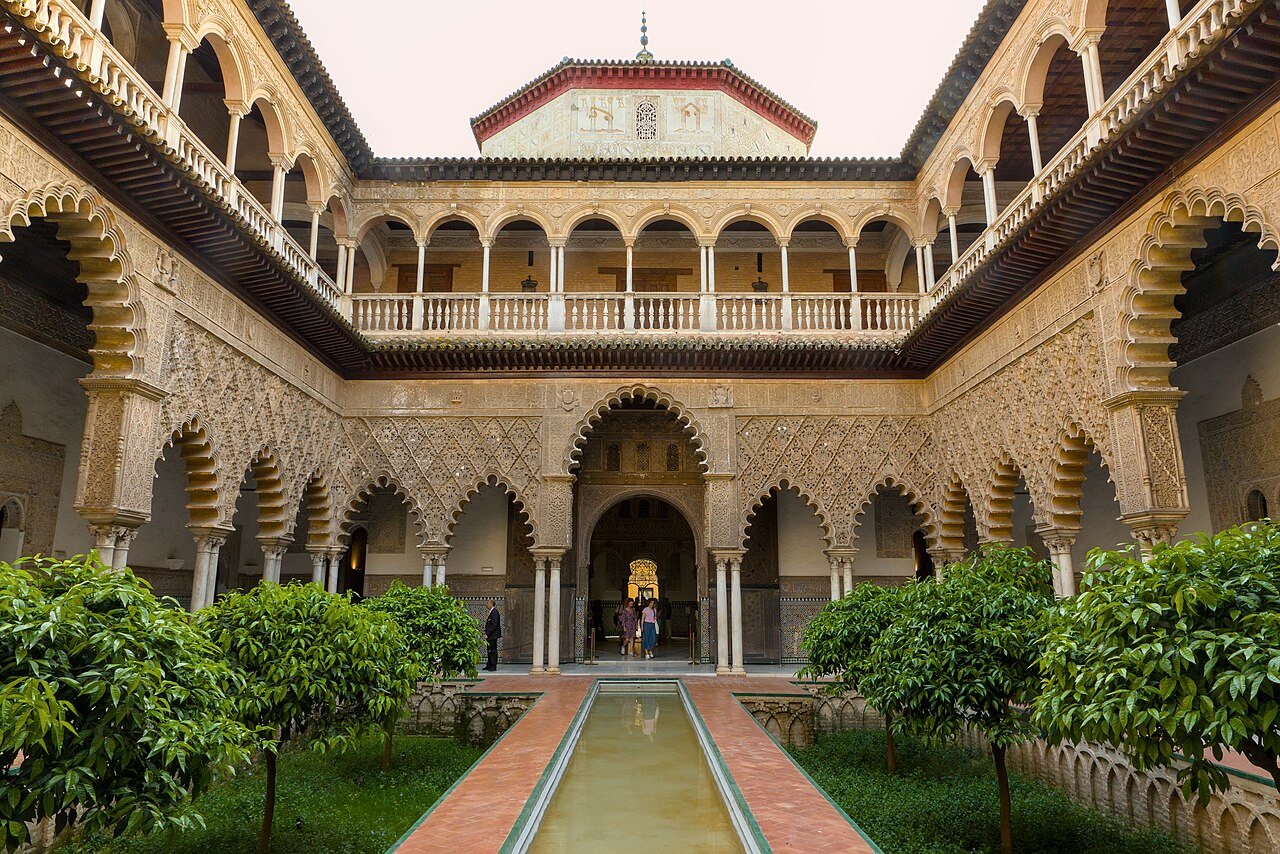
Every guide standing in the Real Alcázar says the word "Mudéjar" at some point, usually while gesturing at a wall of carved plaster and moving on before anyone can ask what it means. It's worth stopping longer, because the word describes something specific, and the Patio de las Doncellas is the best single room in Seville to see it argued out in stone, wood, and tile.
The word itself
Mudéjar doesn't name a style so much as a workforce. After the Christian conquest of Seville in the thirteenth century, the city's Muslim population didn't vanish — many stayed, and among them were the master builders, plasterers, and tile-setters who had trained in the visual language of Almohad and Nasrid architecture: horseshoe and multifoil arches, geometric strapwork, Arabic calligraphy, muqarnas (the stalactite-like plaster clusters that fill corners and cornices). Mudéjar architecture is what happens when Christian kings hire those craftsmen to build palaces for themselves, in that same visual language, sometimes with their own names or pious mottos carved in Arabic script beside a Christian coat of arms.
The Alcázar's most famous patron for this is Pedro I, who rebuilt the palace's core in the 1360s. Pedro was a Christian king who wanted a residence that looked, structurally and decoratively, like the Islamic palaces of Granada — not a copy, but a genuine commission from craftsmen working in that tradition, some of whom, inscriptions suggest, came from Granada itself. That's the "Mudéjar" you're standing inside when you walk into the Patio de las Doncellas.
Reading the patio, wall by wall
The courtyard's name — Patio of the Maidens — comes from a legend about an annual tribute of a hundred virgins once owed to Muslim rulers, a story with no real historical grounding but a persistent hold on the tour-guide script. Ignore the legend and look at the construction instead.
- The arches. The ground floor is ringed with multifoil and horseshoe arches carried on paired marble columns, a rhythm borrowed directly from Nasrid palace architecture. Count how the arches aren't structural in the plain sense — the real weight-bearing work is done by the columns and lintels behind them, and the arches themselves are closer to applied ornament, a screen laid over the opening.
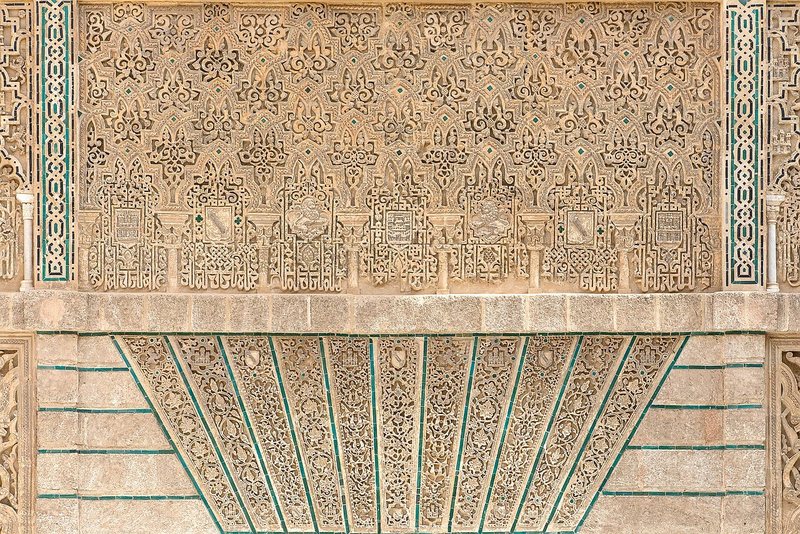
- The plasterwork. Above the arches runs a dense band of carved stucco — sebka work, a lattice of small repeating diamonds, interspersed with vegetal scrollwork and bands of script. Some of the inscriptions are Arabic, some are Gothic Spanish, and they sit side by side without much apparent tension. One recurring phrase associated with Pedro I's building campaigns at the Alcázar is a version of "and there is no victor but God," a formula lifted straight from Nasrid Granada — a Castilian Christian king having his walls praise God in the phrasing of the dynasty he'd just fought.
- The tilework. Lower down, a dado of glazed ceramic tile in interlocking star-and-cross patterns runs around the courtyard at roughly hand height — practical as much as decorative, since glazed tile resists the wear of passing bodies in a way that carved plaster doesn't. ⭐ Crouch slightly and look at the dado close up rather than only at the big plasterwork overhead; the tile patterns are some of the most precisely cut in the building and get skipped by anyone only looking up.
The giveaway that breaks the illusion
Look up. The upper story of the Patio de las Doncellas isn't Mudéjar at all — it's a sixteenth-century Renaissance addition, built under Charles V, with round-arched arcading, classical columns, and none of the sebka or muqarnas work below. It was added roughly two centuries after Pedro's original construction, and for a long time it was treated as the palace's true, finished state; a twentieth-century restoration project removed some later alterations to bring the ground floor closer to its fourteenth-century appearance, which is part of why the contrast between the two levels now reads so plainly. Stand in the center of the courtyard and tip your head back: the join between the two floors is the join between two entirely different architectural instincts, one built by craftsmen steeped in Islamic geometric ornament, the other by masons working from Italian pattern books a Habsburg court had brought north. ⚠️ It's easy to assume the whole courtyard is a single unified "Moorish" design because the ground floor is so dense with pattern that the eye doesn't automatically climb to compare it with what's above.
Why this matters beyond the patio
The same layered logic — Islamic-trained craft applied to Christian commissions, later Renaissance or Baroque additions stacked on top — runs through most of the Alcázar's interior, and understanding it in the Patio de las Doncellas makes the rest of the palace legible. The Salón de Embajadores, just off this courtyard, uses the same plasterwork vocabulary under a wooden dome; the smaller Patio de las Muñecas repeats the arcade format at a more domestic scale. Outside the palace, Seville's Mudéjar habit shows up again in brick bell towers built as minarets were built, and in coffered wooden ceilings in churches across the old city — this was a working tradition, not a single decorated room.
It also helps to know that "Mudéjar" isn't a euphemism for "Islamic architecture that happens to be in a Christian building." It describes a specific historical condition — Muslim craftsmen and their trained successors continuing to build, under new patrons, in a visual language that outlasted the political order that first produced it. The word carries that displacement inside it. Standing in the Patio de las Doncellas with that in mind changes what the carved plaster and the horseshoe arches are doing there: not decoration borrowed for effect, but a continuous craft tradition that the conquest didn't interrupt so much as redirect.
⭐ If you want the contrast without the crowd, come back to this courtyard near the end of a visit, after the gardens, when most visitors have moved on toward the exit and the light through the courtyard has usually shifted enough to pick out the tile dado differently than it did on the way in.
In pictures