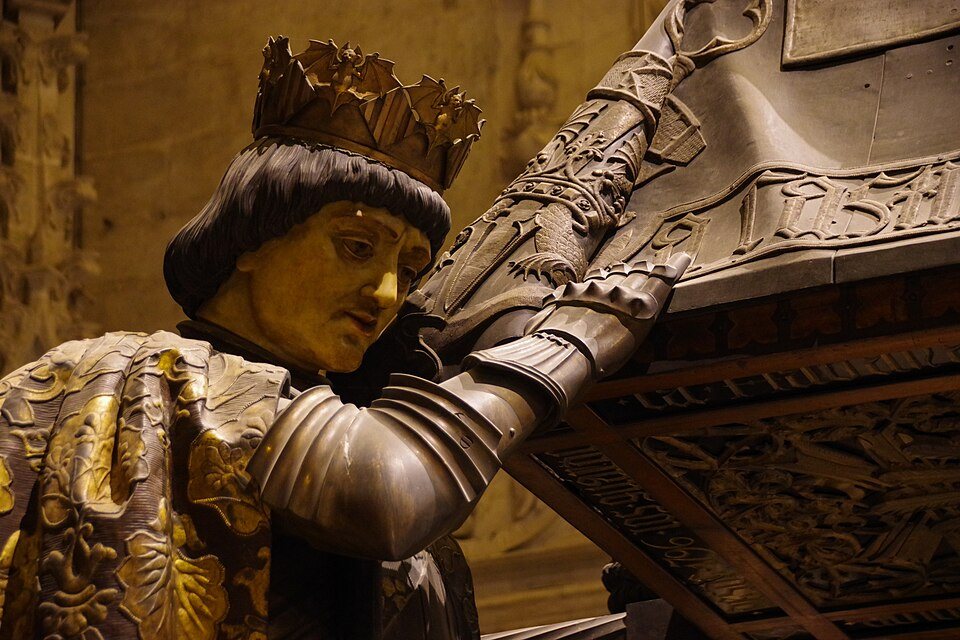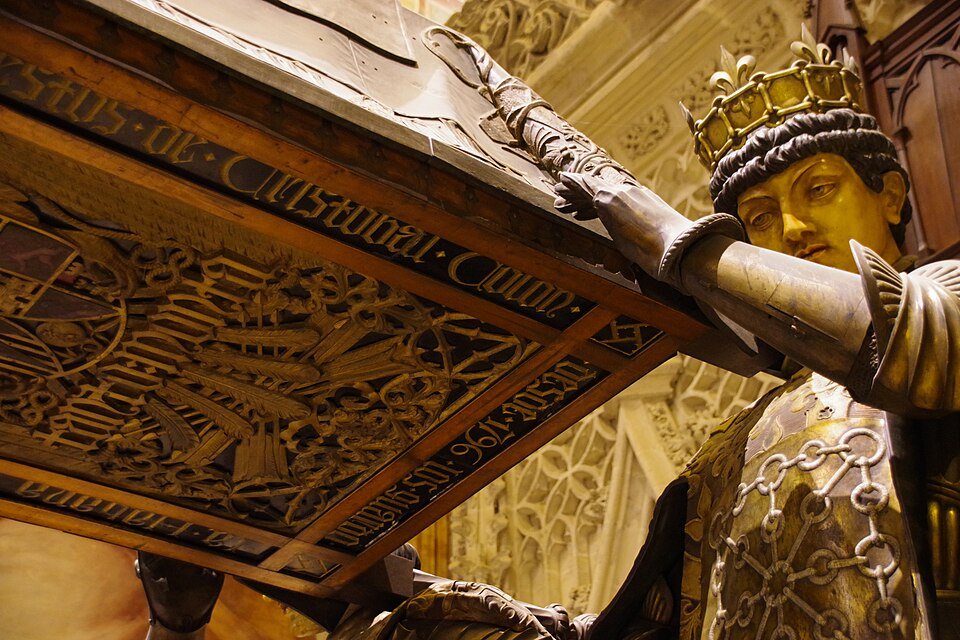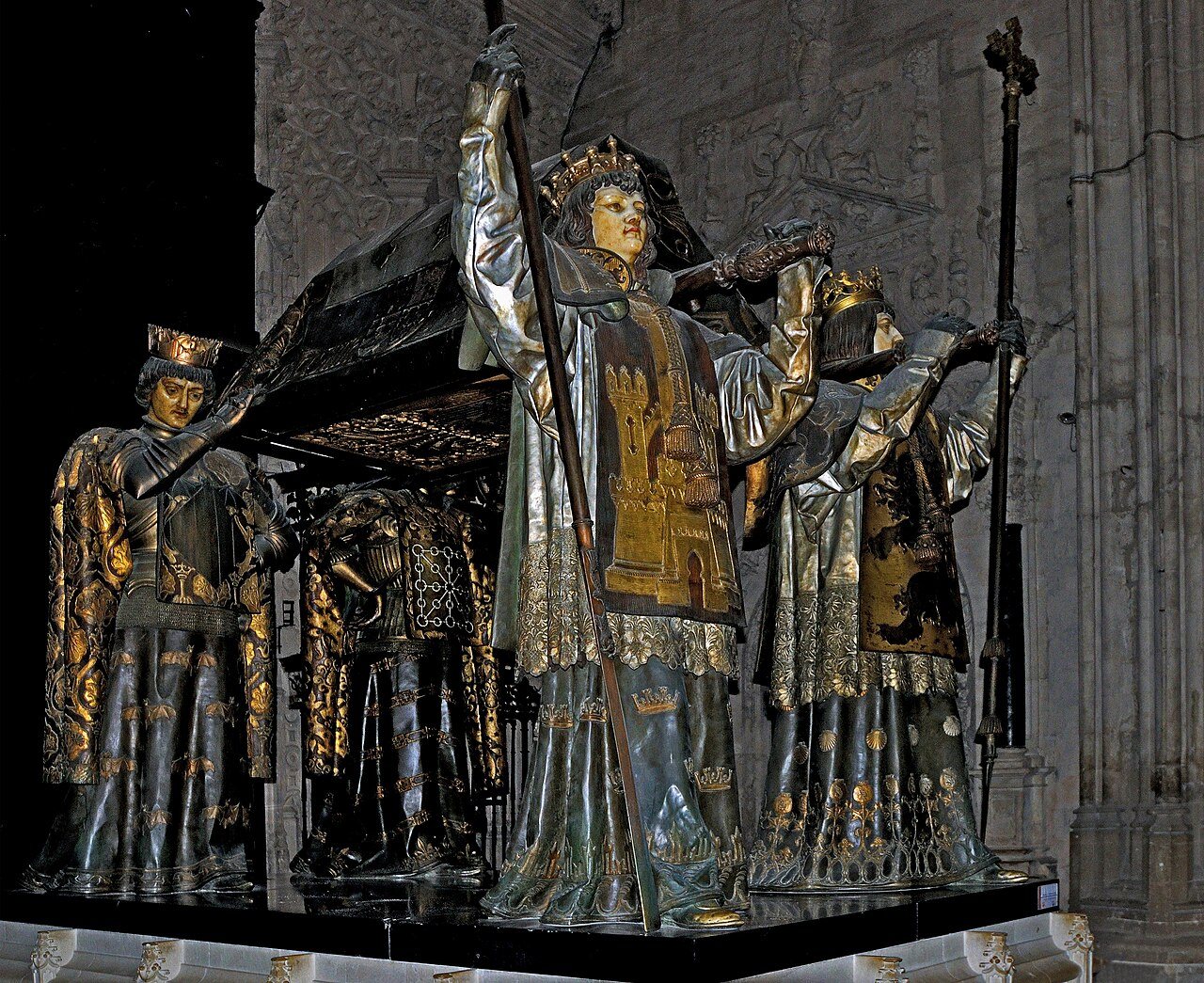
Near the south door of the cathedral, four larger-than-life bronze figures hoist a coffin above their heads, as if caught mid-stride. They represent the kingdoms of Castile, León, Aragón and Navarra, and what they are carrying is labeled as the remains of Christopher Columbus. It is one of the most photographed things in the building, and also one of the least settled. Nobody can say with certainty whose bones are actually inside.
A body that kept moving
Columbus died in Valladolid in 1506. That alone surprises people who assume he died at sea or in the Caribbean. His remains didn't stay in Valladolid, either. Over the following decades and centuries they were moved repeatedly, first within Spain, then across the Atlantic to Santo Domingo, in what is now the Dominican Republic, as part of his family's long campaign to have him buried in the colonial world he had opened up for Spain.
From Santo Domingo the trail splits, and this is where the dispute really begins. When Spain ceded the eastern part of Hispaniola to France in 1795, remains said to be Columbus's were dug up and shipped to Havana, Cuba, then still a Spanish possession. When Spain lost Cuba in 1898, those remains made one more transatlantic crossing, this time to Seville, where they were installed in the cathedral in a tomb finished in 1902.
The complication is that the Dominican Republic never accepted that the correct remains left Santo Domingo in 1795. Dominican authorities maintain that a set of bones uncovered in the cathedral there in 1877, in a box marked with Columbus's name, are the real ones, and that what went to Havana and then Seville was somebody else, possibly a relative. Santo Domingo built its own monumental structure for its claimed remains, the Faro a Colón, and no amount of argument since has fully resolved which city's box is right, or whether both might contain partial remains if the original burial was disturbed or divided at some point in the shuffle.
What the DNA actually showed
In 2003, a team led by a University of Granada forensic scientist got permission to open the Seville tomb and extract material for genetic testing, comparing it against the known remains of Columbus's brother Diego and his son Hernando, both buried in Spain. The results, published some years later, found a mitochondrial DNA match consistent with the Colón family line. That is a real result and it is usually the one quoted to say the matter is closed.
What it does not do is prove whole-body identity, since the Seville remains amount to a small quantity of bone fragments rather than a complete skeleton, which is itself consistent with the story of a body repeatedly exhumed, boxed, and partially transferred over four centuries. The Dominican Republic has not allowed equivalent testing of the remains it holds, so there has been no side-by-side comparison. The honest position, and the one historians researching the case tend to hold, is that Seville very likely holds at least some authentic remains of Columbus, mixed with centuries of uncertainty about completeness and chain of custody. Whether this is certainly him, whole and entire, is not something that can be asserted either way.
⭐ If you want the context before you see the tomb, it helps to know that this monument was built specifically for the 1902 relocation. It is not where Columbus was first buried, and it was never meant to be a tidy final answer. It's a civic and national statement about Spain's relationship to its overseas history, built at a moment, right after the loss of Cuba, when that history had just become a lot more complicated for Spain to claim.
Looking at the monument itself
Set that argument aside for a moment and look at the object. The four bearers are usually read as representing the medieval kingdoms that made up the crown of Spain at the time of Columbus's voyages, a way of saying that the whole of Spain, not one region, carried this legacy. The sculptor was Arturo Mélida, and the piece is in a 19th-century historicist style that doesn't try to blend into the Gothic bulk around it. It's meant to be noticed, standing apart from the altarpieces and side chapels, near enough to the entrance that most visitors reach it early in a visit before their attention is pulled toward the main retable or the Giralda climb.
⚠️ Visitors sometimes assume the tomb is a burial crypt you can walk into or around freely at close range. It isn't. It is a raised, roped-off monument you view from a short distance, which disappoints people expecting something like the royal pantheon at El Escorial. There is no chamber to enter and no inscription that settles the authenticity question for you on-site; the information panels describe the move from Havana in 1898 without adjudicating the Santo Domingo dispute.
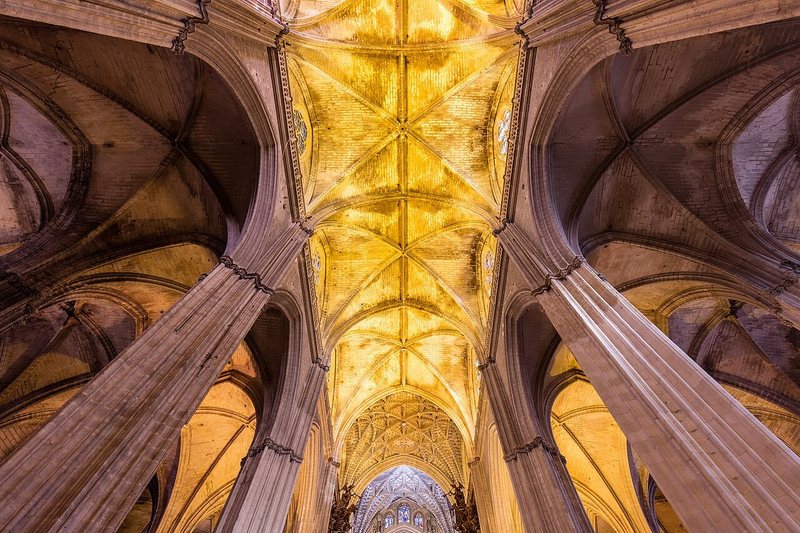
The cathedral itself gives the tomb its gravity. This building is among the largest Gothic cathedrals anywhere, built over the site of the city's former mosque, and the scale means the Columbus monument has to compete for attention with an enormous nave, the choir, and the sheer volume of side chapels. Many visitors walk past it once on the way in and only really stop to look on the way out, once they've adjusted to how much there is inside.
Visiting it alongside the rest of the cathedral
The tomb sits within the standard visitor route through the cathedral interior, so there's no separate ticket or detour required to see it; it comes as part of the same circuit that takes in the choir, the sacristy, and the climb up the Giralda tower. Because it's near an entrance, some visitors see it first and keep it in mind as a kind of marker for the scale of everything that follows. Others miss it entirely on the way in, distracted by the nave's height, and only catch it on the way out.
If you're planning the order of a cathedral visit, it's worth building in a few minutes to read the explanatory panel near the tomb rather than photographing it and moving on, since the Havana-to-Seville story is more specific, and more interesting, than the monument alone communicates. For the wider logistics of visiting, including how the cathedral connects to the Patio de los Naranjos and the Giralda climb, the main cathedral guide lays out a sensible order for seeing everything without doubling back. If Columbus and the age of exploration interest you beyond this one tomb, the Archivo de Indias nearby holds the paperwork side of that history, in the form of the actual colonial administrative archive, and pairs naturally with a cathedral visit on the same day.
In pictures