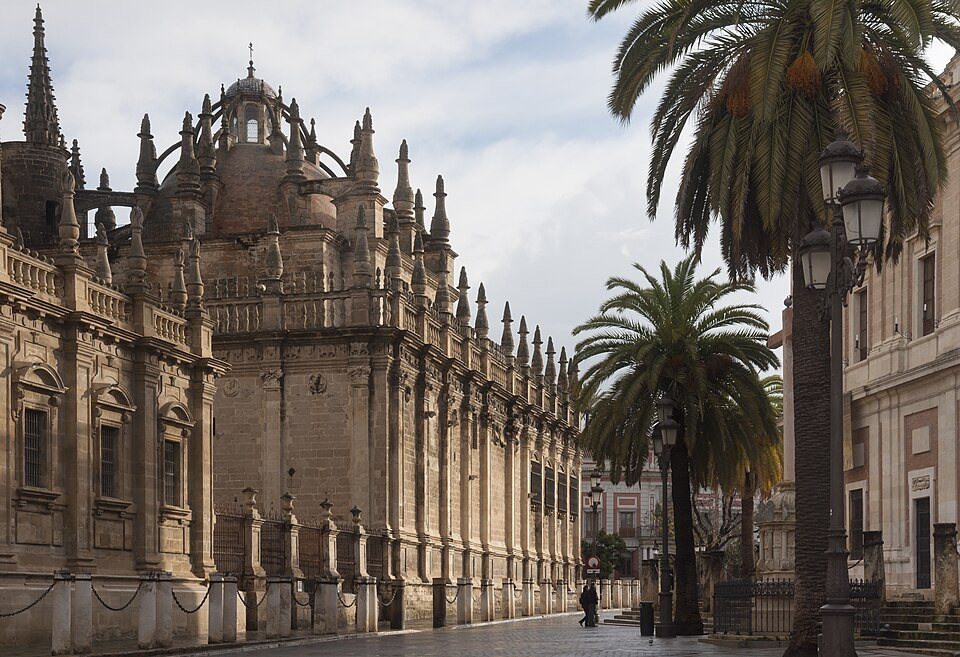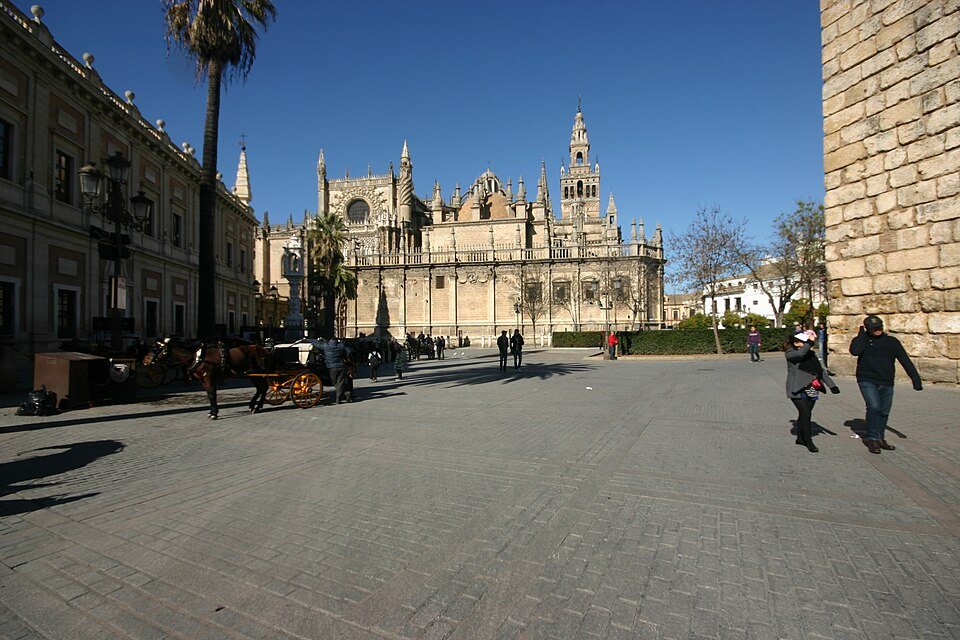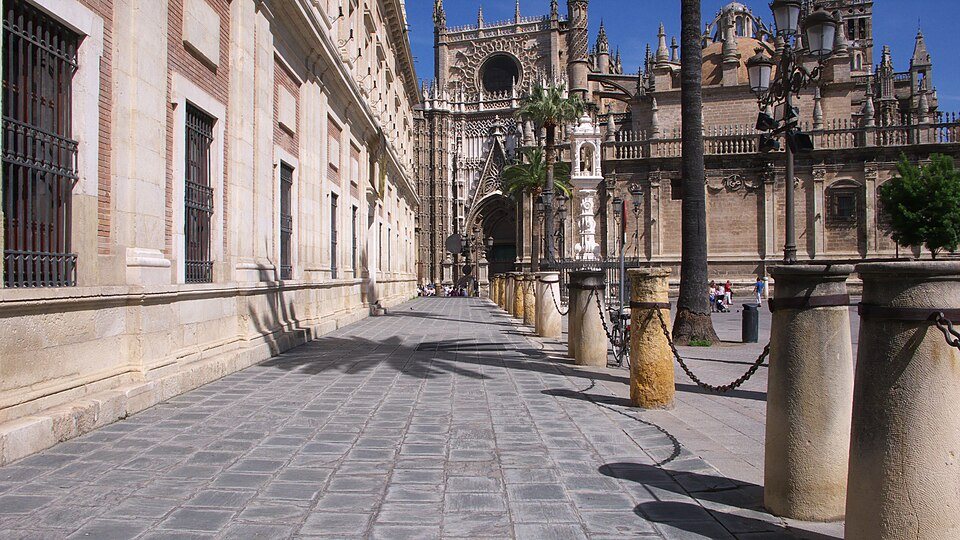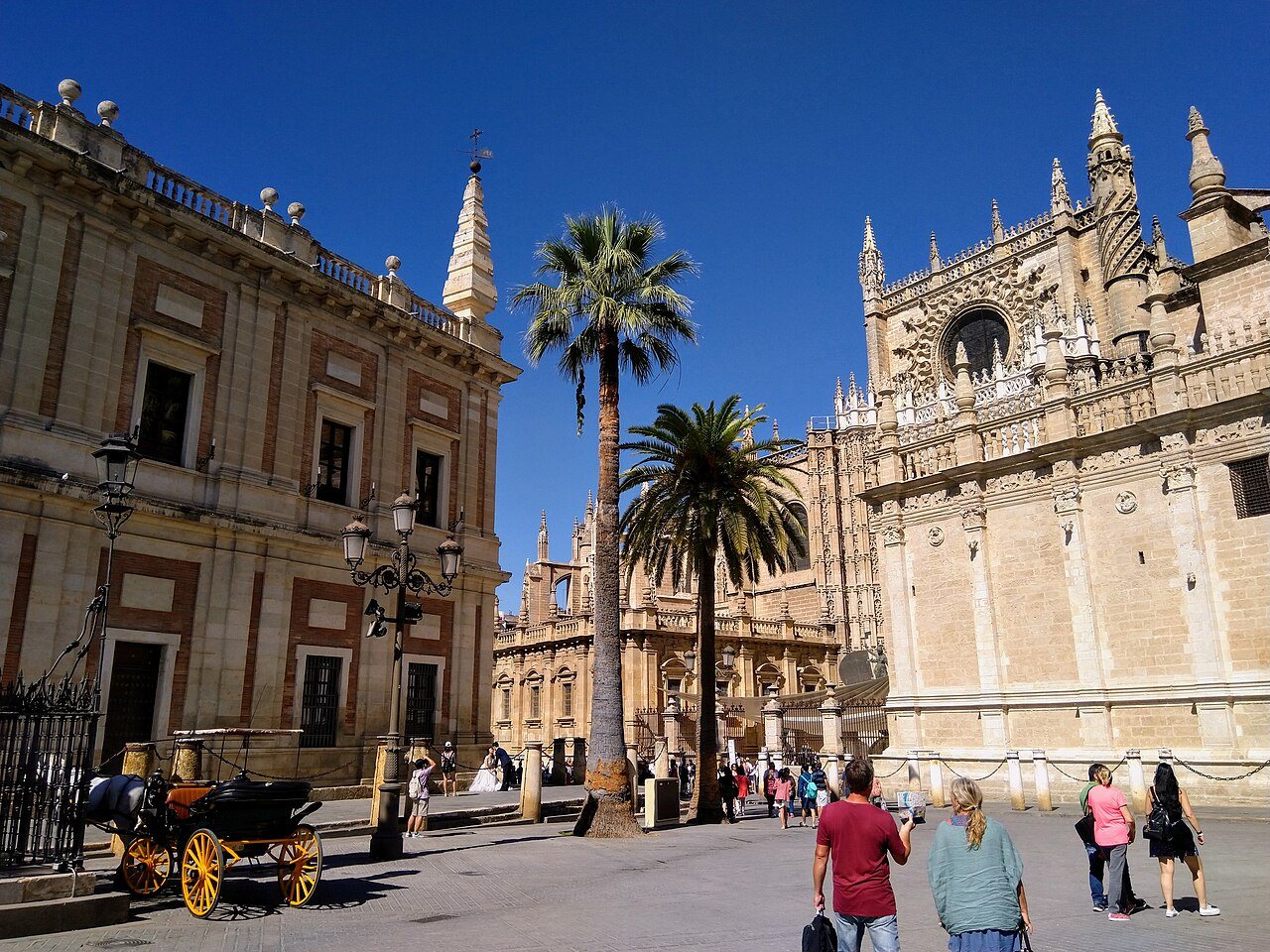
Walk from the cathedral to the Alcázar and you pass a squared-off Renaissance building with a plain façade, stone benches out front, and almost no one going in or out. That's the Archivo de Indias, and the reason to interrupt your walk for it isn't the building — it's what's inside, and the fact that almost everyone else on the plaza is walking past it toward something else.
The archive holds the paper trail of Spain's empire in the Americas and the Philippines: shipping manifests, maps, royal decrees, correspondence between colonial officials and the crown, and documents connected to figures like Columbus and Magellan. Seville was the port that held the royal monopoly on trade with the Indies for most of the colonial period, so the bureaucracy of that trade — permits, cargo lists, disputes, land grants — accumulated here rather than in Madrid. In the late 18th century, Charles III ordered the scattered colonial records gathered into one building, and this is the one he chose: a former merchants' exchange, the Casa Lonja de Mercaderes, built to keep merchants and their haggling out of the cathedral itself.
UNESCO lists the Archivo de Indias together with the cathedral and the Alcázar as a single World Heritage site, which tells you something about how the three are meant to be read as a set — religious power, royal power, and the paperwork that financed both.
What you actually see
This is not a museum with placards leading you room to room. The building is a working archive and research library first, open to the public as a secondary function, so what you get is architecture and a rotating selection of documents on display rather than a curated narrative you can follow start to finish.
The staircase is the single thing most visitors remember: wide marble steps rising through the center of the building under a skylight, in a Herrerian style — the same severe, geometric classicism Philip II's architect Juan de Herrera used at El Escorial. No ornamentation competing for attention, just stone, proportion, and light falling straight down the stairwell. Photographs of it tend to make the building look grander than it feels in person, which is part of the appeal: it's a serious building that isn't trying to impress you.
Upstairs, the archive displays a changing selection of original manuscripts and maps in glass cases — the kind of thing where you'll recognize a signature or a coastline and stop, and otherwise move past at a normal walking pace. Don't expect wall text in the volume you'd get at a history museum. The building's real holdings run into the tens of thousands of documents, stored in the upper galleries that aren't open to casual visitors; researchers apply separately to consult the collection itself.
Why it's empty
The Archivo sits on the same plaza as the cathedral and shares a wall, more or less, with the Alcázar's outer precinct. Every tour group in Seville passes within fifty feet of its entrance. Almost none of them go in, because it isn't on the standard circuit, it doesn't have a queue to signal that something's happening, and the façade gives away nothing about what's inside. ⭐ That's the appeal: after the crush of the cathedral or the Alcázar's crowded first rooms, this is a quiet, cool, un-crowded half hour in the same few hundred meters.
Because it's free and lightly visited, there's no real mechanism to rush you — no timed slot pushing you through, no tour group behind you. You can stand on the staircase as long as you want. The trade-off is that there's genuinely not that much to see if you're after a full afternoon; this is a complement to the cathedral and Alcázar, not a rival to them.
Practical notes
Admission is free, which is unusual for a sight this central in Seville, and the archive is run by Spain's Ministry of Culture rather than the city, so its calendar doesn't always match the cathedral's or the Alcázar's. ⚠️ Hours and closure days shift, and the building sometimes closes for cataloguing work or state functions with little public notice — check the Archivo General de Indias's own site before you build it into a tight schedule, rather than assuming it will be open because the cathedral next door is.
There's no café, no gift shop to speak of, and nowhere really to sit beyond the entrance hall, so this isn't a place to plan around for a break from the heat in the way you might use a shaded garden. Bags are checked at the door and the usual no-flash, no-touching rules apply around the document cases, which is a reasonable price for proximity to paper that's four or five centuries old.
The building connects naturally to a short loop: cathedral and Giralda first, then the Archivo on your way to the Alcázar, since all three sit within a few minutes' walk of each other around the same plaza. If you're doing the Patio de los Naranjos as part of the cathedral visit, the Archivo is a natural detour on the way out rather than a separate trip. For planning the rest of the day around it, see itineraries for how this fits with the Alcázar's gardens and the walk down toward the river.
Is it worth the half hour
If you care about maps, ships, or the mechanics of empire — how a monopoly port actually ran, what a 16th-century cargo manifest looked like, who signed off on a voyage — this is one of the few places in Seville where you can stand close to the original paperwork rather than a reproduction. If none of that interests you, the staircase alone is worth the five minutes it takes to walk through the ground floor and up, before heading back out into the plaza's heat and noise.
It won't fill an afternoon, and it isn't meant to. It's the kind of stop that works precisely because it's short, free, and nearly empty — a counterweight to the two much larger, much busier buildings on either side of it.
In pictures