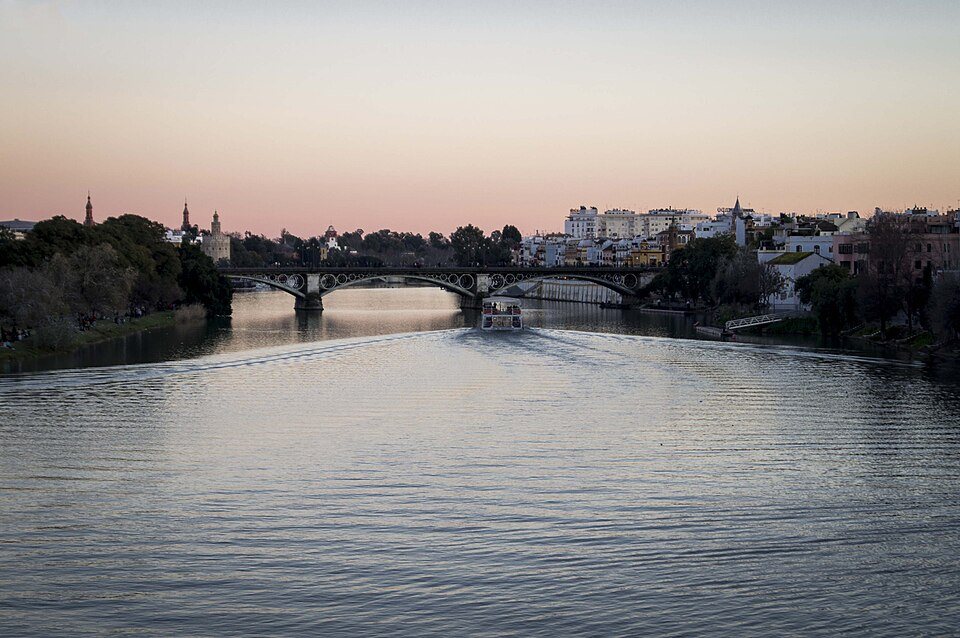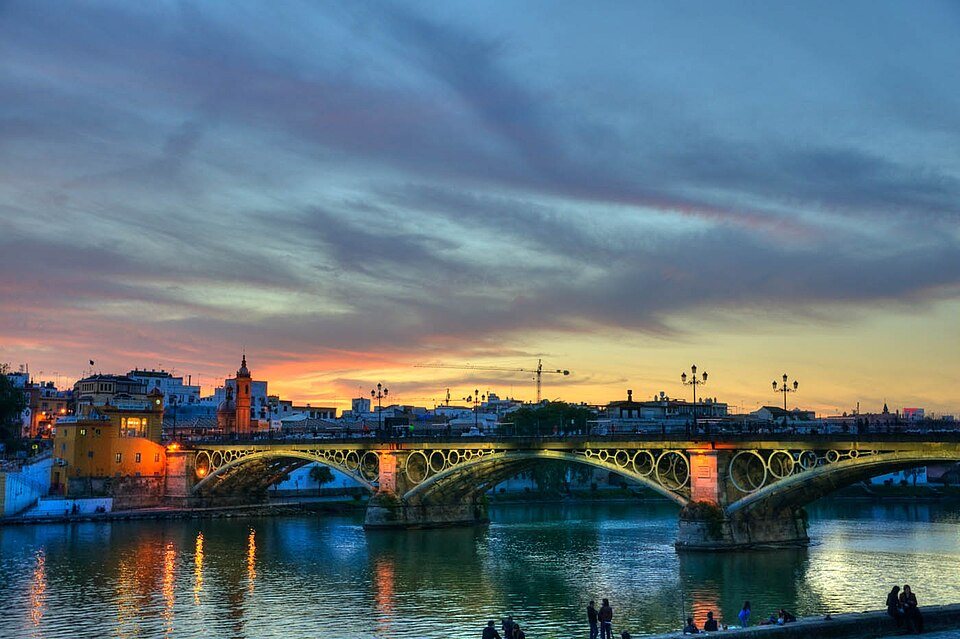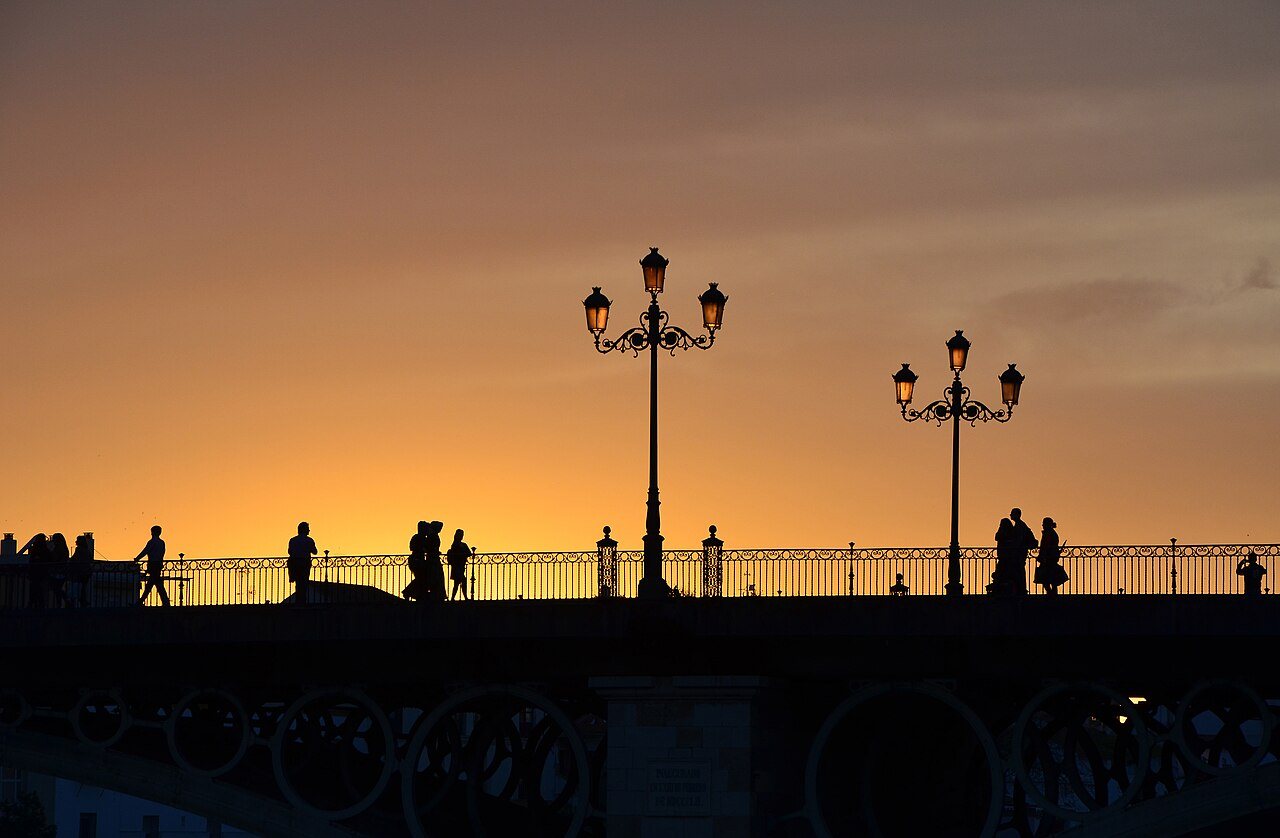
Cross the Puente de Triana and the city changes register. The streets narrow and flatten out, the facades get lower and brighter, and for a stretch along Calle Alfarería and Calle Antillano Campos you start passing shopfronts stacked with glazed plates, tiles, and bowls that someone, usually in a workshop a few steps behind the counter, is still making by hand. That continuity is the real reason to come to Triana, more than any single monument. There isn't one here to speak of. What there is instead is a neighborhood that has kept doing, for itself, the things it has always done.
Ceramics: an industry, not a souvenir rack
Triana's pottery tradition goes back far enough that the riverbank clay beds were already being worked before the district had its current name, and the industrial version of it — tile kilns supplying construction projects across the city, including the glazed surfaces you'll have already seen at Plaza de España — ran for centuries along what's now Calle Callao and Calle Alfarería. Most of the big kilns are gone, but the trade didn't move away; it just got smaller and more visible at street level. Several workshops in the neighborhood still throw, glaze, and fire pieces on site, and a couple will let you see the process if you ask rather than just buy.
The Centro Cerámica Triana, built into the remains of one of the old factory sites, lays out the history of the industry with actual kiln structures and tools rather than just panels of text, which is useful if you want to know what you're looking at once you're back out on the street comparing shopfronts. ⭐ A genuinely useful habit here: look at the backs of the tiles, not just the glazed face. Hand-painted work has slight unevenness in the brushstrokes and small variations between supposedly identical tiles; mass-produced transfer-printed versions are too perfect. Shop owners are generally straightforward if you ask which is which — the handmade pieces take longer and cost more to produce, and most sellers aren't trying to pass one off as the other, but it's easy to assume everything in a ceramics district is handmade when a fair amount of stock now comes from elsewhere.
Guitars, flamenco, and a neighborhood that still claims it
Triana's other claim, harder to verify shop by shop but not disputed locally, is as one of the neighborhoods where flamenco as a public, performed art took shape among river workers, metalworkers, and the Roma families who lived along Calle Pureza and the streets around it in the nineteenth and early twentieth centuries. The population that lived in the old riverside corrales — crowded communal housing blocks — was displaced in municipal rehousing projects in the mid-twentieth century, which is a real rupture in the neighborhood's history and a point of some local grievance; what's often sold as unbroken tradition has a gap in it that's worth knowing about.
What survives is a working guitar-making trade: a handful of luthiers still build and repair flamenco guitars in small workshops, often the same families for two or three generations, and they're generally approachable if you're actually curious about the instrument rather than browsing for a cheap one to take home. Flamenco itself is staged in the neighborhood in smaller, less tourist-oriented venues than the ones clustered near Santa Cruz; nothing here is free of staging for an audience, but the rooms are smaller and the crowd is more mixed.
⚠️ Don't expect flamenco to turn up spontaneously in a bar because you're in Triana. That's a reasonable expectation in some neighborhoods in Andalusia's smaller towns and much less reliable in a city of Seville's size; what you'll find here are scheduled performances in specific rooms, and it's worth asking locally which ones currently have working musicians rather than piped recordings.
The market, the chapel, and the river itself
Mercado de Triana, built over the foundations of the old Castillo de San Jorge — a Inquisition-era fortress whose remains are kept visible underneath part of the market in a small, free interpretive space — is a working food market first and a tourist stop only incidentally. It's a good place to see what Seville actually eats day to day, away from the tapas-bar version of the city's food served a few streets over. The riverside promenade just outside it, Calle Betis, is the most photographed street in the neighborhood for a reason: low buildings in ochre, pink, and white facing the water with the old city and the Torre del Oro across the river, especially in late afternoon light.
Two small religious buildings anchor the neighborhood's identity more than any grand church does. The Capilla de los Marineros and the Iglesia de Santa Ana — the latter one of the oldest parish churches in the city, predating much of what's grand in the historic center — are both modest in scale and heavily used by the neighborhood itself, not run as sights. Triana's two Holy Week brotherhoods, based at these churches, are a serious point of local identity and rivalry with each other, independent of anything happening across the river during that week.
Walking it without overplanning it
Triana rewards slow, undirected walking more than a checklist. A reasonable route starts at the bridge, goes along Calle Betis to take in the river view, cuts inland at the market to pick up Calle Pureza and Calle Alfarería for the ceramics shops and the two chapels, and ends wherever you find a bar with a terrace facing the water — there are several, and none of them are secrets, but they're genuinely good for watching the light change on the far bank.
⭐ The neighborhood is small enough to cover on foot in an afternoon, but plan your crossing back: the bridge is the obvious route, but walking a little further south or north along either bank before crossing gives a different, often better angle on both the river and the old city skyline. For getting here and back, see getting around, and for how Triana fits alongside the city's other districts, the overview at neighborhoods is a useful starting point before you commit to a route.
In pictures