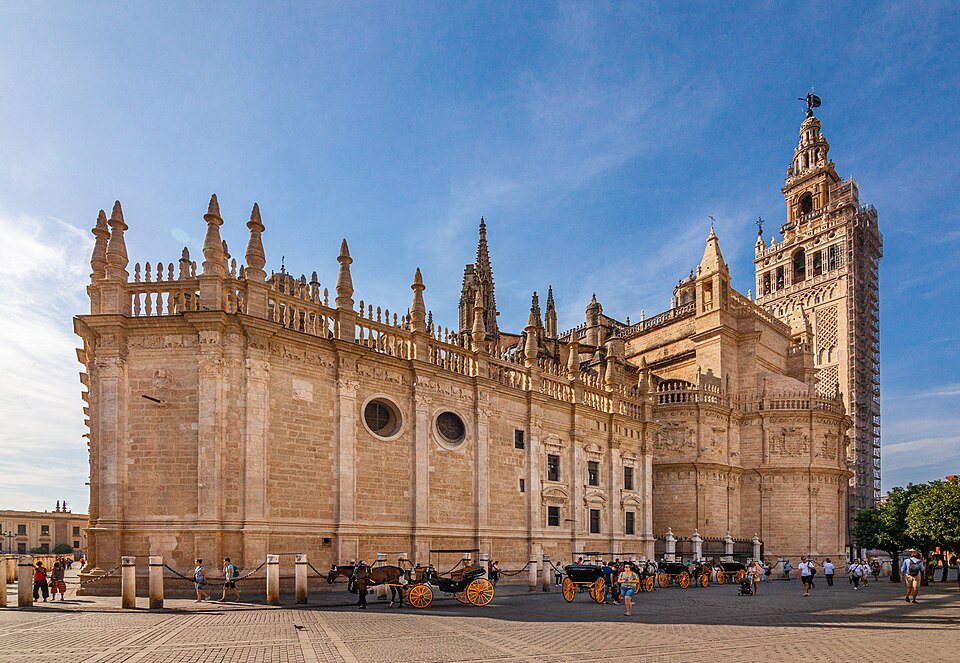
Most visitors to the cathedral assume the climb up the Giralda will involve stairs, because that is how every other bell tower in Spain works. It doesn't. From the base almost all the way to the belfry, the ascent is a continuous ramp, wide enough for two people walking in opposite directions to pass without turning sideways. There are no steps until right near the top, where a short final stretch of stairs delivers you to the viewing level. The reason for this goes back to the tower's origin as a minaret, built under the Almohad caliphate before the cathedral existed around it.
Why a ramp and not stairs
The Giralda began life in the twelfth century as the minaret of Seville's great mosque, and the muezzin who climbed it five times a day did not walk. He rode. A ramp allowed a mount to carry him up, which is why the incline is so gentle and the turns so wide — nothing like the tight stone spirals you find in most European towers. When the mosque was demolished after the Christian conquest and the cathedral built in its place, the tower was kept, heightened with a Renaissance belfry, and topped with the bronze weathervane figure (the giraldillo) that gives the tower its name. The ramp survived all of it, largely unchanged in its lower two-thirds.
The engineering detail that makes the climb interesting rather than merely convenient is the ramp's construction: it rises in a series of straight ramped sections around a square core, doubling back on itself roughly thirty times before reaching the bells. You are never on stairs long enough to think about your knees, but you are climbing for long enough to notice your breathing, particularly in summer heat. There is no elevator and no alternative route — the ramp is the only way up or down, which matters for how the space behaves when it's busy.
What the climb actually feels like
The lower sections are dim, lit by small openings cut into the thick walls, and the surface underfoot is smooth stone that can feel slippery in the wrong shoes. Because it's a ramp rather than steps, people naturally walk at different speeds, and there's no obvious etiquette for passing — some visitors hug the inside of each turn, others drift into the middle, and on a crowded morning you end up doing a fair amount of weaving. Small children often outpace their parents here because the gentle slope doesn't tire legs the way stairs do.
⚠️ The bottleneck is not the ramp itself but the belfry at the top, where the space narrows and everyone is trying to reach the same handful of viewing openings at once. If you arrive right after a tour group has entered, expect to wait your turn at the windows rather than move freely between them.
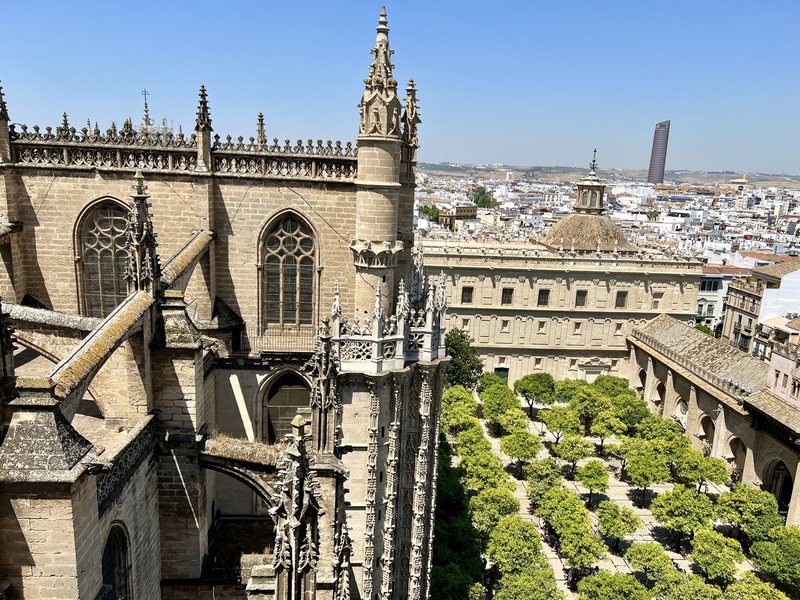
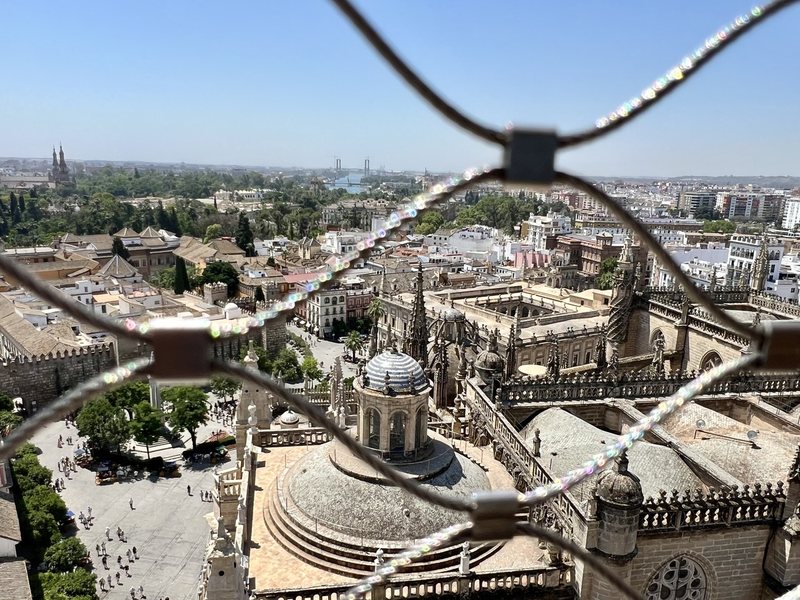
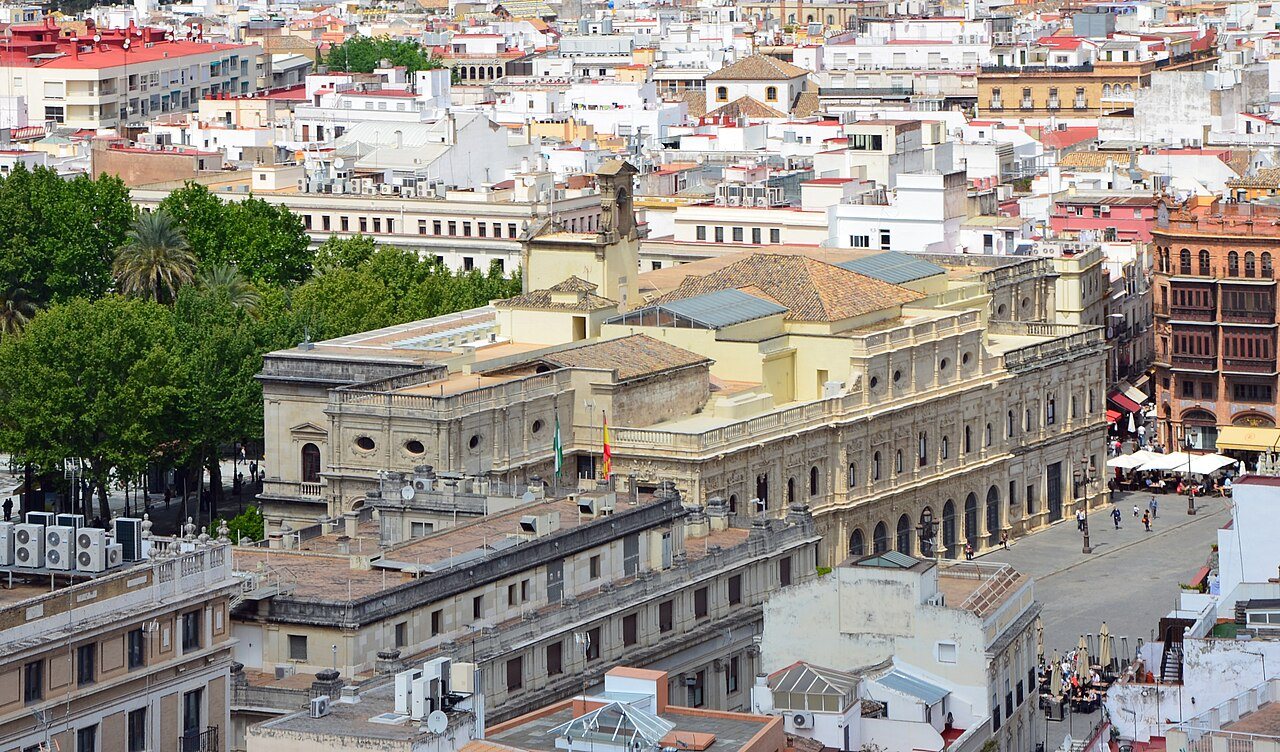
The views from the top take in the Patio de los Naranjos directly below, the rooftops of the Barrio Santa Cruz spreading east, and on a clear day the line of the Guadalquivir and Triana beyond it. It's a different, more architectural perspective than the one from Las Setas, closer to the old city's actual texture of tiled roofs and interior courtyards.
Practical notes for the ascent
Access to the tower is included with cathedral admission and handled through the same ticketing system, so there's no separate line to join once you're inside — you simply find the entrance to the Giralda within the cathedral itself. For current arrangements around timed entry and how the cathedral manages tower access on busy days, check the cathedral's own visitor information rather than relying on what worked last year, since the system has changed more than once.
- ⭐ Go as early in the visiting day as the cathedral allows. The ramp holds heat, and by midday in summer it can feel like climbing inside a kiln, with the crowd making it worse.
- ⭐ Wear shoes with grip. The ramp surface has been polished by centuries of feet and can be genuinely slick, especially on the tighter turns.
- ⚠️ There is nowhere to sit and no way to turn back quickly once you're committed to a section, so this isn't a good climb to start if someone in your group has doubts about managing a sustained incline.
- Photographers should know the window openings are deep-set and narrow, which limits how much of a wide shot you can get — a phone held flat against the stone usually works better than trying to angle for a full frame.
Beyond the climb itself
It's worth remembering the Giralda is not a standalone attraction but part of the cathedral complex, and the tower makes more sense after you've walked the orange tree courtyard at its base, another survival from the mosque period. The courtyard's irrigation channels and the tower's ramp were both built for the same institution, centuries before either belonged to the cathedral that now contains them. Seeing them in that order — courtyard first, then the climb — makes the transition from mosque to cathedral easier to picture, rather than treating the tower as an isolated viewpoint bolted onto a church.
The cathedral itself is often described in superlatives, and while it is among the largest Gothic cathedrals anywhere, exactly how it ranks depends on whether you're measuring floor area, volume, or footprint — claims of an outright record don't hold up consistently. The Giralda predates almost all of it, and climbing it is really climbing a piece of the city's Almohad past that the Christian builders chose to keep rather than tear down. For more on the building it now serves, see the cathedral, and for how this fits into a day that also covers the Alcázar and the old quarter, see itineraries.
In pictures