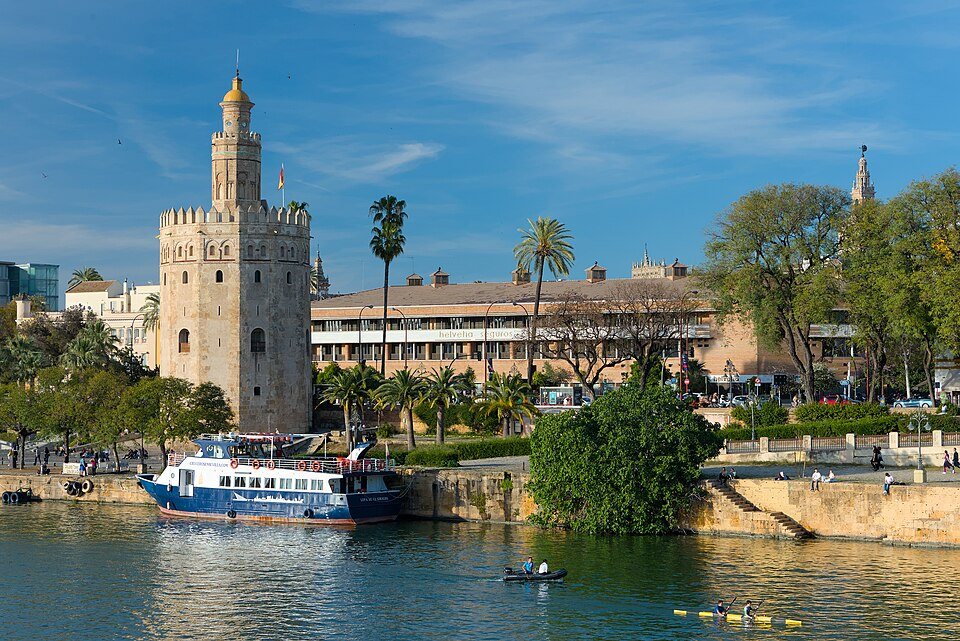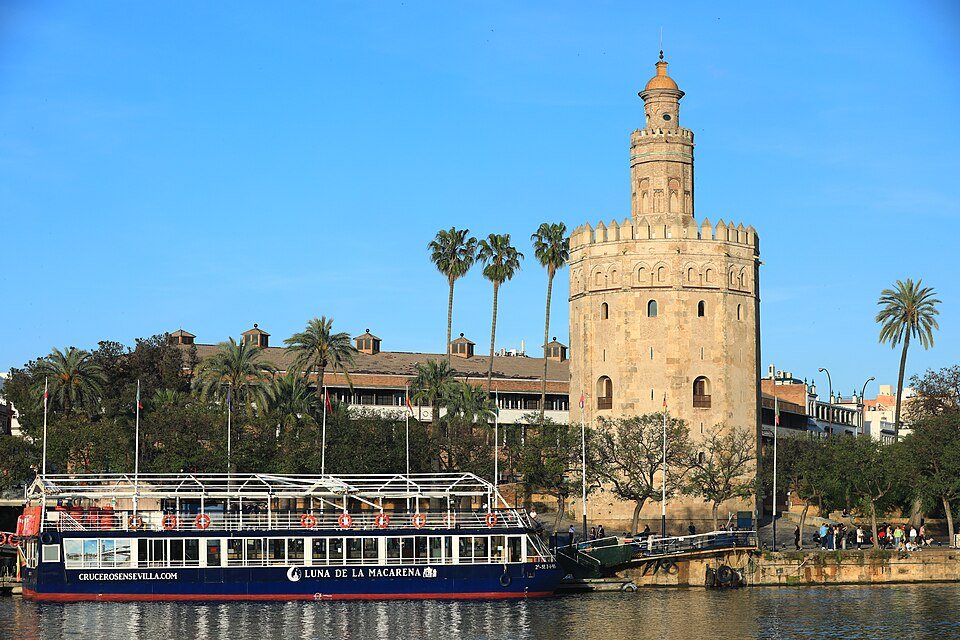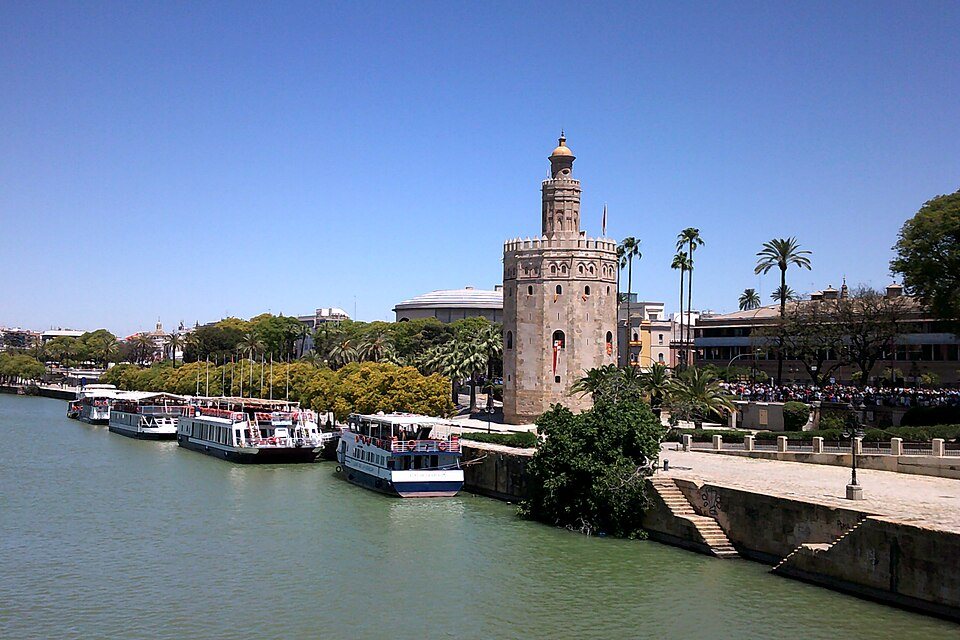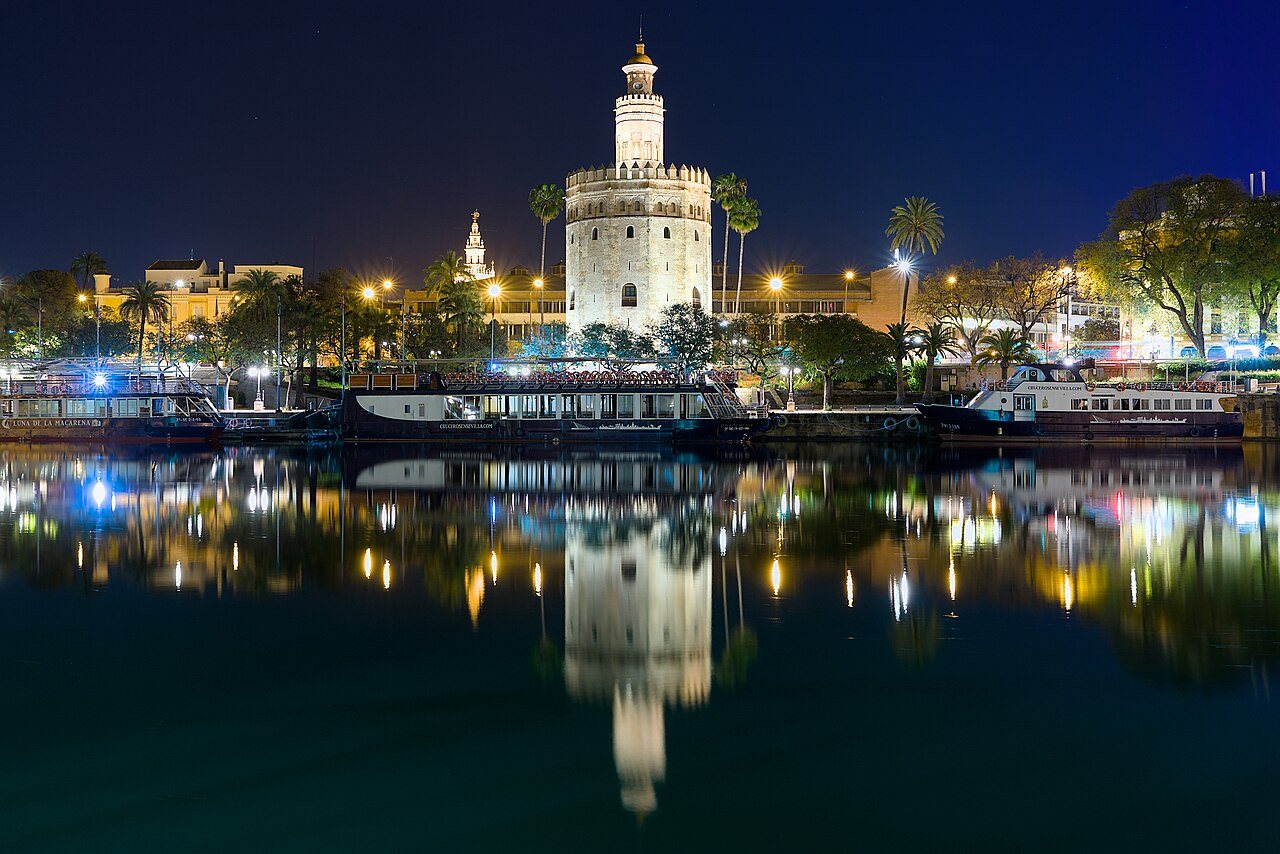
The Torre del Oro sits on the Guadalquivir like a stubby, twelve-sided sentry, and for a long time that's exactly what it was. It's small compared to the Giralda, easy to walk past without a second look if you're heading along the river path toward Plaza de España, but it's one of the few pieces of Seville's Almohad-era defenses still standing roughly where it was built, and the story behind it is better than the tower itself.
Why a tower, and why here
The tower went up in the early thirteenth century, part of the city's Almohad fortifications, at a point where the river ran close under the walls. Seville then was a working river port, reachable from the Atlantic, and the Guadalquivir was both its wealth and its weak point: an open road for anyone who could sail a fleet up it. The Torre del Oro was built to help close that road.
The mechanism was simple and, by medieval standards, effective. A heavy chain stretched from the base of the tower across the river to a corresponding point on the far bank, in what's now Triana. Raise or tension the chain and you could block the channel to shipping, or at least force any vessel to stop and be dealt with. It's the same logic behind harbor chains all over the medieval Mediterranean: you don't need to sink a ship if you can simply stop it from passing.
Whether the chain was ever tested in anger is less documented than the tower's survival. What's clear is that the arrangement reflects how seriously Seville's rulers took the river as an invasion route, not just a trade route — the two were never fully separate.
Where the name comes from
Torre del Oro means "Tower of Gold," and there are competing explanations, none of them fully settled. One points to glazed tiles or a golden-toned render that once covered the exterior and would have caught the evening light off the water. Another ties it to bullion: this stretch of river, after Seville became the gateway for shipping to and from the Americas, saw gold and silver arriving at the docks nearby, and some accounts connect the tower to that traffic, whether as a watchpoint, a holding place, or simply a landmark associated with it. The truth is probably some mix of the two, and no source settles it definitively — treat any confident single explanation you hear with mild suspicion.
What's not in dispute is the tower's shape: twelve sides, a design that's unusual among Seville's remaining Almohad structures and distinguishes it immediately from the square towers and gates elsewhere in the old walls.
What's there to see now
The tower has been added to and changed over the centuries — a cylindrical section on top is a later addition, not part of the original Almohad build, and over time it's served as a prison, a chapel, and a storage point for gunpowder, among other uses, before settling into its current role.
Today it houses a small naval museum, run under the Spanish navy, with models, maps, and material relating to Seville's history as a river port and its role in transatlantic shipping. It's a modest collection rather than a major one, and most visitors spend considerably less time inside than they do looking at the building from outside along the river. The real appeal is the view from the top: a compact, close-up look back at the city along the water, with the river curving past Triana on the opposite bank.
⚠️ The staircase inside is narrow and the rooms are small, so it's not a comfortable stop if you're prone to tight spaces or if you're visiting with a stroller — there's no way around the stairs.
⭐ The tower photographs best from the Triana side of the river in late afternoon, when the light comes from the west and the stone (gold-toned or not) actually earns the name.
The chain, and what happened to it
The chain itself is gone from the river — there's nothing to see spanning the water today — but fragments and links attributed to it have surfaced in various accounts over the years, and the general idea of the river defense is referenced in material inside the tower and in general histories of the city's fortifications. Don't go looking for a physical chain across the Guadalquivir; what remains is the tower at one end of where it used to run, and the historical record of the arrangement rather than the hardware.
It's worth standing at the tower and tracing the line across to Triana with your eye, because it reframes the whole stretch of river. What looks now like a pleasant walking and cycling path along the water, with pleasure boats and the Puente de Triana a short walk upstream, was for centuries a chokepoint that someone thought worth building a fortified tower to control.
Getting there and nearby
The tower sits directly on the river path, within easy walking distance of the Real Alcázar and the Archivo de Indias, and it makes a natural stop if you're walking the river between Santa Cruz and the Triana bridge. There's no need to plan a special trip around it; it works best as something you pass, stop at for ten or fifteen minutes, and keep walking from. Boat trips along the Guadalquivir also depart from near the tower, which is a reasonable way to see the riverfront — including the tower itself — from the water rather than the bank.
For practical details on the museum's hours, access, and any admission arrangements, check with the operator directly before you go, since these are the kind of details that change without much notice.
If you're building a river-focused day, pair this stop with a longer look at the Guadalquivir more generally, and consider finishing on the Triana side, where the chain's far end once sat and where the neighborhood's own river-facing character is worth the walk across the bridge.
In pictures