By late morning in July, the street outside is a different climate from the hallway inside. Step through a Sevillian doorway and the temperature seems to drop before you've gone ten feet. This isn't decoration working on your mood. It's a piece of engineering that predates air conditioning by about two thousand years, and it still works.
The patio is the organizing idea of the Sevillian house. Rooms don't open onto the street; they open onto an internal courtyard, usually paved in marble or tile, often with a fountain or a well at the center, and planted with whatever tolerates shade and heat at once — orange trees, jasmine, ferns in pots that get moved with the sun. The street-facing wall is nearly blind: a door, maybe a grille, thick plaster. The house turns its back on the city and faces inward.
Why a hole in the middle of the house cools it down
The mechanism is simple convection, but it's worth spelling out because it explains almost every other feature of the old city center. Hot air rises and escapes through the open top of the patio. Cooler, denser air sits low, near the fountain or the damp paving, and that denser air gets pulled through the ground-floor rooms by the pressure difference. Water helps twice over: a fountain or a simple bucket-and-mop routine on the tiles cools the air as it evaporates, and that cooled air is exactly what drifts into the sala and the dining room.
Many patios also had an awning, a toldo, strung across the opening in summer — not solid roofing, just enough canvas to cut direct sun while leaving gaps for the hot air to keep venting. You'll still see the hardware for this on buildings in Santa Cruz and around Calle Sierpes, even where the awning itself isn't currently up.
The effect compounds at the scale of a whole neighborhood. Narrow streets shade each other for most of the day; thick walls store the night's coolness and release it slowly; patios breathe hot air upward and out. None of this is accidental. It's a documented, repeated response to a specific problem — a city that gets extremely hot for months at a stretch — and it was refined by people who had no other option.
Roman roots, Moorish refinement, Sevillian stubbornness
The courtyard house isn't a Seville invention. The Romans built atrium houses with a central opening for light, air, and rainwater collection, and the idea was already well established in Iberia by the time they arrived. You can still see the layout at Itálica, just outside the city, where villa floor plans show rooms wrapped around open courts in a pattern a modern Sevillian would recognize immediately.
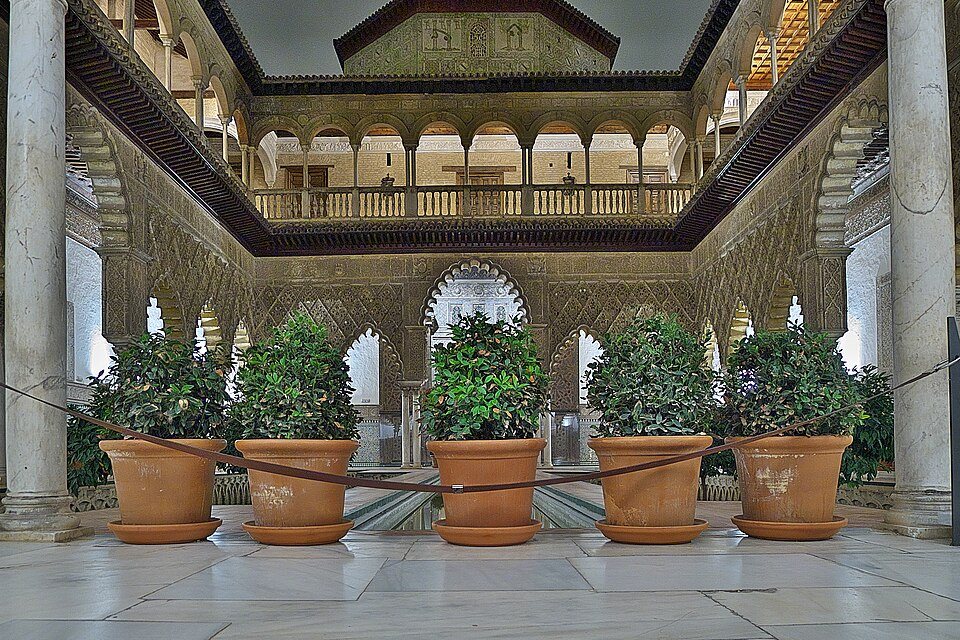
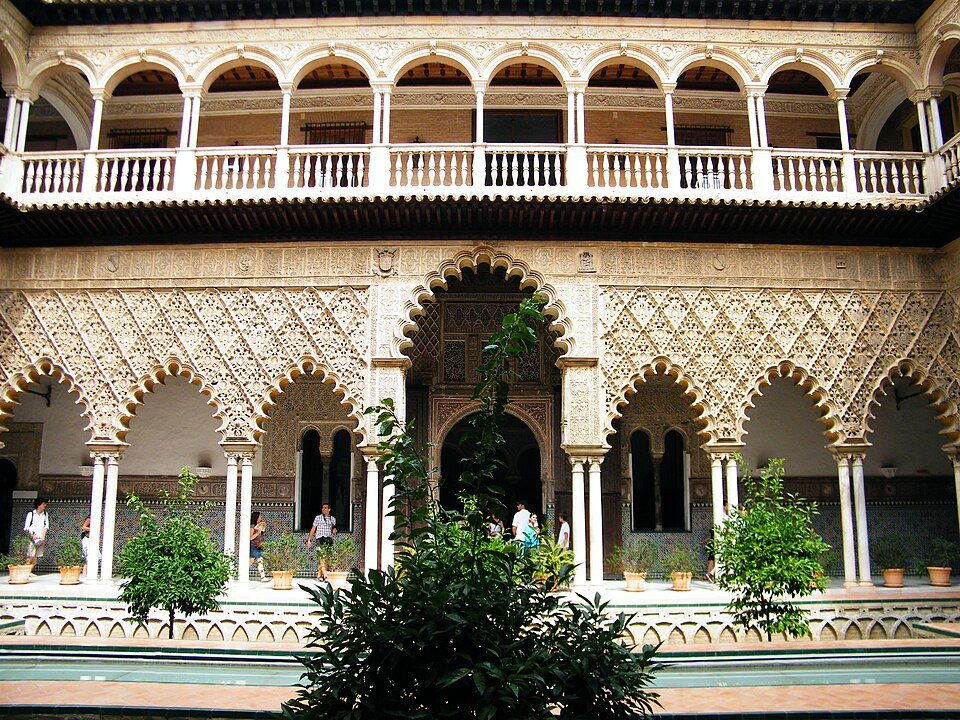
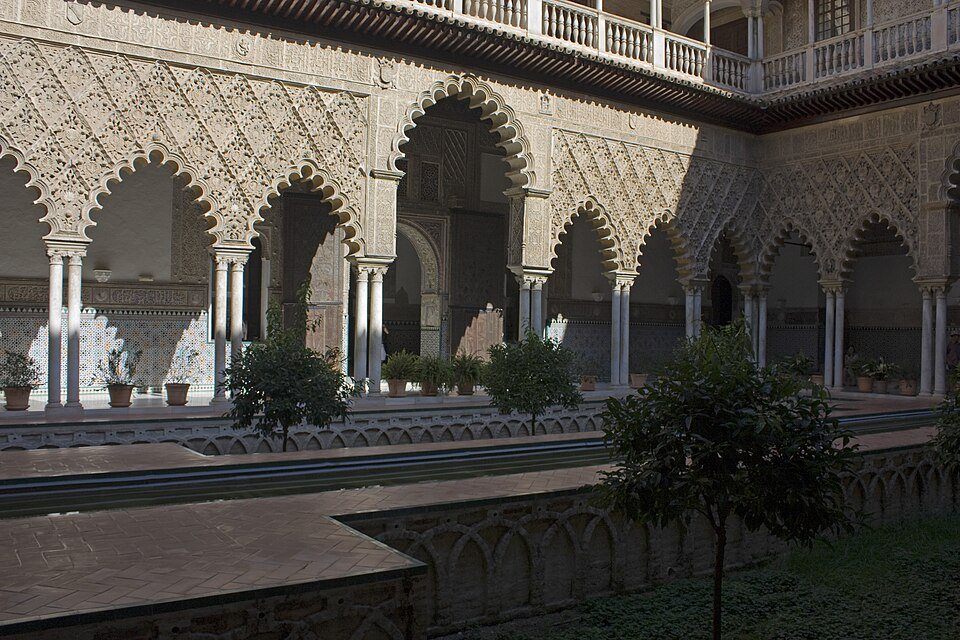
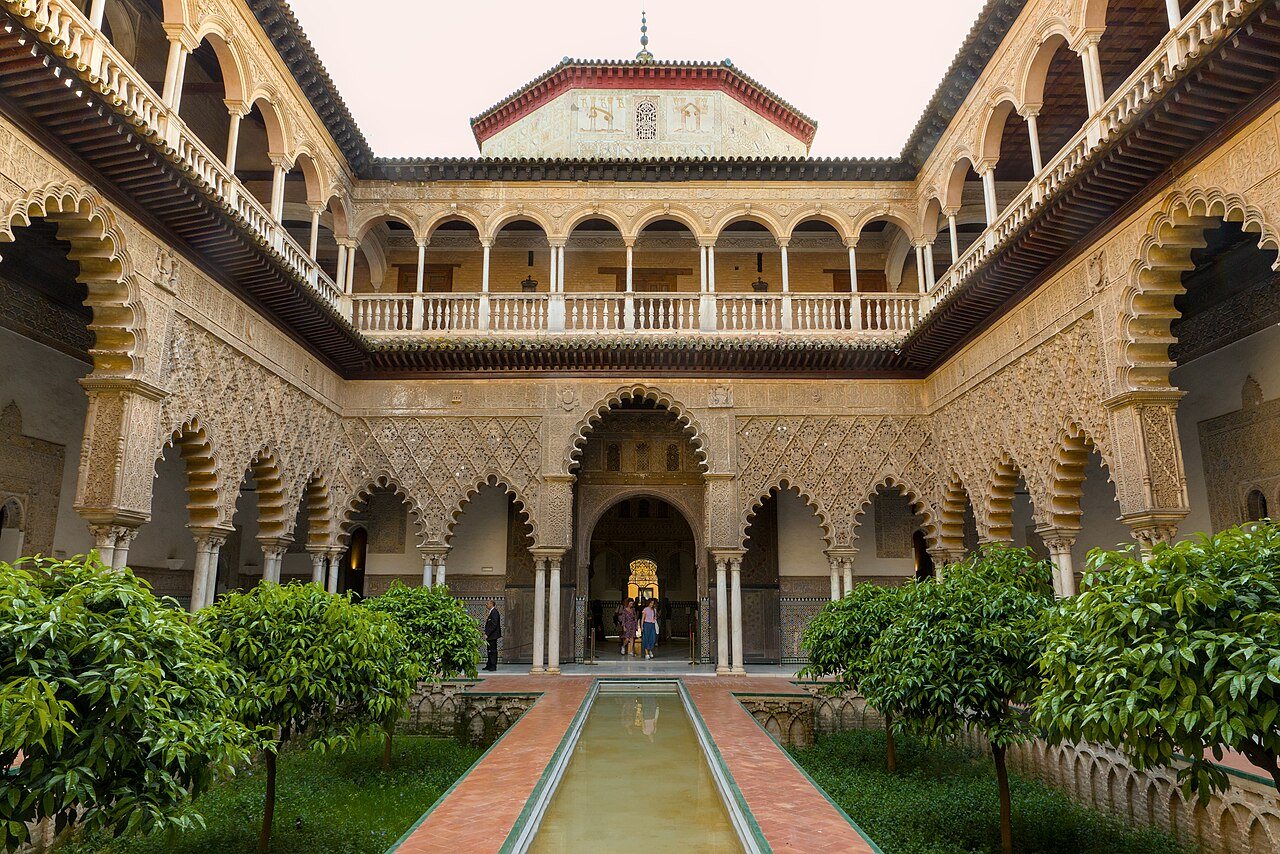
What changed under the centuries of Islamic rule was the refinement of water as a design element — not just a fountain for show but channels, basins, and sunken gardens calculated for airflow and sound. The clearest surviving example of this thinking at its most ambitious is inside the Real Alcázar, where the gardens and courtyards were built and rebuilt over centuries by rulers who understood exactly what they were doing with shade and water. The Patio de las Doncellas there shows the idea at palace scale: a long reflecting pool, sunken plantings below the level of the paving so the leaves stay near the cooler air, and galleries around the edge that are never in direct sun at midday.
A few blocks away, Casa de Pilatos and the Palacio de las Dueñas are private houses built on the same logic, scaled down from royal to merely wealthy. Both are worth visiting specifically for their patios rather than despite them — the rooms around the edges are often less interesting than the courtyard itself.
Finding a real one, not a performance of one
The tricky part for a visitor is that many of the patios open to the public are grand examples attached to palaces or museums, which can give the impression that this was always an aristocratic luxury. It wasn't. Ordinary houses throughout Santa Cruz, Triana, and the older barrios had scaled-down patios doing the same job — a small square of tile, a single orange tree, maybe a birdcage, with the neighbors' windows looking down into it rather than out onto the street.
⭐ The most reliable way to see an ordinary domestic patio, rather than a monument, is to walk slowly through residential Santa Cruz in the mid-morning with doors still ajar for airing, and look through the wrought-iron reja — the decorative grille set into the doorway — rather than trying the door itself. Many houses leave this grille open and the solid door shut specifically so passersby can glimpse the patio without being able to walk in.
⚠️ Don't mistake a restaurant's courtyard seating, however pretty, for a historic patio house — plenty of tapas bars have built or dressed up a courtyard for atmosphere, which is a fine evening out but a different thing from the architecture described here.
The clearest public comparison between palace-grade and merchant-grade patios is a short walk: start at the Alcázar for the maximal version, then go to Casa de Pilatos for the aristocratic-but-domestic version, then wander the streets immediately around the Iglesia del Salvador, where surviving house fronts still show the grilled doors of ordinary patios behind them.
Why this still matters if you're just visiting
None of this is only architectural history. It changes how you should actually move through the city on a hot day. Covered patios and courtyard museums are, practically speaking, air-conditioned by geometry — the Museo de Bellas Artes, itself built around a former convent's cloistered courtyards, is noticeably cooler at its center than at its edges for exactly this reason. Streets that run between tall, close buildings stay shaded far longer than the wide boulevards near Plaza de España, which look magnificent but offer almost no relief at midday.
If you're planning when to be where, the patio logic is also a planning logic: seek out the narrow, courtyard-dense old quarters — Santa Cruz, the streets around Casa de Pilatos, parts of Triana — in the hours either side of noon, and save the open plazas and riverside walks along the Guadalquivir for morning or evening, when the same lack of shade becomes pleasant rather than punishing. For more on timing a day around the heat generally, see this section and the city-wide itineraries built with exactly this rhythm in mind.
In pictures