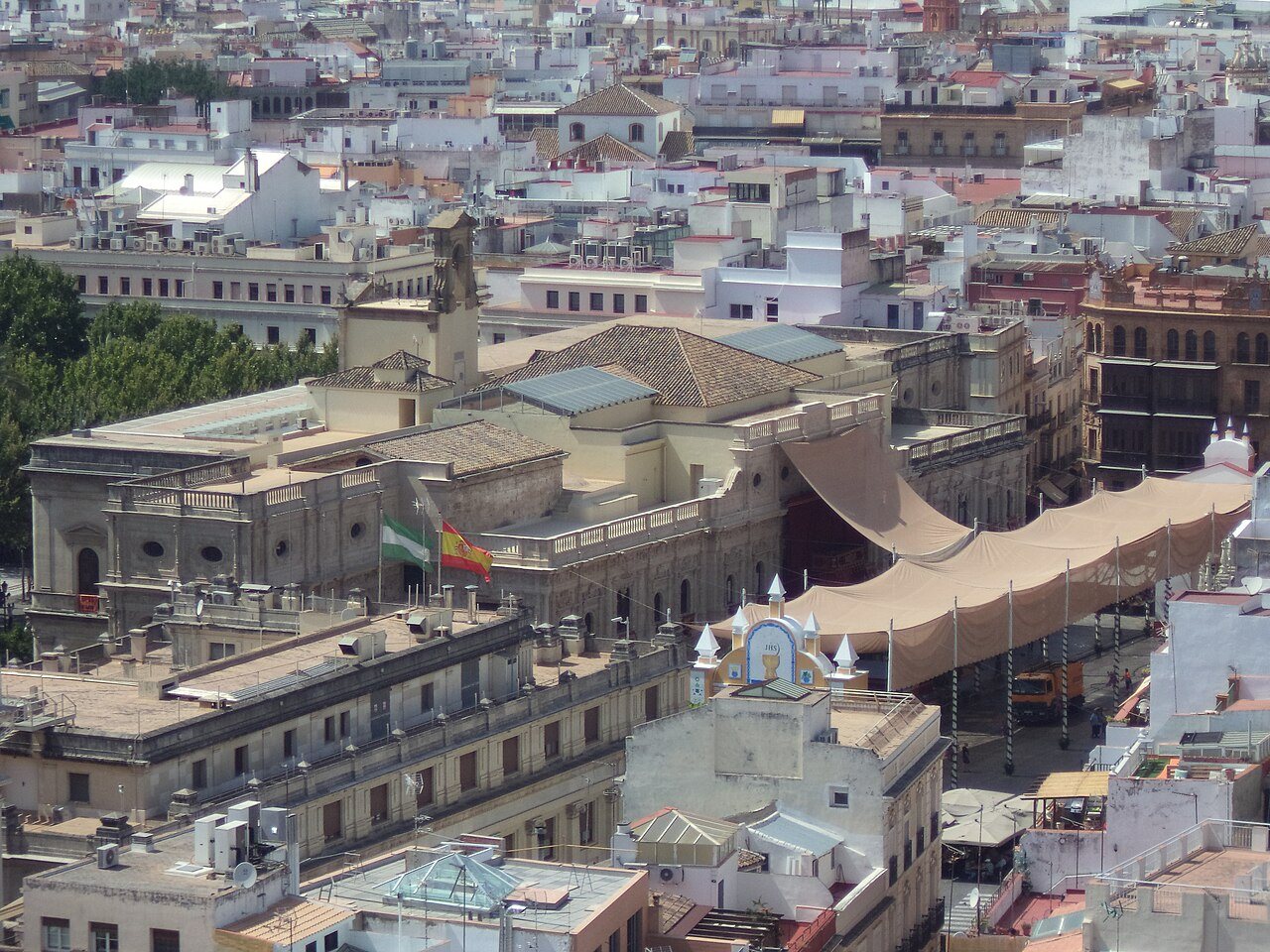
Seville's relationship with the sun is not romantic. For a solid stretch of the year, the sun is a problem to be solved, and the city has been solving it for centuries with a mix of engineering, planting, and plain habit. The most visible solution is also the most photographed: a taut white canvas roof strung above Calle Sierpes, turning the city's main shopping street into something closer to a tunnel than a road.
Understanding why that canvas is there, and where else the same thinking shows up, will change how you plan your days here more than any list of sights will.
The awnings on Sierpes
Sierpes is narrow, pedestrian, and runs roughly north-south through the old commercial core, which means that for much of the day one side or the other would otherwise be in full sun. The toldos — the awnings — solve this by removing the question entirely. Canvas panels are strung from the upper facades on both sides, overlapping along the street's length, so that from spring into early autumn the whole run of the street sits under a single continuous shade cloth. Light still gets through; it comes out diffuse and pale gold rather than direct and blinding.
The system is seasonal. The panels go up when the city judges the sun is enough of a threat to merit it and come down when it isn't, which means a winter visit to Sierpes can look like an entirely different street — open sky, ordinary shadows, shopfronts you can suddenly see from across the road. If you've only ever seen photos of the shaded version, the bare street can be disorienting.
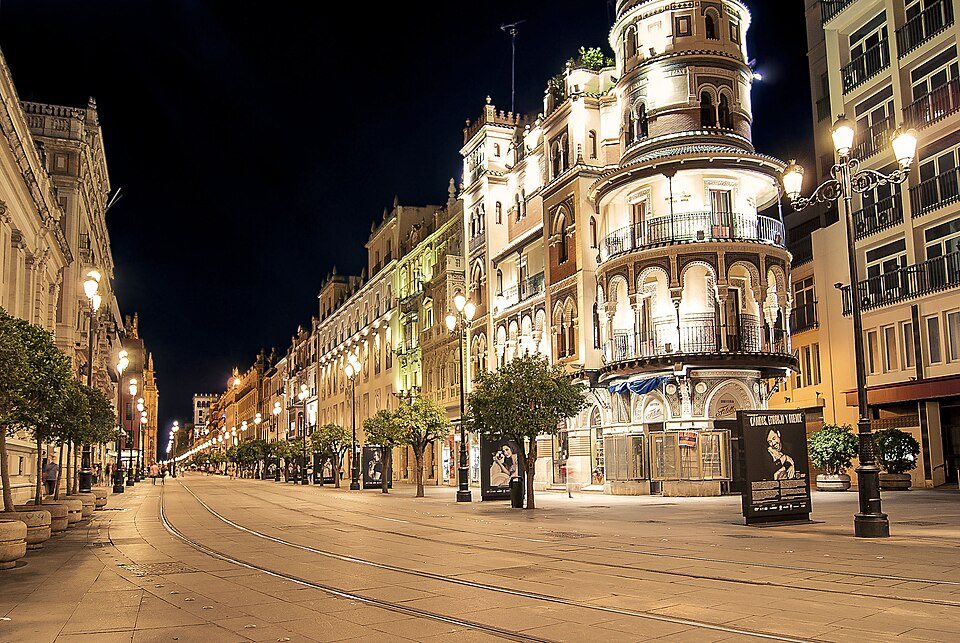
Sierpes isn't unique in this; several other streets in the commercial center near the Iglesia del Salvador get the same treatment, usually the narrower ones where the awning can be anchored facade to facade without a gap too wide to span. What makes Sierpes the one people remember is simply its length and its crowds — it's the street most visitors walk down at least once, awning or no awning, because it connects the cathedral area to the main shopping district.
⭐ If you want the full effect, walk Sierpes around midday in July rather than in the evening. At night the awnings are irrelevant; at midday they're the whole point, and the contrast with the open, sun-blasted plazas at either end of the street is the clearest lesson Seville offers in why shade is infrastructure here, not decoration.
Plazas built or adapted for shade
Awnings are a textile solution for a street; Seville's plazas mostly solve the same problem with trees, water, and geometry, because a plaza is wide enough that canvas stops making sense.
- Trees as the main structure. The Plaza de España and the surrounding Parque de María Luisa were laid out with mature planting as a deliberate design element, not an afterthought — the park's paths bend under palms, orange trees, and plane trees specifically so that a walk through it stays shaded for most of its length. Compare that to the open brick expanse in front of Las Setas, which has almost no tree cover and gets genuinely uncomfortable at midday; the wooden canopy structure itself casts some shade below it, but the plaza around it does not.
- Water as a cooling device, not just an ornament. Fountains in smaller squares around the old city do measurably drop the air temperature right around them, which is why benches near a fountain fill up first on a hot afternoon and the ones in full sun stay empty.
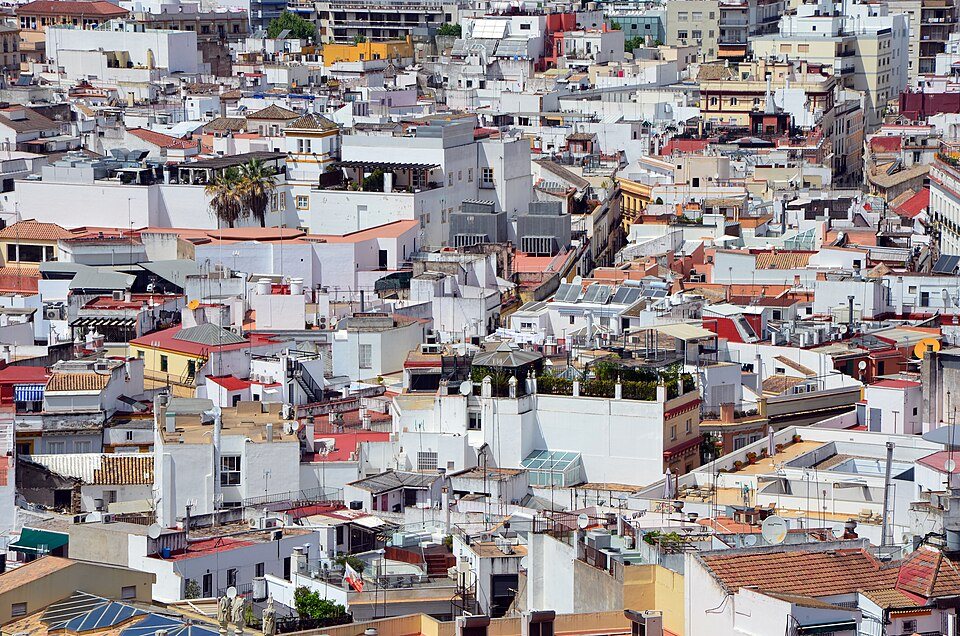
- Narrow streets as intentional shade. The tangle of alleys in Santa Cruz looks picturesque in photographs but it's also functional: the streets are narrow enough, and the buildings tall enough relative to their width, that direct sun only reaches the pavement for a short window each day. Getting lost in Santa Cruz in summer is, accidentally, one of the coolest ways to spend an hour in the city.
⚠️ The flip side of all this shade logic is that the sunniest-looking squares are often the worst places to linger. Travelers drawn to an open, sunny plaza because it photographs well can end up sitting in the one spot in the neighborhood with no relief at all. Look at what the locals are doing — if the tables under an awning or a tree are full and the ones in the open are empty, that's the answer.
Courtyards, patios, and the logic of the inward-facing house
Private shade in Seville works on the same principle as the awnings, just turned inward. Traditional houses here are built around a central patio, often planted and sometimes fitted with its own retractable awning or a toldo of its own, so that the interior of the house stays shaded and relatively cool while the street outside bakes. The Casa de Pilatos and the Palacio de las Dueñas both show this at a grand scale, with galleries running around planted courtyards that function as outdoor rooms rather than gardens to look at from a window.
The Real Alcázar and its gardens use the same idea on a larger footprint — walled enclosures, water channels, and dense planting that keep the interior noticeably cooler than the open streets just outside the gates. The Patio de los Naranjos at the cathedral is a public-facing version of the same instinct: an orange-tree courtyard that was doing shade-and-cooling work for worshippers centuries before anyone thought to photograph it.
Planning a day around shade rather than sights
Most visitors plan a day in Seville by sight: cathedral in the morning, Alcázar after lunch, a wander through Triana in the evening. It works better to plan by shade and let the sights fall into place around it.
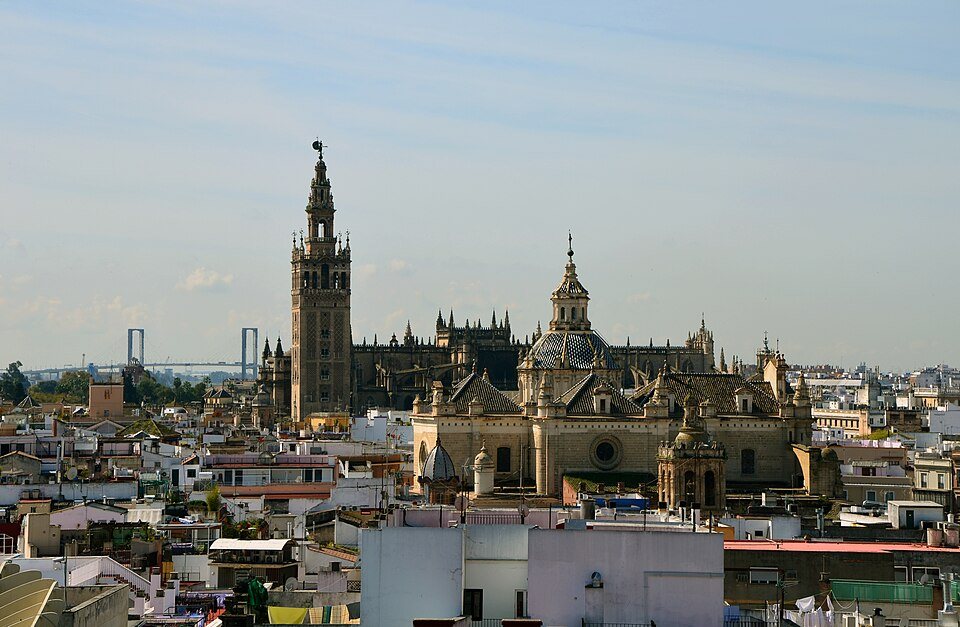
Mornings belong to anything in full sun — the river walk along the Guadalquivir, the approach to the Torre del Oro, the climb up the Giralda if you're doing it at all, since the tower's interior ramp offers no real relief from the heat building inside the stone by midday. Early is also simply quieter, which matters more here than the temperature does for the first hour or two.
Midday is for the shaded interiors: the cathedral itself, the Archivo de Indias, the Museo de Bellas Artes, or the covered stretch of Sierpes. This is also, not coincidentally, when a lot of small businesses either slow down or close for a few hours — build slack into your plan rather than arriving at a shutter.
Evenings open the city back up. Crossing the Puente de Triana as the heat breaks, with Triana's riverside bars filling up, is as much a shade-driven ritual as the siesta is — people simply come back outside once the sun stops being the deciding factor. For more on sequencing a full day around this rhythm, see itineraries, and for the practical business of moving between neighborhoods without a long sun-exposed walk, see getting around.
In pictures